
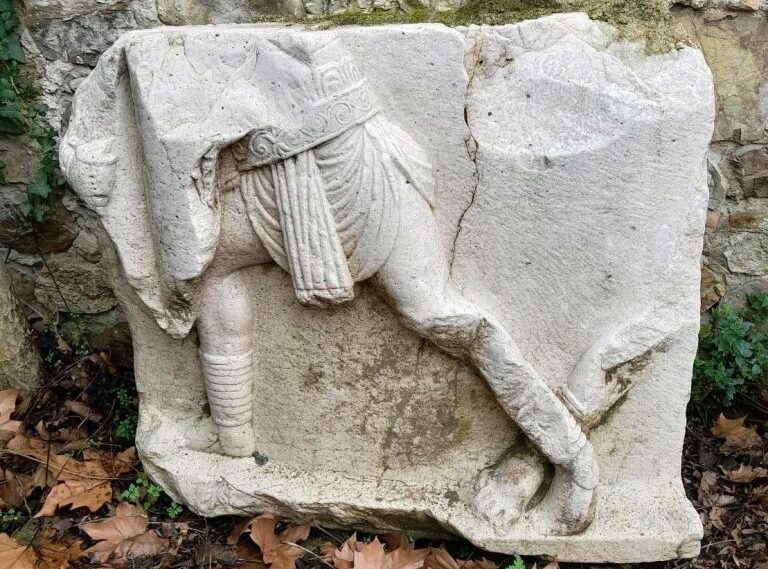
A monumental Roman funerary structure decorated with gladiatorial scenes has been uncovered along the ancient Via Appia in southern Italy, shedding new light on the social world of gladiatorial games during the early Roman Empire.
The discovery was made near the modern town of Apollosa, in the province of Benevento, along a historic stretch of the famed Roman road known as the “Regina Viarum” — the Queen of Roads. Archaeologists believe the tomb once belonged to a wealthy Roman citizen closely connected to the organization of gladiatorial spectacles during the Augustan era.
The find offers rare insight into how elite Romans used monumental tombs to project prestige and identity along the empire’s most important transportation routes.
Discovery Triggered by Floodwaters
Unlike many archaeological discoveries that result from planned excavations, the Apollosa monument came to light following a natural event.
After the Serretelle stream overflowed, unusual stone blocks emerged from the mud. Local volunteer Marco Zamparelli noticed the exposed limestone fragments and alerted heritage authorities.
Archaeologists from the Soprintendenza Archeologia, Belle Arti e Paesaggio for Caserta and Benevento quickly launched an investigation. Under the supervision of archaeologist Simone Foresta, a multidisciplinary team recovered around twenty large limestone blocks and identified the entrance to a decorated underground funerary chamber.
Preliminary analysis suggests the monument dates to the early 1st century AD, during the reign of Augustus or shortly afterward.
A Monument to Gladiatorial Prestige
The recovered architectural elements indicate that the tomb was originally a circular mausoleum approximately 12 meters in diameter, constructed from large limestone blocks.
What makes the monument particularly remarkable is its decoration: sculpted scenes depicting gladiators in combat.
Such imagery is uncommon in Roman funerary contexts and strongly suggests that the individual buried there had a direct connection to gladiatorial spectacles—perhaps as a lanista (gladiator manager), games sponsor, or organizer of public entertainment.
During the early Roman Empire, gladiatorial games were not merely popular spectacles but powerful tools of social prestige and political influence. Elite Romans often financed games to gain public favor, and monumental tombs served as enduring statements of status.
Positioning such a tomb along the Via Appia, one of Rome’s busiest roads, would have ensured that thousands of travelers witnessed the monument—transforming the burial place into a permanent display of wealth and reputation.
The Strategic Importance of the Via Appia
First constructed in 312 BC by the censor Appius Claudius Caecus, the Via Appia was one of the earliest and most significant roads built by the Roman Republic. Originally connecting Rome to Capua and later extended to Brindisi, the route became a vital corridor for military movement, trade, and communication across southern Italy.
Because of its importance, wealthy Romans frequently built tombs and memorial monuments along its edges. Roman law prohibited burials within city limits, leading to the creation of vast roadside necropolises where funerary architecture competed for visibility and prestige.
The newly discovered monument at Apollosa appears to have stood along a strategic stretch of the road between the ancient settlements of Caudium and Montesarchio, an area that once formed an important transit corridor in Roman Campania.
Preservation and Future Research
Following recovery, the architectural blocks have been transferred to the Soprintendenza’s operational center in Benevento, where they are currently being studied and preserved. The materials can already be viewed by appointment.
Researchers are now examining the monument’s decorative program and structural elements in greater detail to reconstruct its original appearance and better understand the identity of the tomb’s owner.
Local authorities in Apollosa have expressed interest in incorporating the site into broader cultural tourism initiatives connected to the historic Via Appia route. Plans are also being discussed for a digital 3D reconstruction, which would allow visitors to visualize the mausoleum as it once stood nearly two thousand years ago.
If confirmed as a monument associated with gladiatorial entertainment, the discovery could provide valuable new evidence about the individuals who organized the brutal spectacles that fascinated—and defined—Roman society.
Soprintendenza Archeologia Belle Arti e Paesaggio Caserta e Benevento
Cover Image Credit: Soprintendenza Archeologia Belle Arti e Paesaggio Caserta e Benevento
