
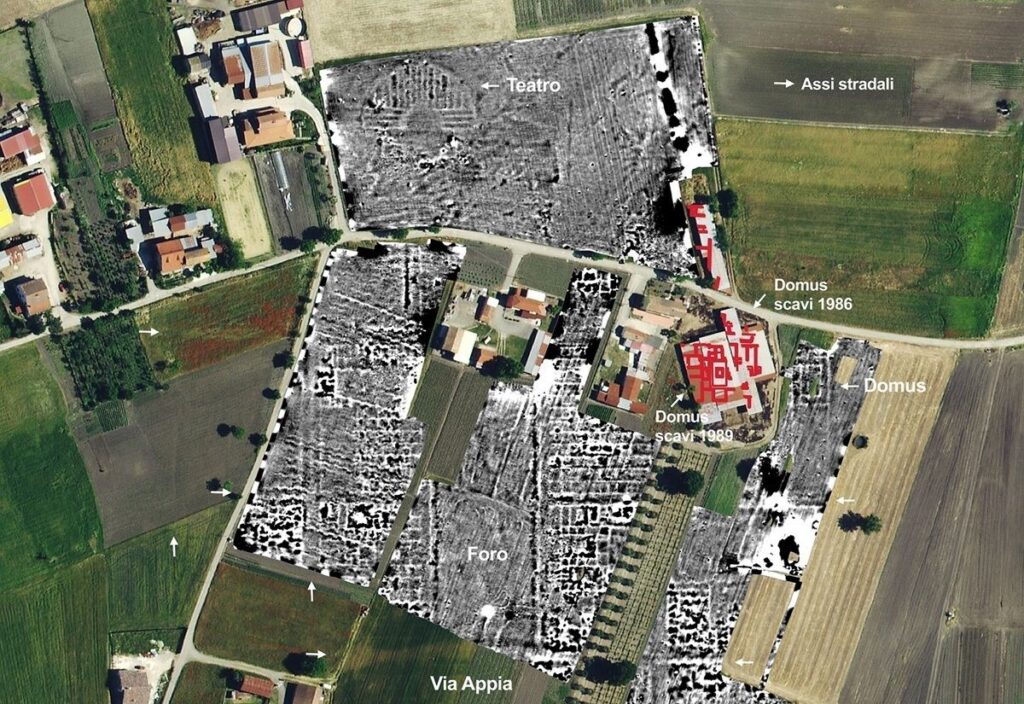
A groundbreaking archaeological campaign at the Fioccaglia Archaeological Site in southern Italy has uncovered the remains of a Roman forum and a previously unknown monumental theater, offering compelling new insights into the urban planning and historical significance of the ancient settlement.
Located in the municipality of Flumeri, in the province of Avellino (Campania region), the site has long intrigued scholars. The latest investigations, led by Professor Giuseppe Ceraudo of the University of Salento in collaboration with regional heritage authorities and the local administration, have now confirmed that Fioccaglia was a fully structured Roman city with impressive public architecture and a strategic position along one of antiquity’s most important roads.
A Strategic Hub Along the Appian Way
The discoveries reinforce the settlement’s critical role along the legendary Via Appia, also known in antiquity as the “Regina Viarum” (Queen of Roads). The Appian Way, recently inscribed as a UNESCO World Heritage Site, connected Rome to southern Italy and facilitated trade, military movements, and cultural exchange.
Scholars identify Fioccaglia with the ancient Forum Aemilii, dating between the 2nd and 1st centuries BCE. Its location near the confluence of the Ufita River and the Fiumarella stream gave it both logistical and economic advantages. The settlement also appears closely linked to the Via Aemilia, commissioned in 126 BCE by the Roman consul Marcus Aemilius Lepidus. Together, these roads positioned Fioccaglia as a vital crossroads in the Roman transportation network of southern Italy.
Advanced Drone Technology Uncovers Hidden Structures
What sets this discovery apart is the innovative methodology employed. Archaeologists combined geophysical surveys with cutting-edge remote sensing technologies, including drones equipped with thermal and multispectral sensors. These tools allowed researchers to detect buried structures by analyzing subtle variations in vegetation growth and soil magnetism.
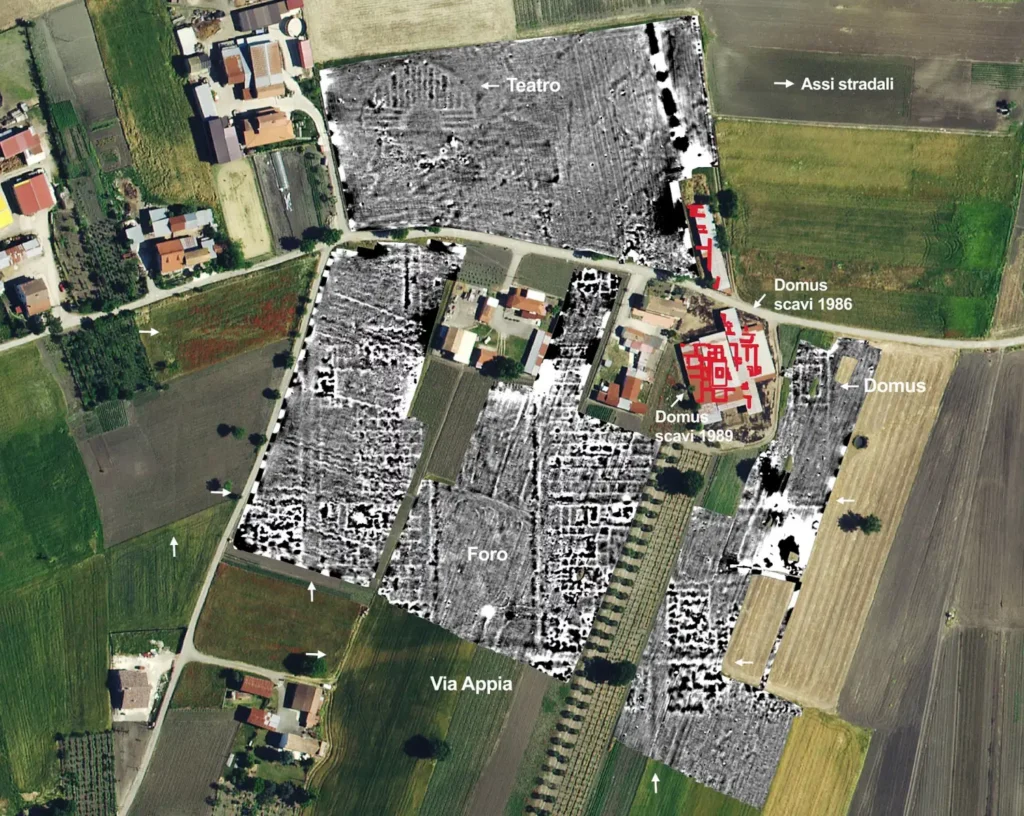
According to Professor Ceraudo, the approach provided “a true X-ray of the ancient center still buried underground,” enabling the team to map the city’s orthogonal layout with remarkable precision. Regular street axes and organized urban blocks have now been clearly identified, confirming that Fioccaglia followed the standardized planning model typical of newly founded Roman colonies.
The Forum: Heart of Public Life
Among the most significant findings is the identification of the forum, the civic and economic heart of the Roman city. Archaeological data reveal a large central square surrounded by public buildings, whose outlines are now distinguishable through non-invasive surveys.
In Roman urbanism, the forum functioned as a multifunctional space for political gatherings, commercial transactions, and religious ceremonies. The scale and organization of Fioccaglia’s forum suggest that the settlement was more than a minor roadside stop—it was a thriving urban center integrated into the administrative and economic framework of the Roman Republic.
Discovery of a Monumental Theater
Equally remarkable is the discovery of a monumental theater previously unknown to scholars. The structure’s size and architectural prominence indicate a city with strong cultural ambitions and sufficient resources to support large-scale public entertainment.
Roman theaters were not merely venues for performances; they symbolized civic identity and Romanization. The presence of such a building in Fioccaglia underscores the depth of Roman cultural influence in Irpinia during the late Republican period. It also suggests a population sizable and prosperous enough to sustain public spectacles and civic events.
Earlier Clues Confirmed
The recent findings build upon earlier excavations conducted in the 1980s, which uncovered a paved decumanus (main east-west street) and an elegant domus decorated in early Pompeian style. These discoveries had already hinted at the presence of elite residents and a well-developed urban environment.
The newly mapped forum and theater now complete the picture of a planned city featuring representative housing, paved roads, and monumental public spaces. Together, they confirm Fioccaglia’s status as a structured and strategically important urban center in inland Campania.
A Key Site for Understanding Romanization in Irpinia
Fioccaglia plays a crucial role in understanding the Romanization of Irpinia, a historically complex region in southern Italy. The integration of local communities into Roman political, economic, and cultural systems transformed the landscape between the 2nd and 1st centuries BCE.
The city’s orthogonal grid plan, monumental architecture, and strategic road connections exemplify how Roman urban models were implemented in newly incorporated territories. As such, Fioccaglia offers valuable evidence for scholars studying the expansion of Roman influence beyond the capital and into regional hubs.
Protection and Future Development
The archaeological campaign was carried out in close cooperation with the Soprintendenza Archeologia, Belle Arti e Paesaggio for the provinces of Salerno and Avellino and the Municipality of Flumeri. Officials have emphasized that the synergy between academic research and heritage protection is essential for developing a long-term management and enhancement plan.
Local authorities have expressed their commitment to transforming Fioccaglia into a landmark cultural destination for inland Campania. Its proximity to ongoing infrastructure projects in the Ufita Valley, including the future Hirpinia High-Speed Railway Station, could further boost accessibility and tourism potential.
In the coming months, non-invasive investigations will continue to verify and refine the newly identified structures. The goal is to consolidate conservation strategies while preparing a structured program for public engagement and site enhancement.
A Promising Future for Fioccaglia
The discovery of the forum and monumental theater marks a turning point in the study of Fioccaglia. By combining advanced technology with interdisciplinary collaboration, researchers have illuminated a once-buried Roman city whose significance had long been underestimated.
As investigations progress, Fioccaglia is poised to become one of the most important archaeological references for understanding Roman urbanism and infrastructure in southern Italy. The site not only enriches knowledge of the Appian Way’s network but also highlights the enduring value of innovative archaeological research in uncovering the hidden layers of Europe’s ancient past.
Cover Image Credit: Aerial view and magnetic survey map showing the newly identified structures. Ministry of Culture (MiC), Italy
