
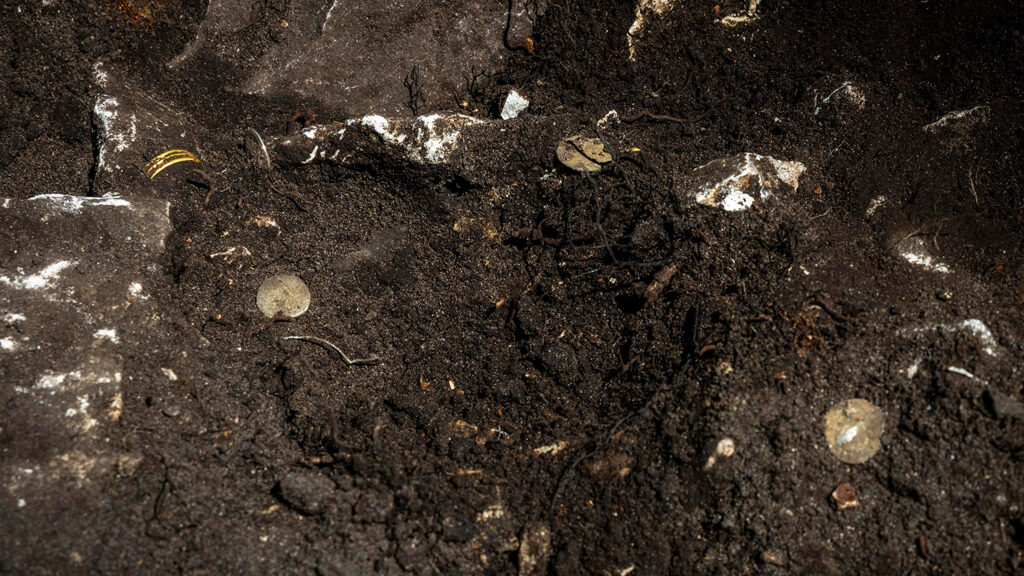
A final sweep with a metal detector at an ancient farm in Sweden has uncovered 45 Roman silver coins and a gold ring. Buried centuries after the coins were minted, the collection holds an unexpected surprise: two of the coins are ancient counterfeits, possibly produced in what is now Ukraine.
The discovery on the Baltic island of Gotland offers a glimpse into how Roman money circulated far beyond the empire’s borders. Although the coins date from AD 98 to 192, archaeologists believe someone concealed the collection around AD 450.
A Final Metal Detector Sweep Reveals an Ancient Fortune
The discovery came during archaeological investigations linked to the expansion of the Gotland Regiment near the Tofta military training area. Archaeologists from Gotlands Museum and the archaeological company Arendus have been examining an old farm complex, possibly the former Bars gård, historically known as Bardhs or Bardhes.
Earlier excavations had revealed several buildings, and the latest investigations focused on another part of the settlement. As work on one house foundation neared completion, a final metal detector sweep produced a strong signal beside a foundation stone.
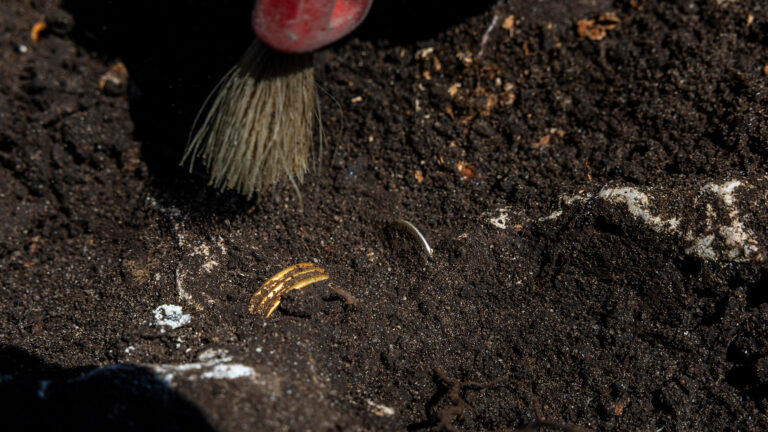
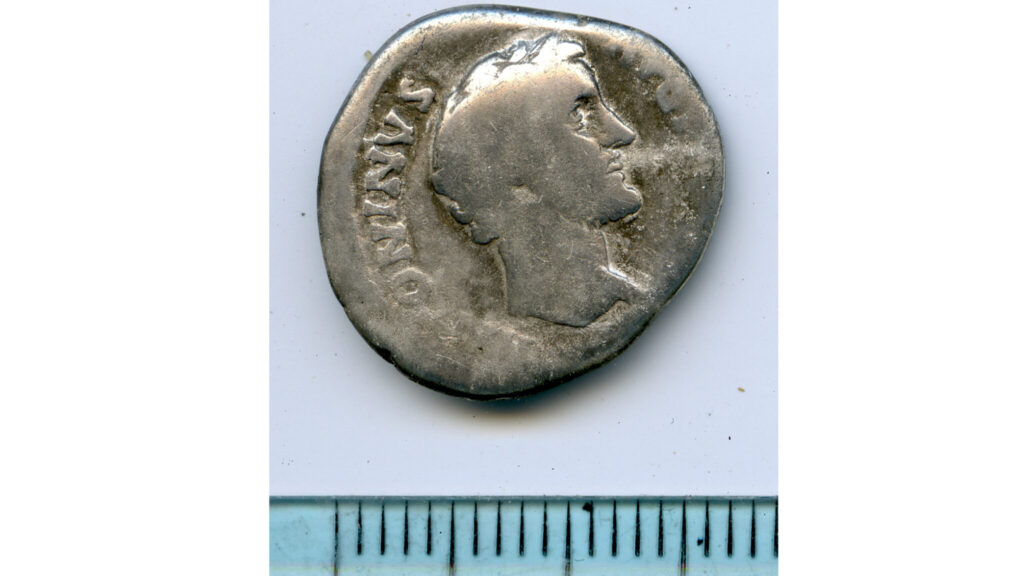
Archaeologists carefully removed a small silver coin and brushed away the soil, revealing the portrait of Emperor Antoninus Pius, who ruled Rome from AD 138 to 161. More signals followed, and by the end of the working day, the team had recovered 45 silver denarii and a gold finger ring.
The discovery stood out even on Gotland, an island famous for its silver hoards. Most belong to the Viking Age, while the Tofta collection dates to the Migration Period, several centuries earlier.
Two Ancient Counterfeits Among Coins of Nine Imperial Figures
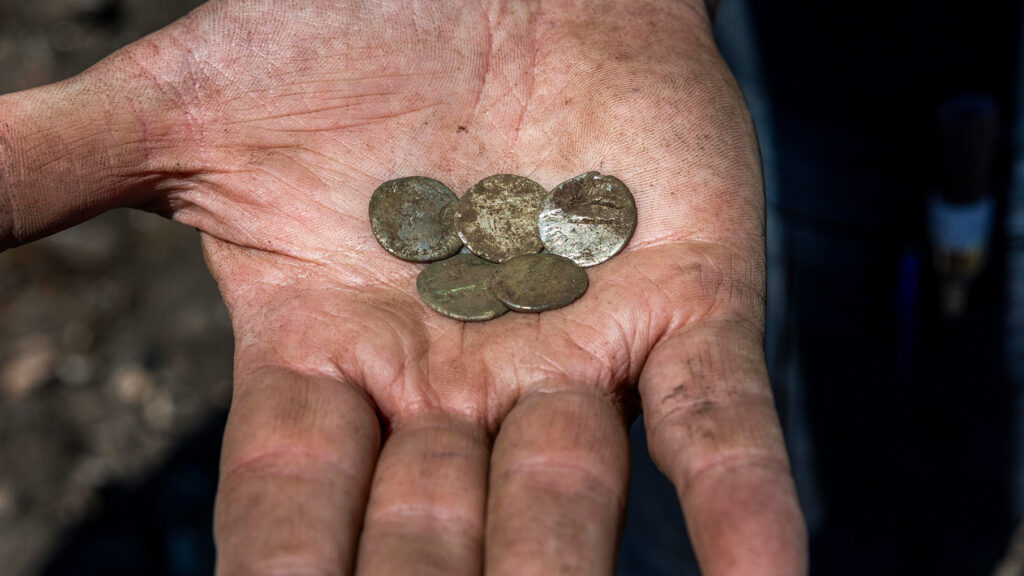
The 45 coins span nearly a century of Roman imperial history and feature five emperors and four empresses. Numismatist Lennart Lind examined the collection for Gotlands Museum and identified the rulers represented on the coins.
The emperors are Trajan, Hadrian, Antoninus Pius, Marcus Aurelius, and Commodus. The empresses are Sabina, Faustina I, Faustina II, and Lucilla, whose portraits connect the collection to successive generations of Rome’s imperial families.
Two denarii, however, attracted particular attention. According to archaeologist Per Widerström of Gotlands Museum, they are ancient counterfeits, probably manufactured in the territory of present-day Ukraine.
Their presence introduces another layer to the discovery. Alongside official Roman currency, the collection contains imitations that may have reached the Baltic through exchange networks extending across eastern Europe.
Gotland has yielded an exceptionally large concentration of Roman denarii, demonstrating its connections with the wider Roman world. The precise route taken by the Tofta counterfeits remains unknown, but their possible eastern origin adds to the evidence for contacts across regions far beyond the empire’s frontiers.
Why Were Roman Coins Buried More Than 250 Years Later?
Perhaps the most intriguing question concerns the considerable gap between the coins’ production and their burial. Even the youngest denarii were more than 250 years old when someone apparently concealed the collection around AD 450.
Lind suggests that the coins reached Gotland during the fourth century and continued circulating in the island’s economy into the fifth. Their long use shows that Roman currency retained a role in regional exchange well after its original production.
The gold finger ring offers an important chronological clue. Its design resembles types known from the middle of the fifth century, supporting the archaeologists’ proposed burial date.
An initial radiocarbon analysis of a bone recovered from one of the investigated buildings provides additional context. The result indicates that the structure remained in use during the fifth century, placing the farm’s occupation within the same general period as the hoard.
Together, the coins, ring, and radiocarbon evidence support a Migration Period date for the deposit. However, archaeologists have yet to establish why someone buried the objects or whether their owner ever intended to recover them.
An Abandoned Farm and Nine Much Older Graves
The Tofta farm remained occupied from approximately AD 150 to 550, spanning the Roman Iron Age and the Migration Period in Scandinavia. Archaeologists found relatively few everyday objects inside the investigated buildings, including bones, pottery fragments, and a fishing hook.
Widerström suggests that the occupants may have abandoned the settlement during the difficult conditions of the sixth century. A major climatic disturbance in AD 536 brought unusually cold weather to parts of Europe, contributing to agricultural problems across Scandinavia. Whether this event directly affected the farm remains unknown, and the silver hoard appears to have entered the ground decades earlier.
Elsewhere within the regimental area, investigations ahead of road construction revealed nine much older graves. An archaeological inventory recorded six possible burials in 1939, but a survey in 1976 failed to confirm them. The latest excavations have now established the presence of nine graves dating to the Pre-Roman Iron Age.
Three graves have rectangular outlines, while six are circular. The largest measures approximately six by four meters, and finds include bronze fittings associated with a sword suspension and possibly a shield boss.
One grave contained approximately 4.5 kilograms of cremated human bones. Osteological analysis identified at least two individuals, including an adult man, and researchers believe the remains may represent three people.
Although the burial ground predates the silver hoard by several centuries, both discoveries reveal the long history of human activity beneath the modern military site.
The Tofta collection raises a different question: how did Roman coins, including two ancient counterfeits, retain their value for generations before someone finally left them beneath the soil of Gotland?
