
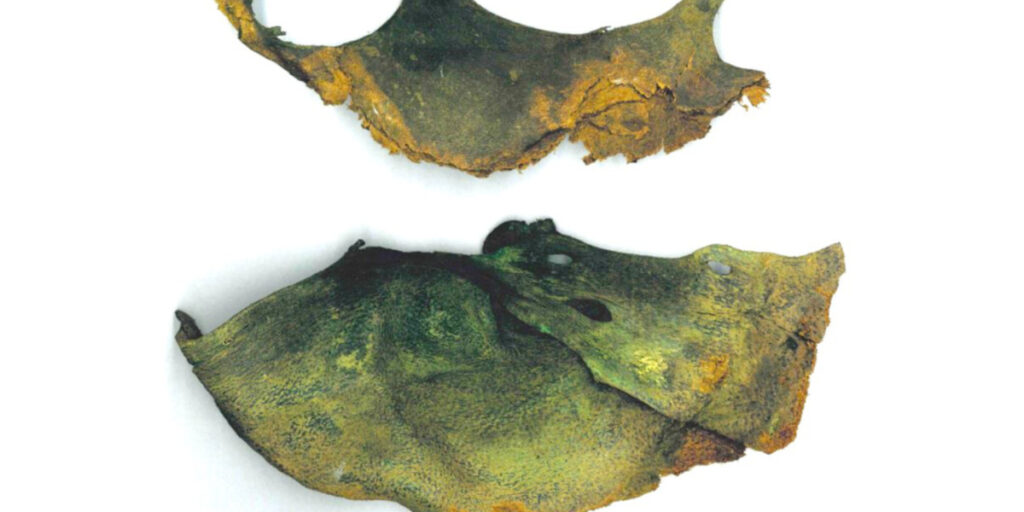
Sweden’s oldest known shoe has been identified after researchers re-examined leather fragments that had spent decades in museum storage under the wrong label: bearskin.
The fragments were excavated in 1943 from a cairn at Igelsta–Västerängen in Roslagen, eastern Uppland, but were long treated as the remains of a bear pelt found beneath a Roman cauldron. A new study published in Fornvännen by Thomas Eriksson, Ylva Telldahl, and Maria Neijman now argues that the pieces are not an animal pelt at all, but parts of a shoe dating to the Roman Iron Age, roughly the first to third century A.D.
That makes the find the oldest known shoe remains from Sweden.
A forgotten find from one of Uppland’s richest Iron Age graves
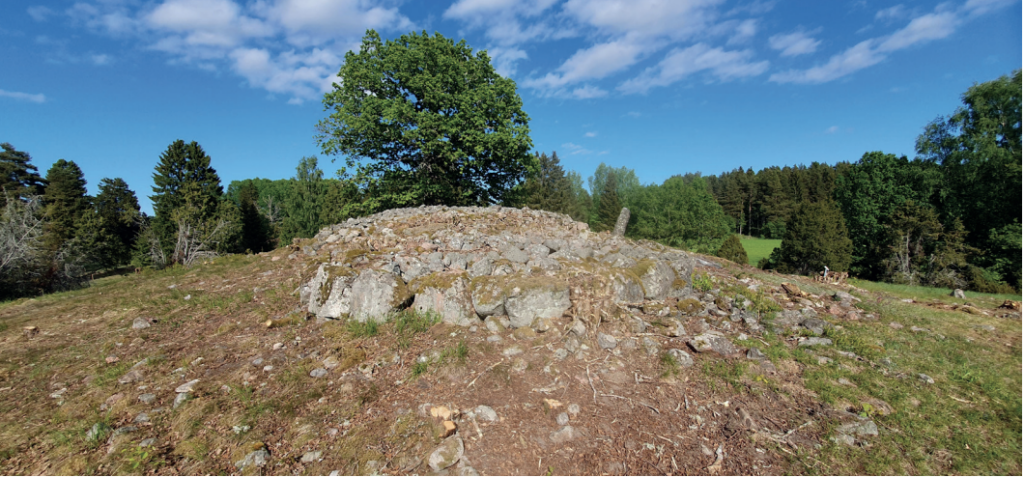
The shoe fragments came from cairn A51, a monumental grave in a cemetery at Igelsta–Västerängen, in Söderby-Karl parish. The cairn measured about 13 meters in diameter and 1.5 meters in height, making it a highly visible burial monument in the landscape.
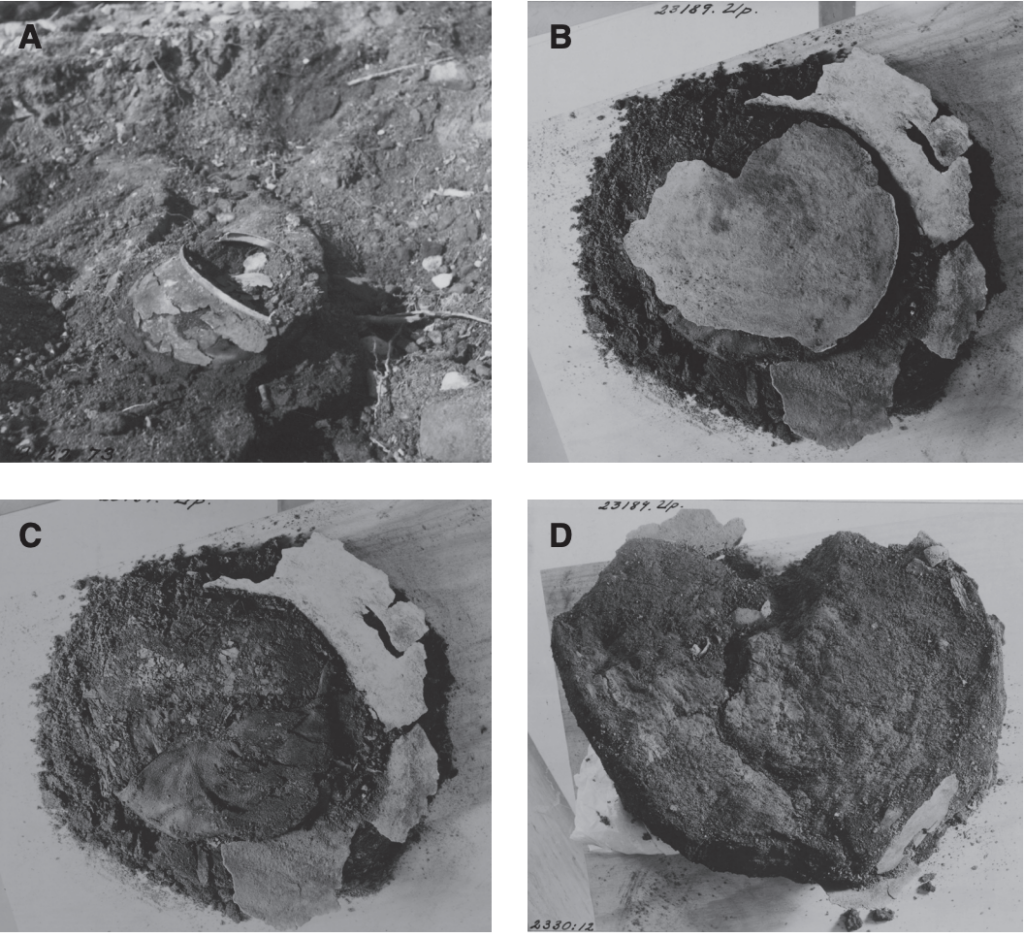
When archaeologist Harry Thålin investigated the site in 1943, the grave produced an exceptional group of finds. Among them were a Roman Østland-type bronze cauldron, mounts from two drinking horns, cremated human bones, and unburnt animal bones. The leather fragments were found between the base of the cauldron and a wooden tray.
For decades, those fragments were understood as “bearskin under the cauldron.” The interpretation was not absurd at the time. Bear pelts are known from high-status Iron Age graves in Scandinavia, often represented by claws. But the Igelsta grave contained no bear claws, and the shape of the leather pieces did not fit neatly with the idea of a pelt.
When the material was re-examined at the National Historical Museum of Sweden in 2023, the older interpretation began to unravel.
Cut holes, wear marks, and lacing changed the story
The fragments preserve details that are difficult to explain as simple pelt remains. One piece has large D-shaped cut-out holes. Another has small holes along the edge, with visible wear and tension marks. These are exactly the kinds of features archaeologists look for when identifying footwear: fastening points, lacing holes, and areas shaped by use.
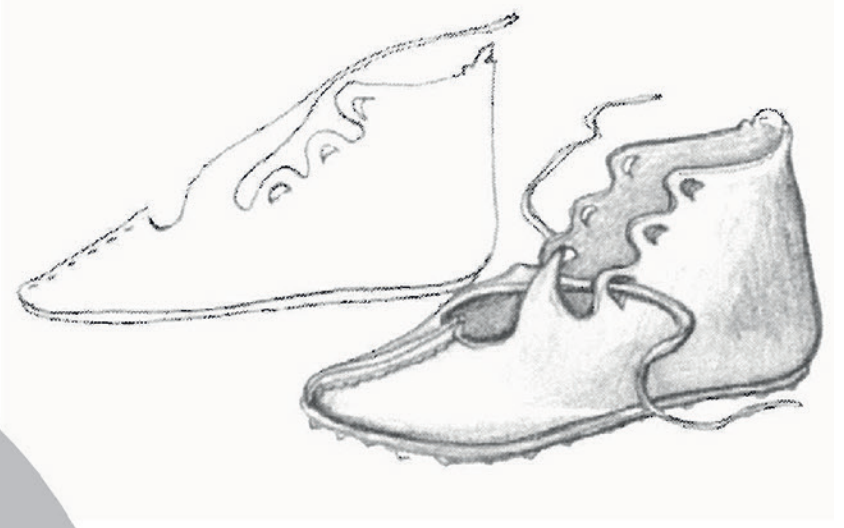
The researchers suggest that the fragments belonged to a shoe with Roman-influenced design features. Its closest parallels are not in Sweden, where earlier prehistoric footwear is essentially absent, but in Roman and Roman-provincial material from places such as Britain and Germany.
The Igelsta shoe may have resembled a higher-ankle boot rather than a light sandal. The preserved fur and relatively closed construction suggest footwear suited to colder weather. It was probably a practical object, but its placement in the grave gave it a second life as a ritual object.
A Roman-style object in a Swedish burial landscape
The Igelsta shoe is important because it was not found alone. It was part of a burial setting filled with signs of status, long-distance contact, and ritual drinking.
The Roman cauldron, drinking horn mounts, and chain link the grave to a wider network around the Baltic Sea, southern Scandinavia, Poland, and the Roman world. Gotland may have served as a key contact point in that exchange system. In this sense, the shoe does not simply tell us what someone wore. It helps reveal how Roman goods, local traditions, and elite identity could intersect in Early Iron Age Sweden.
The researchers argue that the shoe was probably locally made, but with clear Roman influence. That detail matters. It suggests that Roman styles were not merely imported as finished objects. They could also be adapted by local craftspeople and folded into Scandinavian burial customs.
Radiocarbon dates show a more complex grave history
The grave itself turned out to be more complicated than previously thought. Radiocarbon analysis indicates that the cremated human bones near the cauldron belonged to an earlier burial, dating to the Early Pre-Roman Iron Age, around 405–209 B.C.
By contrast, unburnt sheep or goat bones found inside the cauldron date to a later phase, broadly consistent with the Roman Iron Age artefacts. The cairn therefore seems to have been used more than once, either for repeated burial activity, ritual deposition, or both.
This means the shoe and the Roman cauldron were not simply part of the original construction of the cairn. They were added later, in a setting already charged with ancestral significance.
The study raises several possibilities. The later deposit may represent an inhumation whose skeleton did not survive. It may have been a cenotaph for someone whose body was absent. Or it may have been an offering made to the dead or to ancestral powers connected with the cairn.
Preserved by Copper, Placed with Purpose
Organic materials rarely survive in Swedish graves from this period. The Igelsta shoe survived because of its unusual micro-environment. Copper salts from the bronze cauldron helped preserve the leather, giving the fragments a greenish hue.
Its placement was also unusual. The shoe was not found on a foot. It had been placed beneath the cauldron, between the metal vessel and the wooden tray. That deliberate position suggests symbolic meaning.
Shoes have long carried ritual associations in northern European funerary traditions. The study cautiously points to later literary parallels, including the idea of “Hel-shoes” in medieval Icelandic saga tradition, where footwear could be given to the dead for the journey beyond life. The Igelsta burial is much earlier, so the comparison cannot be used as direct evidence. But it does show why footwear may have carried meanings beyond simple function.
DNA analysis added another intriguing detail. The material was once thought to be bear. Newer tests were fragmentary, but they suggested possible links to squirrel and canid families, such as dog or wolf. If confirmed, that would make the shoe even more unusual, though the researchers remain careful in their interpretation.
Sweden’s oldest shoe rewrites a small but vivid part of Iron Age life
The Igelsta fragments are modest in size, but their significance is large. They push the record of preserved Swedish footwear back long before the Viking Age and show that clothing, craft, and imported taste could play a role in elite burial rituals.
They also offer a reminder of how museum collections can still produce major discoveries. The shoe was not newly excavated. It had been sitting in storage since the 1940s, hidden in plain sight by an old interpretation that no longer held up under closer analysis.
A few pieces of leather, once dismissed as a bear pelt, now reveal a more complex picture: a high-status grave, Roman-connected drinking rituals, local craftsmanship, and a shoe that may have carried both practical and symbolic weight.
In the end, Sweden’s oldest shoe was not found by digging deeper into the ground. It was found by looking again.
Eriksson, T., Telldahl, Y., & Neijman, M. (2026). A cairn in Roslagen with the oldest shoe in Sweden. Fornvännen, 121, 81–97. https://doi.org/10.66449/fornvn.v121i2.64004
Cover Image Credit: Leather fragments once identified as bearskin have now been recognised as parts of Sweden’s oldest known shoe. The Swedish History Museum.
