

Archaeologists in Saudi Arabia have uncovered a rare collection of 100 gold jewelry pieces dating back more than 1,100 years, offering a striking glimpse into wealth, craftsmanship, and trade during the Abbasid era.
The discovery was made at the Dariyah archaeological site in the Al-Qassim region, where the Saudi Heritage Commission has completed its fourth consecutive season of excavation and survey work. The gold pieces appear to have belonged to a single private adornment set, possibly worn for ceremonial or elite occasions.
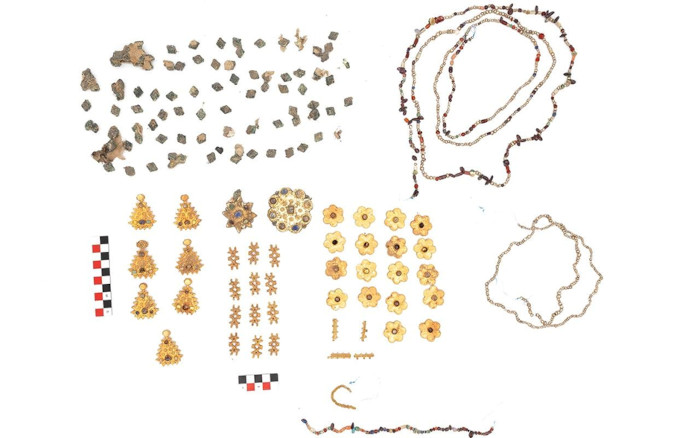
What makes the find especially compelling is not only its age, but its condition. The collection includes pendants, decorated discs, gold spacers and multi-colored beads, many of them still preserving the delicate visual language of early Islamic metalwork.
A private treasure from the Abbasid world
The jewelry has been dated to the Abbasid period, when the caliphate connected vast parts of the Islamic world through trade, pilgrimage, scholarship, and artistic production. The Abbasid era, beginning in the 8th century, is often associated with major advances in science, literature, urban culture, and luxury craftsmanship.
At Dariyah, that world now appears in miniature through gold.
Several pieces are decorated with floral motifs placed inside geometric forms, a design approach widely associated with Islamic art. One large disc-shaped ornament stands out for its symmetrical arrangement of colored stones around a central design. Other pieces seem to have functioned as necklace elements, with fine spacers used to organize beads and pendants into complex arrangements.
The owner of the set remains unknown. It may have belonged to a wealthy resident, a traveler, a merchant family or someone connected to pilgrimage traffic. For now, its disappearance is part of the mystery.
Goldwork shaped by skill and trade
According to the Saudi Heritage Commission, the artifacts were made using sophisticated goldsmithing methods. Craftsmen hammered thin sheets of gold into shape, pressed decorative patterns into the surface, and set colored stones into carefully prepared gold frames.
That level of technical control points to a mature tradition of metalworking. It also suggests access to materials, taste, and wealth beyond ordinary domestic life.
The colored stones are particularly important. Even when their sources are not yet fully identified, such inlays often indicate participation in wider exchange networks. In a settlement positioned along major movement corridors, jewelry was not just decoration. It was a visible sign of status, mobility, and contact.
Dariyah on the Basran Hajj route
Dariyah’s location helps explain why such an object might have ended up there. The site lies southwest of Al-Qassim, among valleys and mountains that formed part of historic routes across the Arabian Peninsula.
The area was linked to the Basran Hajj route, used by pilgrims traveling from Iraq toward Mecca. These routes were not only religious roads. They carried merchants, goods, ideas, news and artistic styles across long distances.
A stop along such a route could become a small but active center of exchange. The gold jewelry fits that picture. It suggests a settlement connected to movement, money, and cultural contact during the early Islamic centuries.
More than a treasure find
Excavations at Dariyah also uncovered stone building foundations, mudbrick walls, plastered rooms, hearths, pottery vessels, glass fragments, soapstone objects, and metal tools. These remains point to stable occupation during the late ninth century AD, not a temporary camp or isolated burial deposit.
That wider archaeological setting matters. Without it, the jewelry would be only a beautiful hoard. With it, the discovery becomes evidence for a lived settlement tied to Abbasid-period trade and pilgrimage.
Dr. Jasir Suliman Alherbish, CEO of the Saudi Heritage Commission, said the discovery reflects the richness of Saudi Arabia’s cultural heritage and the Kingdom’s historic position as a crossroads of trade routes and cultural exchange.
The Dariyah gold collection now adds a vivid new chapter to the archaeology of early Islamic Arabia. It shows that the desert routes of the Abbasid world were not empty passages between cities. They were active corridors where faith, commerce, and luxury craftsmanship could meet.
Cover Image Credit: Saudi Arabia Ministry of Culture
