
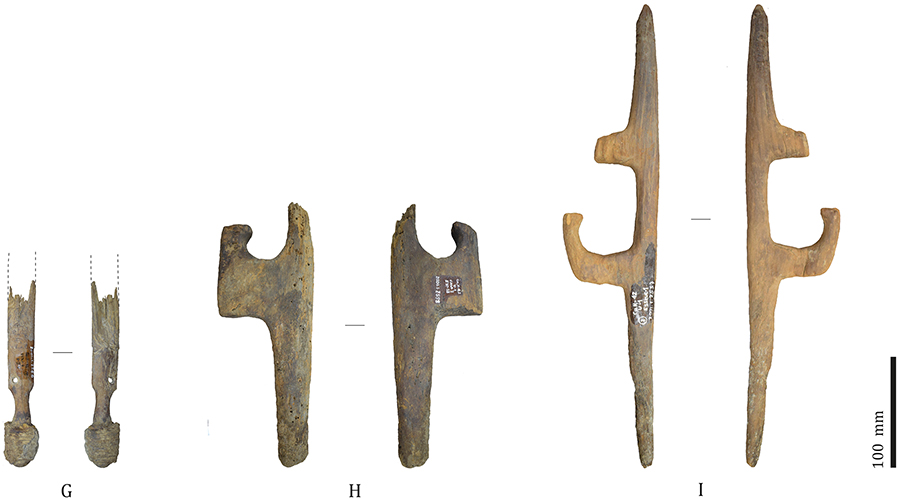
Archaeologists have identified 5,000-year-old spear-throwers in Chile that may have been used to hunt guanacos and vicuñas, wild relatives of llamas.
Reanalysis of wooden hunting devices from an Atacama Desert settlement suggests that ancient coastal communities pursued wild camelids and attached considerable social value to land hunting.
Nearly half a century after archaeologists recovered a collection of unusual wooden objects from the coast of northern Chile, two of them have now been directly dated to around 5,000 years ago.
The objects are spear-throwers—handheld devices used to launch long darts with greater speed and range than could be achieved by throwing them with the arm alone. The new radiocarbon results make the examples from Caleta Huelén 42 the oldest directly dated spear-throwers currently known in the Andes.
The findings, published in the journal Antiquity by archaeologists Benjamín Ballester and Patricio de Souza, provide rare physical evidence for an early hunting technology that is usually difficult to trace because the devices were commonly made from perishable materials such as wood.
Rediscovering weapons excavated in the 1970s
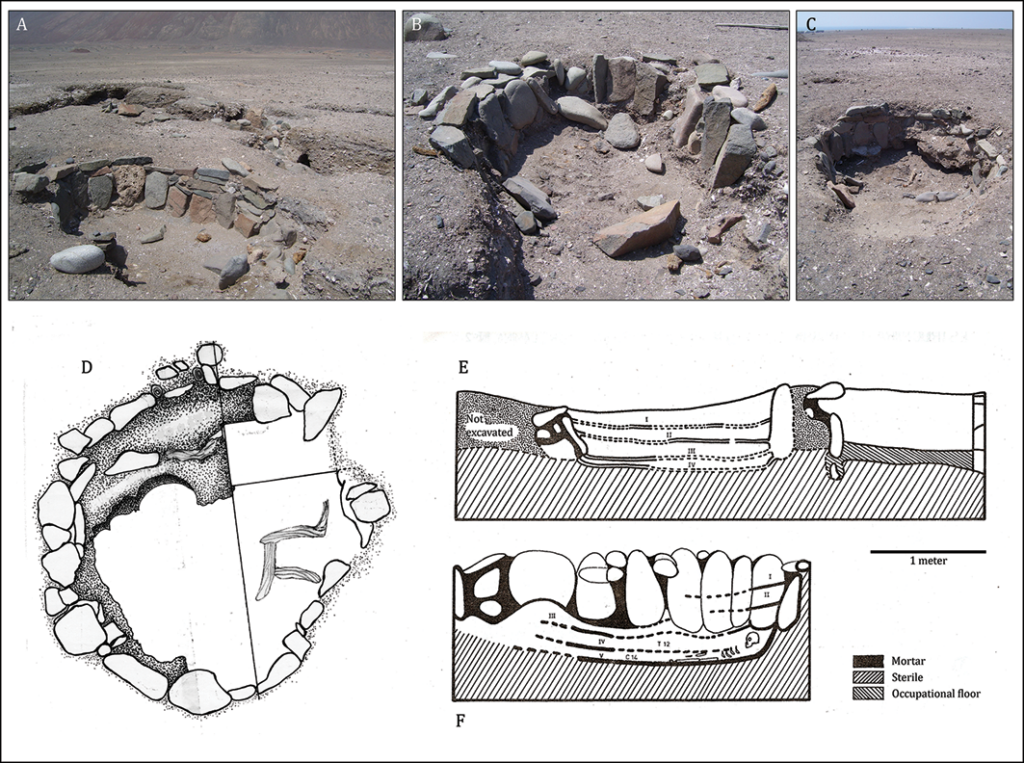
Caleta Huelén 42 lies on a narrow coastal terrace near the mouth of the Loa River, where one of the world’s driest deserts meets the Pacific Ocean. The settlement is located about 900 metres from the present shoreline and only 100 metres from the riverbed.
Excavations conducted between 1971 and 1973 revealed more than 100 semi-subterranean structures built into a dense midden of shells, animal bones and manufacturing debris. The site was occupied by Late Archaic marine hunter-gatherers between approximately 6000 and 4000 years ago.
Their economy was closely connected to the sea. Archaeologists recovered fishing lines, hooks, weights, harpoons and other equipment used to capture fish and marine animals. Beneath some of the habitation floors, however, they also found collective burials accompanied by textiles, ornaments, pipes and hunting implements.
Among the finds were 12 objects originally identified as estólicas, the Spanish term commonly used in the Andes for spear-throwers. Nine came from funerary contexts, while three were recovered from domestic midden deposits.
The artefacts were described during the 1980s but had not been comprehensively re-examined. When Ballester and de Souza returned to the collection, now housed at the University of Antofagasta, they were able to locate nine of the original 12 specimens.
The researchers analysed their dimensions, construction and materials while also reviewing unpublished field notebooks, drawings and photographs from the original excavations. Samples from two broken wooden spear-throwers were then selected for radiocarbon dating.
Two weapons date to around 3000 BC
The two directly tested artefacts produced median calibrated dates of approximately 5040 and 4870 years before present. Their calibrated ranges place them broadly between about 3340 and 2870 BC.
These results do not necessarily mark the invention of the spear-thrower in the Andes. Earlier examples may once have existed but failed to survive, or remain unidentified in museum collections. Nevertheless, the Caleta Huelén 42 specimens provide the earliest direct chronological evidence currently available for the technology in the region.
A spear-thrower functions as an extension of the hunter’s arm. A hook at one end supports the base of a dart, allowing the device to act as a lever during the throwing motion. This transfers additional force to the projectile and makes it possible to strike targets from a greater distance.
The most complete example from Caleta Huelén 42 is approximately 28 centimetres long. It retains a carefully shaped handle and part of a bone hook secured with a loop of leather or sinew.
Seven of the nine studied objects share a recognisable design: a defined handle, a flattened central body and a narrower projection that once held or supported the dart. Some contain grooves that may have helped position the projectile, while two have small perforations near their handles, possibly for attaching a cord or improving the hunter’s grip.
They were not simple pieces of carved wood. Their makers combined dense hardwood with bone hooks, leather or sinew bindings and, in some cases, red pigment. The surfaces were scraped or polished until they became smooth and regular. The variety of components visible in the collection shows that these were carefully assembled technical instruments rather than roughly fashioned sticks.
Hunting beyond the shoreline
The presence of spear-throwers in a community so closely associated with fishing initially presents a puzzle. The inhabitants already possessed specialised harpoons for hunting marine animals, making it unlikely that the wooden throwing devices served the same purpose.
Ballester and de Souza instead propose that they were used on land, particularly to hunt camelids. Wild guanacos and vicuñas—the relatives of domesticated llamas and alpacas—would have provided meat as well as bone, sinew and other materials.
Camelid remains are common at coastal archaeological sites in the Atacama region. Some of their bones were transformed into tools used in the maritime economy, including components for harpoons and fishhooks. Hunting animals inland may therefore have supported life at the coast in ways that extended far beyond food.
Evidence from the interior Andes strengthens this interpretation. Rock art and archaeological finds show hunters using darts and spear-throwers to capture camelids. Similarities between the Chilean objects and a spear-thrower found roughly 500 kilometres away near the Doncellas River in north-western Argentina may also reflect exchanges of knowledge between coastal and inland communities.
The researchers nevertheless caution that hunting may not have been the devices’ only function. Their possible use during interpersonal conflict cannot be excluded.
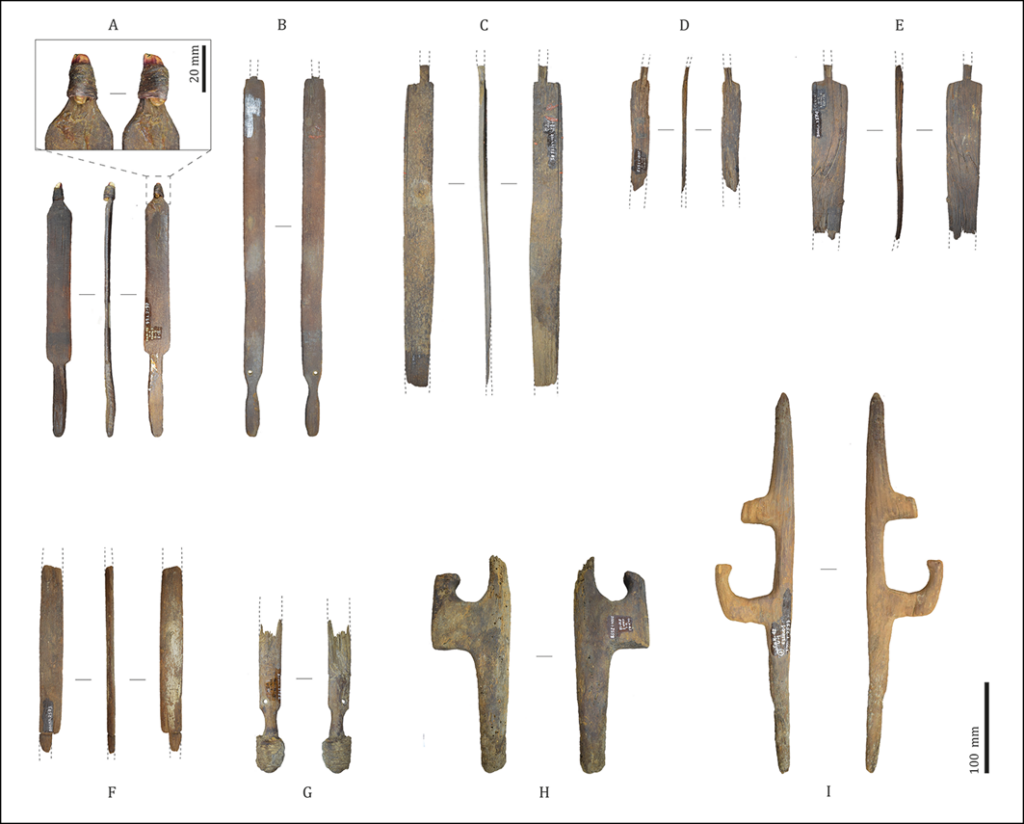
The spear-throwers from Caleta Huelén 42 analysed in this article. Credit: Ballester, B., & de Souza, P. (2026)
Were the smaller spear-throwers made for young hunters?
Several specimens are considerably smaller than the others. The original excavators described them as “miniature” spear-throwers, although their shape and operating system appear consistent with the larger examples.
One possibility is that the smaller devices were made for younger members of the community. Such objects could have allowed children or adolescents to practise handling weapons and gradually acquire the skills required for hunting.
The hypothesis remains unproven. Size differences could reflect individual preference, distinct uses or incomplete preservation rather than age. The study therefore stops short of identifying the smaller pieces as children’s equipment.
Their presence does, however, raise questions about how technical knowledge was transmitted. Successful dart hunting required more than possession of a weapon: hunters needed to understand animal behaviour, terrain, distance and the physical coordination required to launch a projectile accurately.
Hunting tools with social meaning
The contexts in which the spear-throwers were discovered suggest that they carried meaning beyond their immediate practical value.
Most of the original collection came from graves, where the devices had been placed alongside the dead. Several appear to have been repaired or carefully maintained before deposition. Even the complete spear-throwers recovered from domestic middens may have been deliberately placed rather than casually discarded.
Their treatment suggests that land hunting held considerable social importance among people traditionally characterised primarily as marine hunter-gatherers. Spear-throwers may have expressed the identity, expertise or status of particular individuals while also representing wider connections between coastal and inland communities.
The technology remained in use along the Atacama coast for thousands of years. Archaeological evidence suggests that bows and arrows began gradually replacing spear-throwers by the second half of the fifth century AD, although the two systems may have overlapped for a time.
The Caleta Huelén 42 collection shows how objects excavated decades ago can still alter archaeological chronologies. By returning to museum storerooms and unpublished field records, the researchers established that sophisticated dart-launching technology was already part of life on Chile’s desert coast at least 5,000 years ago—and may have been present in the Andes considerably earlier.
Ballester, B., & de Souza, P. (2026). Spear-throwers from Caleta Huelén 42 (northern Chile): implications for south-central Andean hunting technologies. Antiquity, 1–18. doi:10.15184/aqy.2026.10398
Cover Image Credit: Ballester, B., & de Souza, P. (2026)
