
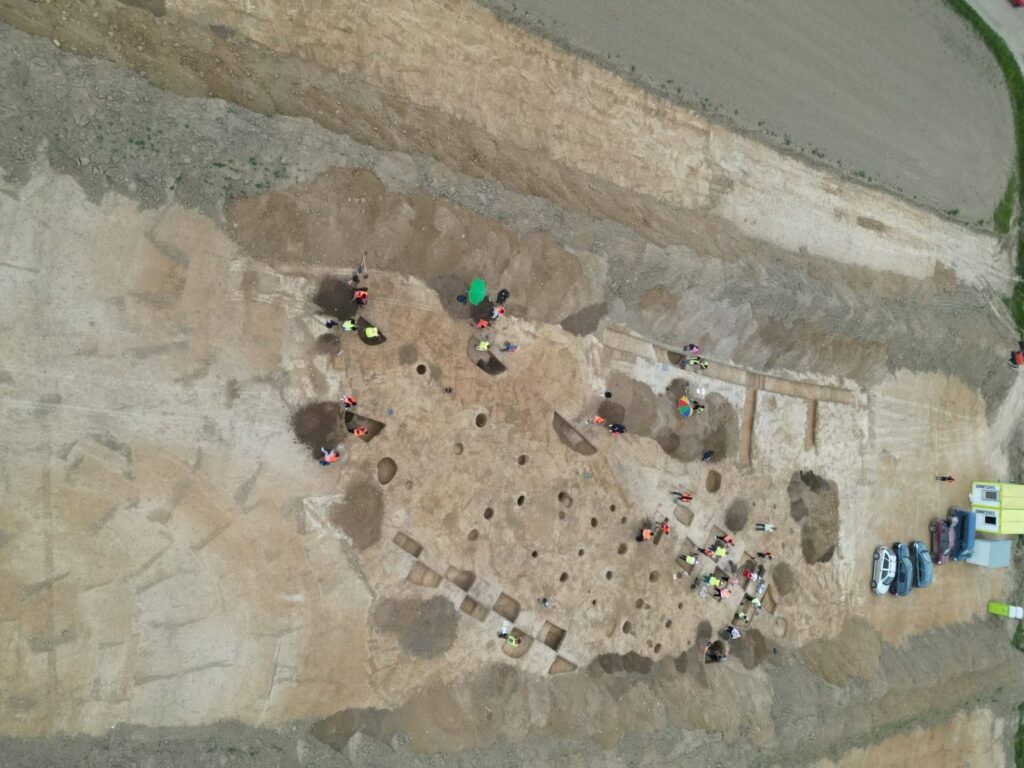
A single prehistoric house discovered during highway excavations in Czechia has turned out to be part of a much larger archaeological landscape. Months after the first building plan was identified, archaeologists have now recognized approximately 16 Neolithic longhouses, some stretching an impressive 36 meters in length.
The discoveries were made along the planned D55 highway between Kokory and Přerov in central Moravia. Dating back approximately 7,000 years, the houses belonged to some of the region’s earliest farming communities. Together with storage pits, ovens, and other settlement remains, they offer a glimpse of everyday life when agriculture was transforming Central Europe.
From a Single House to an Early Farming Landscape
When archaeologists announced the first findings in November 2025, one of the discoveries was the complete ground plan of a Neolithic building near Rokytnice. At that stage, researchers had investigated more than 300 archaeological features along the highway route.
The excavation subsequently expanded, revealing additional settlements associated with the Linear Pottery culture, one of the earliest farming traditions in Central Europe.
By the time fieldwork concluded on July 29, 2026, approximately 16 longhouse plans had been identified across the Neolithic sites near Kokory and Rokytnice. Some measured up to 36 meters, demonstrating the considerable scale of buildings constructed by communities living in the region thousands of years before the first cities appeared.
The wooden buildings themselves have not survived. Instead, archaeologists identified their outlines through traces left in the ground, allowing the original dimensions of the structures to be reconstructed.
Such longhouses were characteristic of the Linear Pottery culture, whose communities spread through large parts of Central Europe during the sixth millennium BC. They were built around substantial timber frameworks, with posts supporting the walls and roof. Their size reflects the considerable investment of labor and building materials required to establish permanent farming settlements.
The Moravian discoveries are particularly informative because archaeologists have identified multiple building plans rather than a single isolated structure. Further analysis may help clarify how these houses were arranged and whether they belonged to successive phases of occupation.
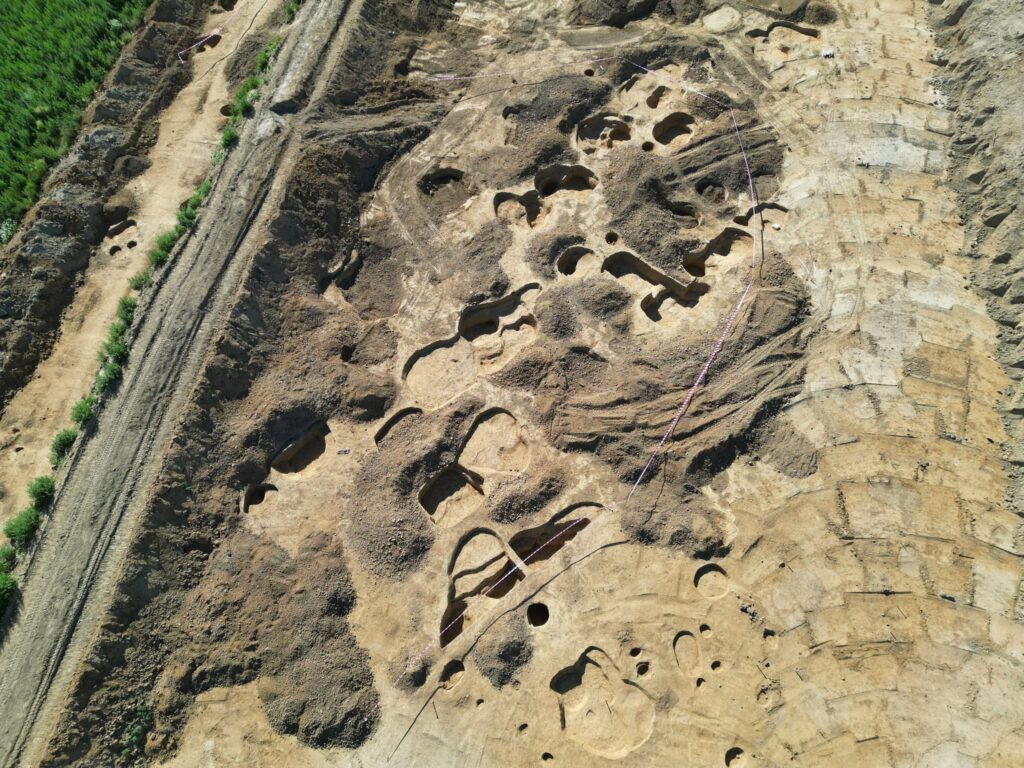
Alt text: Overhead view of excavated prehistoric pits and settlement features in central Moravia, Czechia
What Was Life Like Around the 36-Meter Houses?
The buildings were not the only traces left by the Neolithic inhabitants.
Archaeologists also uncovered storage pits, ovens, and other features associated with daily activities. These discoveries help place the houses within a broader settlement environment, where food production, storage, and domestic work formed essential parts of everyday life.
For communities that depended on agriculture, storing harvested crops was particularly important. Storage pits could preserve provisions, while ovens provided facilities for heating and food preparation.
The surrounding landscape would have supported farming and animal husbandry, activities central to the Linear Pottery way of life. Unlike earlier mobile hunter-gatherer populations, these communities invested in substantial buildings and established agricultural settlements.
The excavation offers an opportunity to investigate how such activities were organized at the newly exposed sites. However, the announced findings do not establish how many people occupied each house or whether all 16 buildings stood at the same time.
One of the largest concentrations of archaeological remains was recorded at Kokory–Podsedky, where researchers investigated 974 features. These represent multiple periods of occupation, rather than exclusively Neolithic activity.
A Highway Reveals More Than the First Farmers
The Neolithic settlements were part of a much larger investigation conducted by the Archaeological Center Olomouc for the Czech Road and Motorway Directorate.
Under the direction of archaeologist Marek Kalábek, the team examined nearly seven kilometers of the planned D55 route between September 2025 and July 2026.
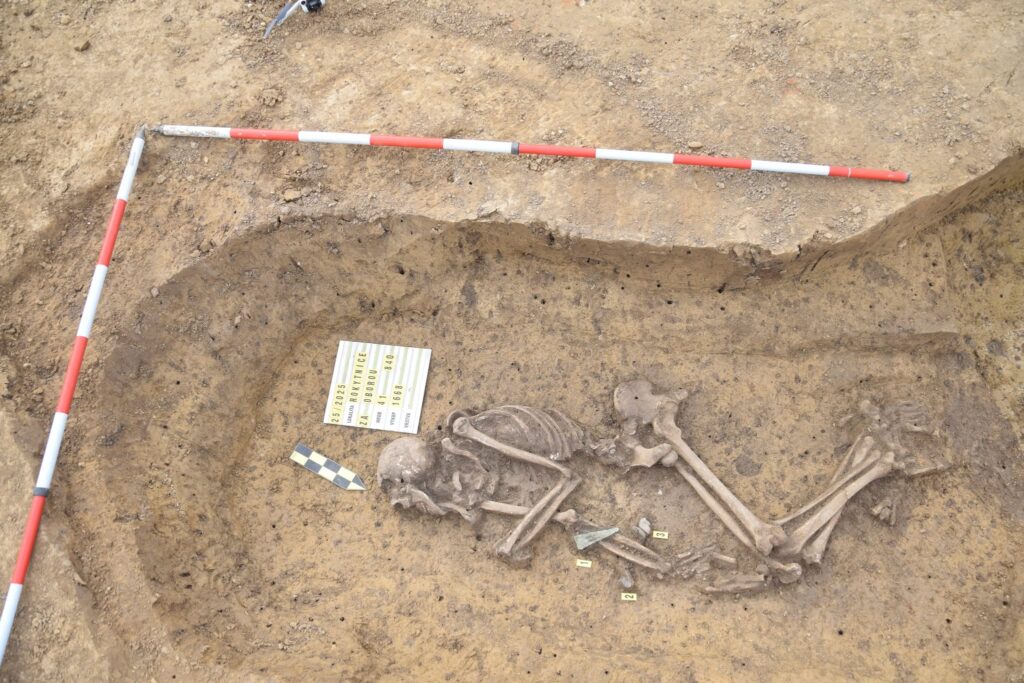
In total, archaeologists documented 1,879 settlement features and 65 inhumation and cremation graves, along with an additional human burial found within the fill of a settlement feature. The investigation confirmed 12 previously anticipated archaeological sites and identified a previously unknown location at Dluhonice.
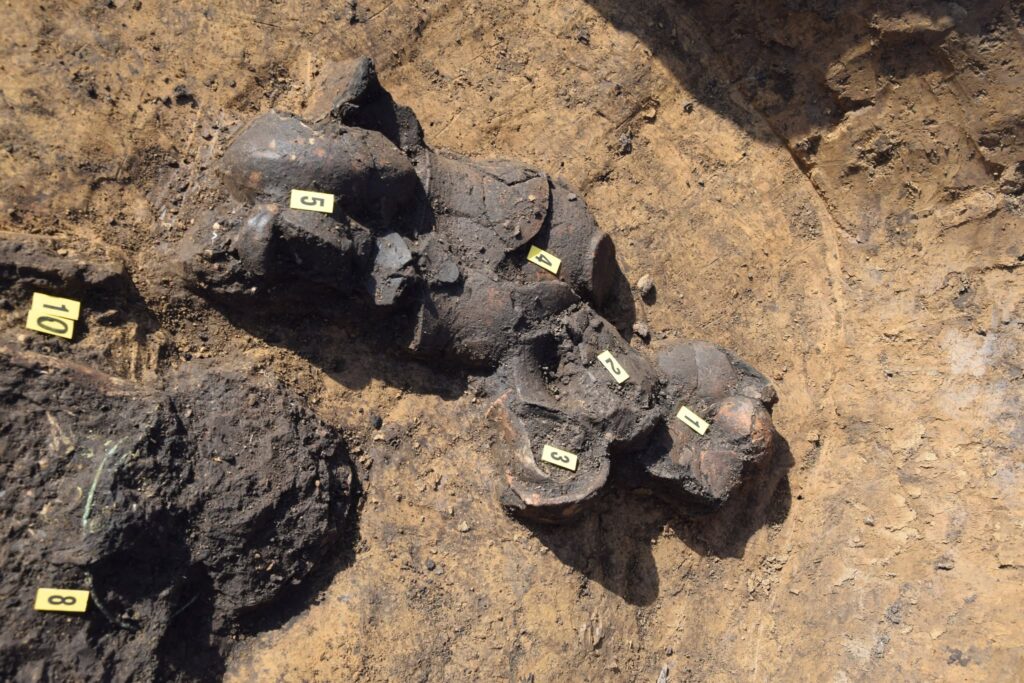
Later communities also left substantial evidence of their presence. Early Bronze Age cemeteries contained objects including copper ornaments, bone beads, pottery vessels, bronze pins, and bracelets. Researchers also identified 18 Late Bronze Age cremation graves.
At Dluhonice, a burial associated with the Corded Ware culture contained pottery, a copper ornament, and a stone tool. These discoveries illustrate how the landscape continued to attract communities long after its earliest farmers had established their settlements.
Yet the Neolithic houses remain a particularly tangible connection to the region’s earliest agricultural inhabitants. Their surviving ground plans reveal the dimensions of buildings that once stood within a landscape of fields, storage facilities, and domestic activity.
What Happens to the Discoveries Next?
Although excavation has ended, the recovered material is now undergoing cleaning, conservation, documentation, and specialist analysis at the Archaeological Center Olomouc. The findings will subsequently be transferred to the Museum Archaeology Center at the Olomouc Regional Museum.
Kalábek is also scheduled to present the discoveries to the public during Archaeology Day on October 17, 2026, at the Archaeological Center Olomouc.
For the researchers, the highway excavation has transformed an initially isolated Neolithic house into evidence of a much broader settlement landscape. Further study of the 16 building plans and their associated features may provide a clearer picture of how some of central Moravia’s earliest farming communities lived nearly 7,000 years ago.
