

Archaeologists in Czechia are uncovering new details about a 6,500-year-old prehistoric sanctuary whose entrances appear to have been carefully arranged around the movements of the Sun and Moon. The enormous enclosure near the village of Chleby predates the earliest phase of Stonehenge by more than 1,000 years.
The monument, located in the Nymburk region of Central Bohemia, measured about 230 meters across and was surrounded by a ditch more than 2.5 meters deep. Twelve entrances interrupted the almost circular enclosure, creating a monumental space unlike other known sites of the same period in the region.
Researchers led by the University of West Bohemia in Pilsen now argue that those entrances were not positioned at random. Their geometry appears to have allowed prehistoric communities to observe important points in both the solar year and the much longer lunar cycle.
Twelve entrances turned the landscape into an observatory
Archaeologists have identified two particularly significant observation points within the enclosure.
One corresponds to the Moon’s most extreme rising and setting positions on the horizon during its approximately 18.6-year cycle, an astronomical phenomenon known as a major lunar standstill. The other links sunrise at the summer solstice with sunset at the winter solstice.
The second alignment immediately invites comparison with Stonehenge, whose principal axis also reflects the Sun’s position around the summer and winter solstices. But Chleby belongs to a much earlier chapter of European prehistory.
Organic material recovered from the Czech site indicates that communities constructed the enclosure roughly 6,500 years ago, during the early Eneolithic period. By comparison, the first major earthwork phase of Stonehenge dates to around 3000 BC, while its famous stone settings appeared several centuries later.
Petr Krištuf of the University of West Bohemia, who leads the research, believes the solar arrangement may have carried powerful symbolic meaning for early farming communities. The summer solstice could represent beginning and renewal, while the winter solstice marked an ending within the seasonal cycle.
Rather than functioning simply as a defensive enclosure, Chleby’s immense ditch and carefully arranged openings therefore point toward a landscape built for gatherings, ceremonies and astronomical observation.
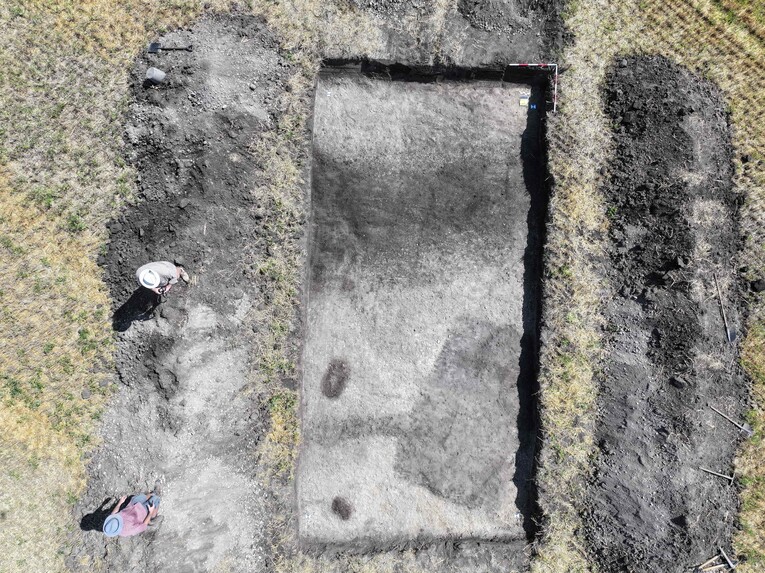
Bull skulls point to rituals at the entrances
Physical evidence from the ditch strengthens the interpretation of Chleby as a ritual centre.
Archaeologists discovered bull skulls and horns close to some of the entrances, raising the possibility that they once decorated monumental gateways into the enclosure.
Cattle held economic importance for Europe’s first farming communities, but they also acquired strong symbolic roles. Jan Turek of Charles University notes that the bull became an important religious symbol among early agricultural societies across several parts of prehistoric Europe.
Visitors approaching Chleby thousands of years ago may therefore have entered through gateways marked by cattle remains before gathering inside the huge enclosed space.
The scale of the construction itself suggests considerable communal effort. Digging a ditch more than two meters deep around a structure hundreds of meters across would have required organized labor extending far beyond a single household.
People returned to Chleby thousands of years later
The story of Chleby did not end when its original builders disappeared.
Much later, during the Early Bronze Age, people associated with the Únětice culture used part of the old monument for burial. Archaeologists discovered a multiple grave there in 2016 while investigating the earlier enclosure.
A detailed study published in 2023 concluded that the grave contained the remains of between 15 and 18 individuals, deposited over time rather than during a single event. Researchers also conducted ancient DNA analysis to test whether the burial represented a family tomb. The results showed that the people placed in the grave did not all belong to one biological family.
That discovery suggests that the ancient enclosure—or at least the memory attached to its location—continued to matter many centuries after its original ritual function had changed.
Eventually, however, that memory seems to have faded.
By the Iron Age, researchers believe the great enclosure had lost its earlier significance. People gradually filled the ditch and established an ordinary settlement across the former ritual landscape.
This long transformation makes Chleby particularly valuable. Unlike a monument frozen within one period, the site preserves evidence of how one place could move from sanctuary to burial ground and finally to everyday settlement over thousands of years.
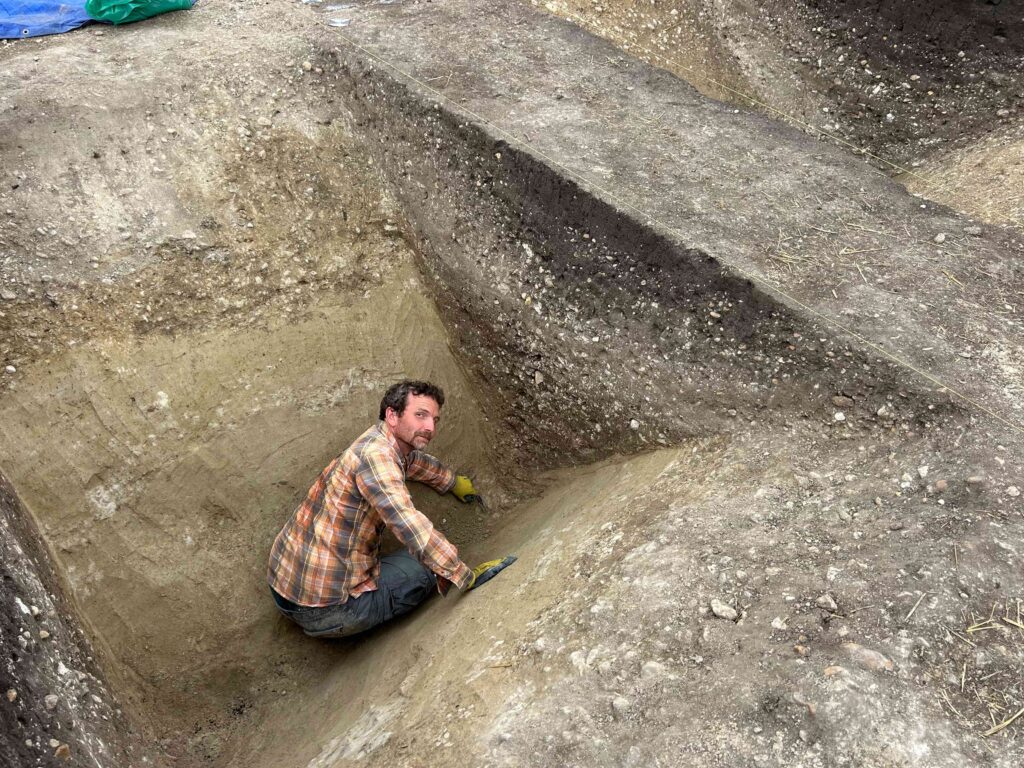
Chemical traces could reveal what happened inside
Archaeologists are now looking beyond artifacts and human remains to reconstruct what people actually did inside the enclosure.
Jan Fišer of the University of Hradec Králové is studying soil samples from the monument and its surroundings. Human activities can alter concentrations of elements and compounds in the ground, leaving chemical signatures even when visible objects have disappeared.
Those traces could help researchers identify areas where people gathered repeatedly, handled animals, prepared food or conducted activities that left little conventional archaeological evidence.
The work forms part of the international project Long-term Land Use Dynamics within the Areas of Prehistoric Ritual Places, involving the University of West Bohemia, Charles University and the University of Hradec Králové.
For now, Chleby presents an unusually early example of prehistoric communities reshaping an entire landscape around collective activity and the sky above them. More than a millennium before the first earthworks appeared at Stonehenge, people in Central Europe had already created a monumental space where ritual, seasonal time and the movements of the Sun and Moon appear to have converged.
