14 December 2025 The Future is the Product of the Past

Extraordinary 27,000-Year-Old Gravettian Female Figurine Head Discovered at Amiens-Renancourt, Northern France

Recent archaeological excavations at the Amiens-Renancourt 1 site in northern France have unveiled an extraordinary Gravettian-era female figurine head, dating back approximately 27,000 years.

This rare find stands out among Upper Paleolithic art for its detailed facial features and intricate headdress—offering unprecedented insight into early human artistic expression during the late Palaeolithic era.

Discovery not only enriches our understanding of Upper Paleolithic art but also challenges long-held assumptions about Gravettian female statuettes, often referred to as “Venus figurines.


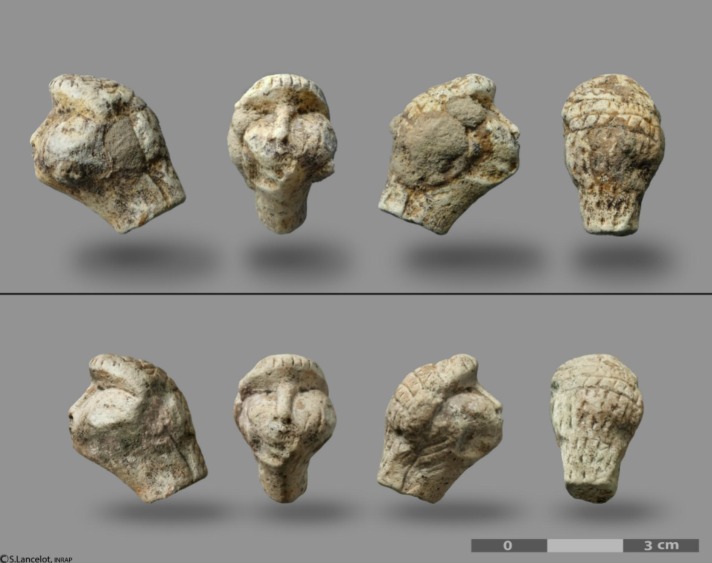
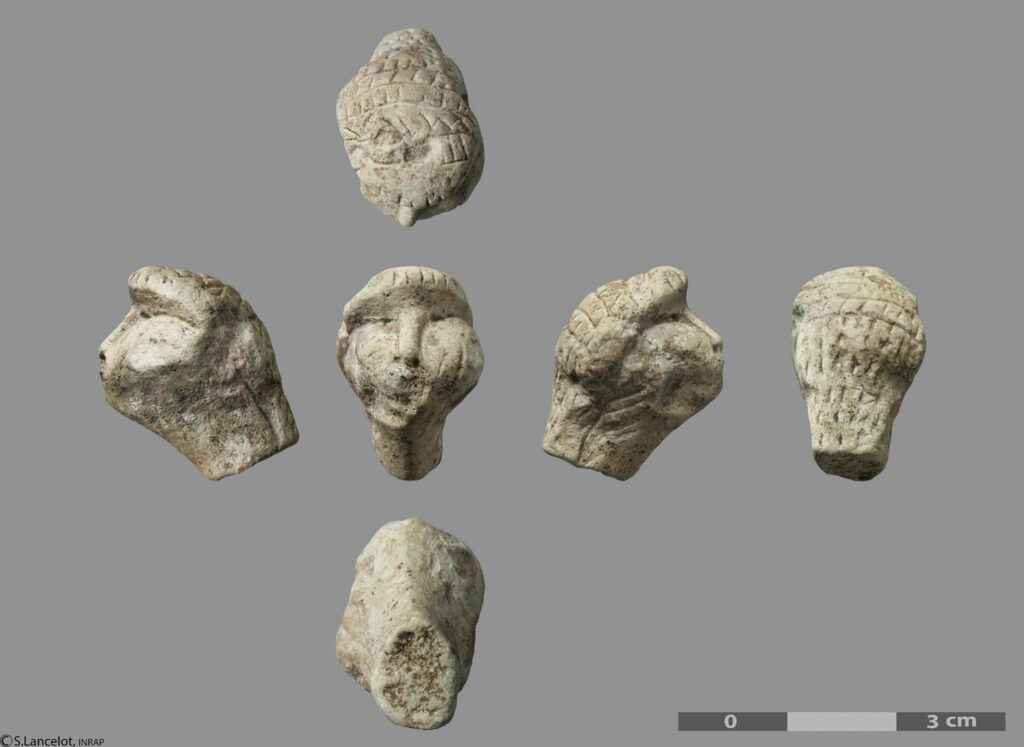
Figure Head shown before and after cleaning of concretions Credit: Stéphane Lancelot, Inrap

Figure Head shown before and after cleaning of concretions. Credit: Stéphane Lancelot, Inrap

A Unique Find in Gravettian Archaeology

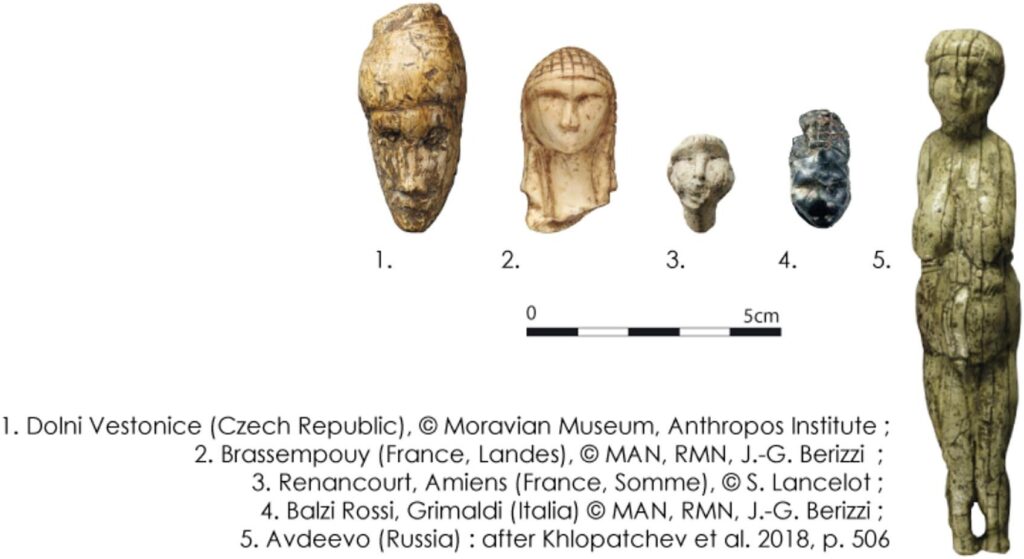
Since the late 19th century, female statuettes from the Gravettian period have fascinated researchers, primarily due to their symbolic importance and enigmatic nature. However, these figurines are typically small, fragmentary, and devoid of detailed facial features. Most lack heads altogether or present heavily abstracted forms. The discovery at Amiens-Renancourt is a rare exception: a finely carved chalk head featuring detailed facial anatomy and an elaborate headdress, offering a rare glimpse into Gravettian artistic expression.

Measuring only 2.1 cm in height, the figurine’s facial features—such as the nose, eyes, and cheeks—are rendered with unusual precision. Notably, the upward gaze, indicated by sunken eye sockets, contrasts with the downward-facing heads of most known Gravettian figurines. The back of the head is adorned with intricate incisions, including grid-like patterns, vertical lines, and notches, which researchers interpret as representing braided hair, a net, or a ritual headdress. Such detailed representation of hairstyle is unique among Gravettian art and may reflect social or ritual significance.


📣 Our WhatsApp channel is now LIVE! Stay up-to-date with the latest news and updates, just click here to follow us on WhatsApp and never miss a thing!!


Rare are the Gravettian faces. Credit: Journal of Archaeological Science: Reports

Contextualizing the Discovery: Amiens-Renancourt 1

Located near the Selle and Somme valleys, the Amiens-Renancourt 1 site has been a focus of intensive archaeological study since 2013. The site provides one of the best-preserved stratigraphic and paleoenvironmental contexts for Gravettian occupation in Europe, dating to approximately 27,200–27,800 years ago during a milder interstadial climate phase.

Excavations have uncovered over twenty statuettes, primarily carved from ivory and soft stone, with a notable use of chalk—an uncommon material for the period. The statuettes typically depict nude female forms with exaggerated hips and minimal limb detail, consistent with Gravettian artistic conventions. Importantly, the statuettes and fragments were produced on-site, reflecting an active workshop or habitation area with complex social and artistic activity.
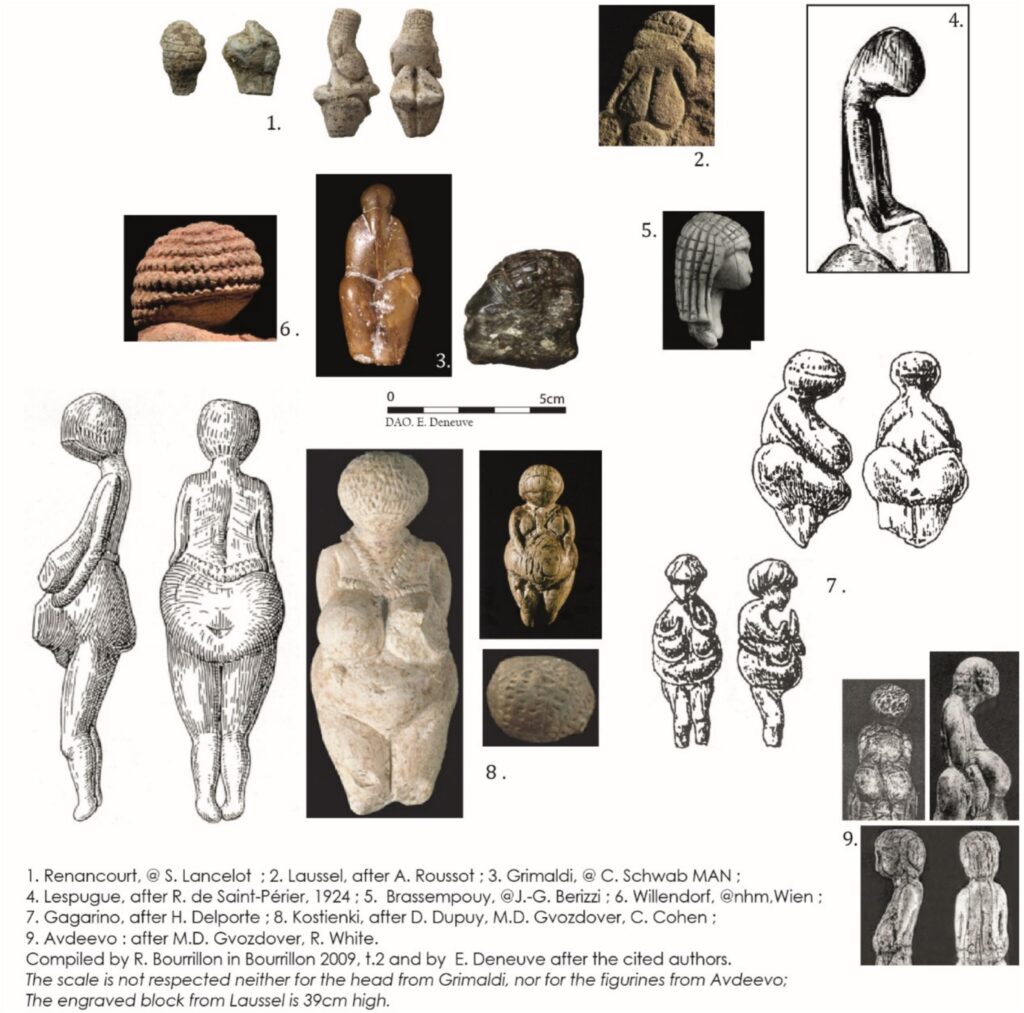
Headpiece or hairstyle? Gravettian fashion catalog. Compiled by R. Bourrillon & E. Deneuve, after the cited authors. Credit: Journal of Archaeological Science: Reports

Significance for Paleolithic Art and Culture

This newly discovered figurine challenges the conventional perception of Gravettian “Venus” figurines as anonymous, stylized symbols of fertility or female deities. Instead, the individualized facial features and distinct headdress suggest a possible portrayal of a specific individual or social role. The grid patterns and ornamentation echo motifs found across Europe and Russia, indicating cultural connections and shared artistic traditions among Gravettian groups.

Moreover, the craftsmanship reveals sophisticated techniques in carving fragile chalk, preserving fine details such as scraping and polishing marks. This underlines the technical skill and aesthetic sensibility of Upper Paleolithic artisans.
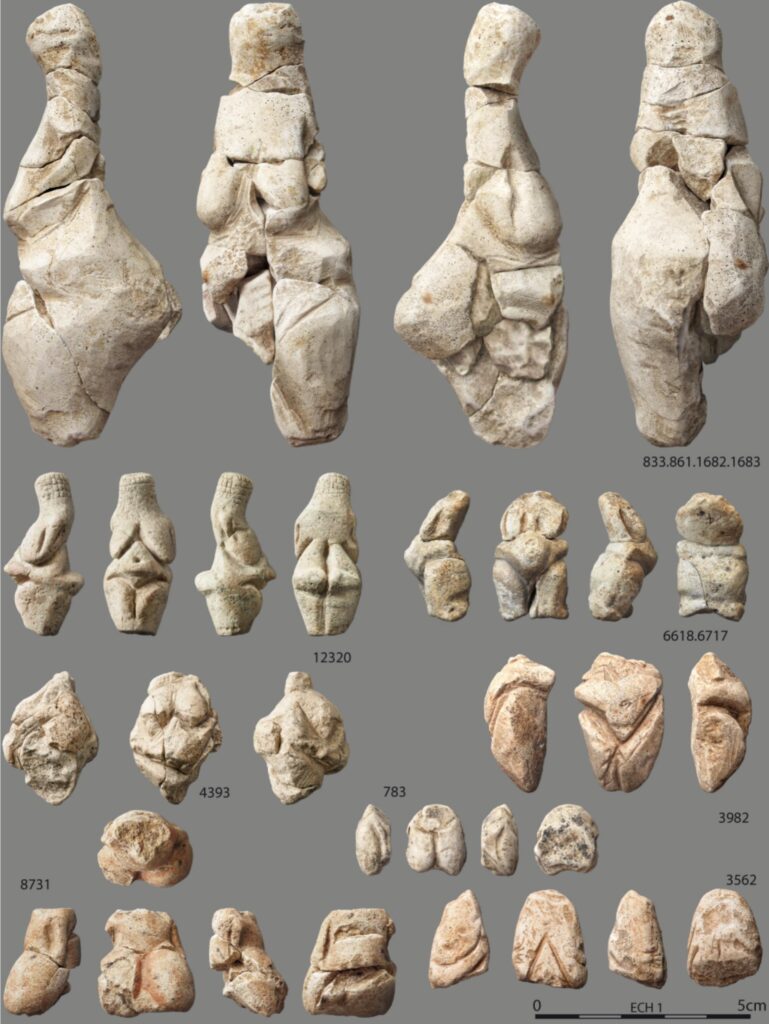
Female statuettes of Amiens-Renancourt 1. Credit: Stéphane Lancelot, Inrap

Future Research and Display

Following meticulous restoration, including microscopic cleaning and 3D modeling, the figurine is slated for exhibition at the Musée de Picardie in Amiens, alongside other findings from the site. Ongoing interdisciplinary studies aim to deepen our understanding of the social, artistic, and environmental contexts of this exceptional discovery.

Clément Paris, Émeline Deneuve, Claire Brière, David Hérisson, Pierre Antoine, Paule Coudret, Sylvie Coutard, Jean-Pierre Fagnart, Nejma Goutas, Jessica Lacarriere, Olivier Moine, Caroline Peschaux, Maxence Toubin. “A new face for the Gravettian. Exceptionnal discovery of a female statuette at Amiens-Renancourt 1 (France)”. Journal of Archaeological Science: Reports, Volume 66, October 2025, 105285, doi.org/10.1016/j.jasrep.2025.105285

Related Articles

A Polish-Croatian team discovered Ancient Roman Temple under a Croatian 18th Century church

24 November 2022

24 November 2022

Under an 18th-century church, the Church of St. Daniel in Danilo near Sibenik, Croatia, the foundations of an ancient Roman...

Ancient Well Dating Back to 7th Century AD Discovered on Failaka Island

18 March 2025

18 March 2025

An ancient well, dating back to the pre-Islamic and early Islamic periods, has been discovered on Failaka Island, providing valuable...

Human Presence in Malta Earlier Than Previously Thought: Hunter-Gatherers Navigated 100 km by Sea 1,000 Years Before Farmers

14 April 2025

14 April 2025

Recent archaeological findings have dramatically reshaped our understanding of human history in the Mediterranean, revealing that hunter-gatherers were capable of...

The discovery of a 380-million-year-old heart sheds new light on our bodies’ evolution

16 September 2022

16 September 2022

Researchers from Curtin University have discovered the world’s oldest heart in a ‘beautifully preserved’ ancient jawed fish fossil 380 million...

Archaeologists may have Found a Viking Age Marketplace in Norway

21 February 2024

21 February 2024

Archaeologists from the University of Stavanger have identified the possible remains of a marketplace from the Viking Age on a...

Three-Year-Old Discovers 3,800-Year-Old Canaanite Seal at Archaeological Site of Tel Azekah

2 April 2025

2 April 2025

At the site of the famous battle between David and Goliath, a three-year-old girl named Ziv Nitzan discovered a scarab-shaped...

Uncovering a Rare Enamelled Roman Brooch in Scotland

6 March 2025

6 March 2025

Recent research by GUARD Archaeology highlights a rare enamelled Roman brooch, suggesting its potential use in a “foundation offerings ritual”...

Two Archaic Sculptures was Unearthed in Milas Euromos 2021 Excavations

2 July 2021

2 July 2021

Milas Euromos 2021 archaeological excavations continue. During the excavations of Milas Euromos 2021, archaeologists unearthed two archaic period statues (kuros)...

Academics Uncover Ancient Roman Physicians Galen’s Pharmacy Legacy in İzmir

27 February 2024

27 February 2024

As a part of research on medicinal plants in Bergama, İzmir’s historic district where Galen (129 AD -200 AD) once...

New study reveals the Milky Way’s hidden role in ancient Egyptian mythology

11 April 2024

11 April 2024

The ancient Egyptians were keen observers of the night sky. They incorporated their astronomical observations into their religion, mythology, and...

Restoration Complete: Athena Temple in Side Reopens to the Public

24 March 2025

24 March 2025

The Athena Temple, once overshadowed by the more prominent Temple of Apollo, has emerged as a significant historical and cultural...

Nearly 300-million-year-old Oldest known fossilized reptile skin found in Oklahoma cave resembles that of modern crocodiles

17 January 2024

17 January 2024

Paleontologists say they’ve identified and described the oldest fossilized reptile skin ever found. A team of paleontologists from the University...

Rare 1,900-Year-Old Aramaic Inscription Discovered in Dead Sea Cave Near Ein Gedi

11 August 2025

11 August 2025

Archaeologists have uncovered a rare 1,900-year-old Aramaic inscription in a Dead Sea cave near Ein Gedi, possibly linked to the...

A Gold Mourning Ring Found on The Isle of Man

21 April 2021

21 April 2021

The ring found with a metal detector on the Isle of Man in December 2020 will be exhibited in the...

Ancient Roman Soldier’s Wrist Purse: A Unique Find in Former Enemy Territory

24 June 2025

24 June 2025

Archaeologists in South Moravia have unearthed a remarkable and historically significant artifact: a bronze fragment of a Roman soldier’s wrist...