
15 November 2025 The Future is the Product of the Past

From Toy to Treasure: Detectorist’s ‘Lucky Mistake’ Reveals 2,000-Year-Old Roman Brooch in Dorset

A metal detectorist in Dorset, southwest England, has unearthed a 2,000-year-old Roman brooch. Initially mistaken for a child’s toy, the rare find sheds light on Roman Britain and the enduring allure of metal detecting.

A Lucky Mistake in Dorset

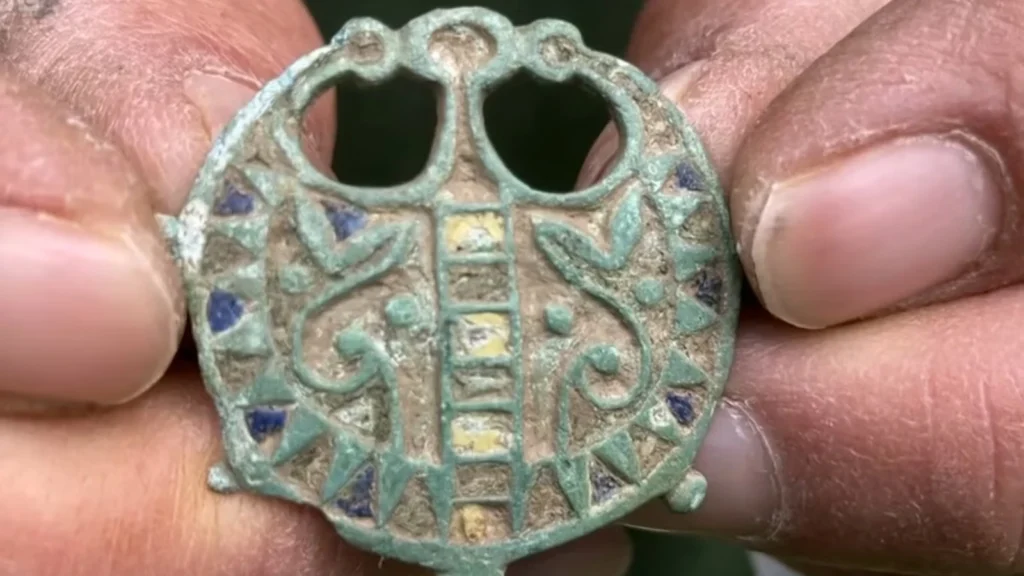
What looked like a child’s lost trinket turned out to be a rare Roman brooch nearly 2,000 years old, uncovered by metal detectorist Martin Williams in a ploughed field near Dorchester. The 54-year-old estate maintenance manager, who has been metal detecting for just four years, initially tossed the object into his bag of scrap before realizing its true significance.

Williams explained that at first glance the find resembled a child’s badge or toy car. “It was only when I cleaned it at home that I saw the bronze material and thought, ‘thank God I didn’t break it,’” he said. The brooch, identified as dating between 1,800 and 2,000 years ago, likely belonged to someone living during the period of Roman rule in Britain (43–410 AD).

Rare Find for Dorset

Local experts confirmed that the brooch is an “unusual item for Dorset” and not a common type nationally. Its discovery adds to the growing evidence of Roman presence in the region, even though no Roman road directly crosses the field. Williams believes an abandoned medieval church nearby may have been connected to the object’s history.

The site has yielded impressive finds before: 14 Bronze Age axe heads, now in the British Museum, as well as more than 30 Roman coins and two medieval posie rings, each valued at over £1,000. These discoveries highlight the archaeological richness of Dorset’s farmland, where centuries of activity lie buried just beneath the soil.


📣 Our WhatsApp channel is now LIVE! Stay up-to-date with the latest news and updates, just click here to follow us on WhatsApp and never miss a thing!!


The World of Roman Brooches

Brooches were not mere ornaments in Roman Britain. They served a functional role as clothing fasteners while also acting as displays of wealth, identity, and sometimes regional style. From simple utilitarian pins to elaborate decorative pieces, brooches are among the most frequently uncovered Roman artifacts across Europe.

The newly found brooch offers a glimpse into everyday life nearly two millennia ago, bridging the gap between personal fashion and broader cultural exchange in the Roman provinces. Its preservation is particularly lucky, considering Williams nearly discarded it among scrap metal.

Metal Detecting and the Law

In England, the hobby of metal detecting has surged in popularity in recent years, helped by the BBC comedy Detectorists, which inspired new enthusiasts across the country. Groups in Devon, Cornwall, and Dorset have even stopped taking new members due to demand.

Under the Treasure Act 1996, detectorists are legally required to report finds that may qualify as treasure—typically objects more than 300 years old and containing precious metals, or hoards of coins. If declared treasure, museums have the option to acquire the object, rewarding both finder and landowner. If not, items are usually returned.

Official reports show 1,377 treasure cases in 2022, a sharp rise compared to the previous year. These include remarkable discoveries such as the Chew Valley Hoard and a silver penny minted by Viking ruler King Guthrum, declared treasure in 2024 as the first known coin issued by a Viking king in Britain.

A Personal Passion for the Past

Williams, who uses a secondhand metal detector he bought for £600, says he spends much of his free time exploring local fields. Over just four years, he has filled “30 China chests” with artifacts, from medieval rings to ancient coins.

“I love the buzz of finding something untouched for hundreds, sometimes thousands of years, and then linking it together with history. It’s fascinating,” he explained. If the brooch is not acquired by a museum, he has even considered gifting it to the estate owners, who allow him to detect on their land.

For archaeologists and enthusiasts alike, the Dorset brooch serves as another reminder that Britain’s ancient past still lies hidden beneath its fields, waiting for a lucky eye and careful hand to bring it back into the light.

Cover Image Credit: BBC

Related Articles

4,500-Year-Old Idols Discovered at Tavşanlı Höyük in Western Anatolia

16 September 2025

16 September 2025

Archaeologists in Türkiye have uncovered a remarkable set of artifacts at Tavşanlı Höyük (Tavşanlı Mound), one of the largest Bronze...

A secret chamber has been found in the famous Gorham Cave Complex

29 September 2021

29 September 2021

A cave chamber sealed off by sand for some 40,000 years has been discovered in Vanguard Cave inside the Gorham’s...

Archaeologists in the Tangier Peninsula Discovered Three Ancient Cemeteries, Including a Stone Burial Dating to Around 4,000 Years Ago

17 May 2025

17 May 2025

A significant archaeological discovery in northern Morocco’s Tangier Peninsula, situated just south of the Strait of Gibraltar, has led to...

Remarkable Roman Villa Full of Strange Artifacts Discovered from a Bronze Age Site in England

3 April 2024

3 April 2024

Archaeologists have uncovered a “richly decorated” remarkable Roman villa complex during excavations at Brookside Meadows in Grove, a village in...

A Thousand-Year-Old Iron Age-old grave in Finland Is Ascribed to a Prominent Non-Binary Person

10 August 2021

10 August 2021

Archaeologists found a weapon grave in Finland’s Suontaka Vesitorninmäki in 1968. The remains discovered in the burial have been at...

The Error That Caused II.Ramses to Lose the Battle of Kadesh

5 February 2021

5 February 2021

The Battle of Kadesh between the Hittites and Egyptians in Anatolia, the two superpowers of the Bronze Age period, has...

New Study Finds, 4,000-Year-Old Toolkit Unearthed Near Stonehenge Was Used to Work Gold

16 December 2022

16 December 2022

Archaeologists from the Universities of Leicester and Southampton in the United Kingdom recently published a study claiming that enigmatic artifacts...

In Egypt, archaeologists have discovered a 4,500-year-old Sun temple.

16 November 2021

16 November 2021

Archaeologists discovered an ancient Sun temple in the Egyptian desert that dates back 4,500 years. The remains were discovered under...

The famous archaeologist says he will announce the discovery of the mummy of Queen Nefertiti, one of Egyptology’s main riddles, next month

14 September 2022

14 September 2022

On December 9, 2021, Egypt’s archaeological mission, headed by renowned Egyptologist and former Antiquities Minister Zahi Hawass, resumed its search...

Brick tombs dating from the Jin Dynasty have been unearthed in Shanxi Province

15 August 2021

15 August 2021

Archaeologists discovered two brick tombs at an old cemetery with 14 crypts in north China‘s Shanxi Province. The findings offer...

A unique tomb decorated with amber was discovered near Petrozavodsk

26 August 2021

26 August 2021

According to a press release from the Petrozavodsk State University a unique tomb was discovered on the western shore of...

Archaeologists have discovered the ruins of what may be one of the four lost Ancient Egyptian “Sun Temples”

31 July 2022

31 July 2022

A Polish and Italian archaeological mission, while conducting an excavation in the Abusir necropolis near Saqqara in Egypt, unearthed the...

A Roman sarcophagus containing two skeletons was found in Bath, England

29 June 2021

29 June 2021

Stone walls, a Roman sarcophagus, and a cremation burial have been unearthed in a renovation project at the Bathwick Roman...

Archaeologists Found Evidence of a Lost Temple in Chorazin Linked to Jesus’ Healing Miracles

12 August 2024

12 August 2024

Recent archaeological excavations in Israel may have unearthed the remains of a long-lost temple, believed to be the very site...

Unique work of Minoan art, the Pylos Combat Agate must be the David of the Prehistoric era

21 November 2021

21 November 2021

Found in a Greek tomb dating back 3,500 years, the artifact is so well designed that it looks as lively...