
10 November 2025 The Future is the Product of the Past

Farmer Found an Ice Age Cave Under His Field

A naturally formed cave was found near the town of Kraśnik in southeastern Poland, used by humans during the Ice Age. The cave was discovered by a farmer named Adam Bryczek.

Adam Bryczek was wandering through his land when he came across something that looked like a pit. However, it was originally a small opening on the ground, but gradually expanded with the passage of time, and finally collapsed.

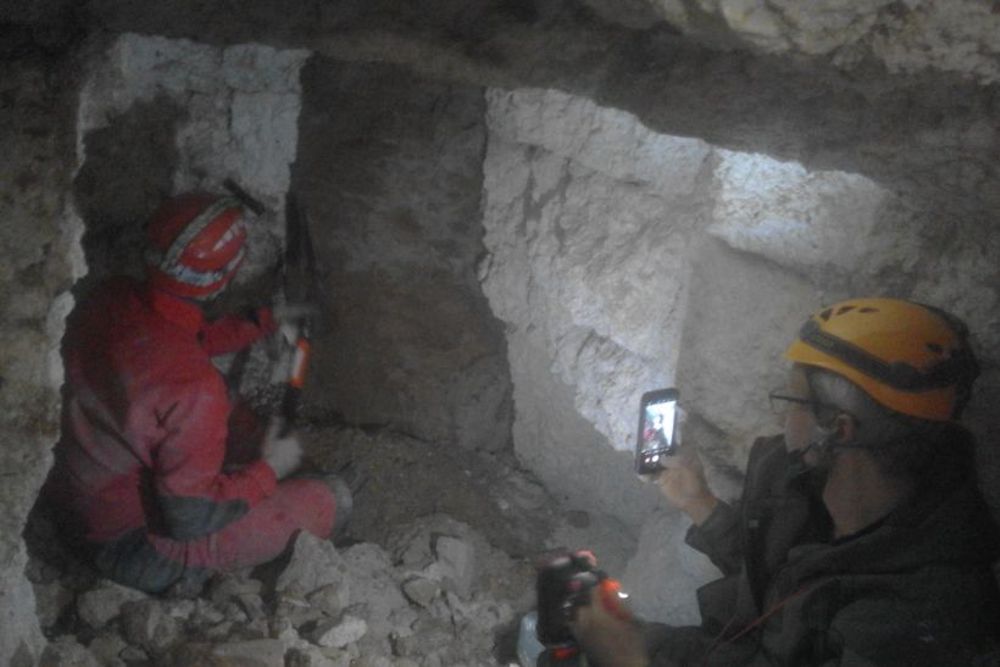
Bryczek was taken aback and found that the opening led to an underground cave about 10 meters underground. The cave was tens of square meters in size and could reach a maximum height of 140 cm-not enough for most adults to stand upright.

Adam Bryczek reported the cave to Dominik Szulc, guardian of the monuments in Kraśnik County in January. Later, the cave was visited by archaeologists from Lublin, the capital of the region.

The cave was formed as a result of the dissolution of the bedrock by groundwater. Such caves are called solutional caves.


📣 Our WhatsApp channel is now LIVE! Stay up-to-date with the latest news and updates, just click here to follow us on WhatsApp and never miss a thing!!


According to the news in The First News, Szulc:

“The cave undoubtedly dates back to the Pleistocene (2.58 million – 11,700 years ago), and more precisely, perhaps the so-called glaciations of the Nida or San (730,000-430,000 years ago),” he said.

He explained that during this period, the Scandinavian ice sheet covered the Lublin Heights, while the area was covered by thick snow. During the temporary increase in temperature, a large amount of flowing water dissolved the limestone and formed the walls, floor, and ceiling of the cave.

Although the cave was formed naturally, the researchers pointed out that humans have visited the cave, apparently extracting stones for construction. The walls of the cave show signs of mechanical work left by the tools.

In a post on Facebook, Szulc did not publish the cave’s exact location, warning that it could be dangerous.

He wrote: “It is not suitable for access to visitors, because it is too small and low, with a steep and dangerous entrance leading to it.”

Experts are now working on a way to secure the cave so that people can enter again to conduct scientific research.

Related Articles

Pharaonic Hieroglyphic Inscription of Ramses III Found in Southern Jordan

20 April 2025

20 April 2025

In a remarkable archaeological breakthrough, a hieroglyphic inscription bearing the royal cartouche of Pharaoh Ramses III (1186–1155 BC) has been...

Ancient Egyptian Kohl recipes more diversified than previously thought

28 April 2022

28 April 2022

Researchers analyzed the contents of 11 kohl containers from the Petrie Museum collection in London and have revealed that the...

A Batavian Cavalry Mask was found on the Battlefield of Roman Comrades

22 July 2022

22 July 2022

Archaeologists have discovered that a rusty corroded plate they found 4 years ago at an old battlefield in the city...

In China, 2700-Year-Old Face Cream Made from Moon Milk for Men was Found

14 February 2021

14 February 2021

At a Chinese excavation site with Chinese and German researchers, evidence of a 2,700-year-old male facial cream was found. In...

Divers Uncover Over 1,000 Spanish Coins Worth $1 Million from Florida’s 1715 ‘Treasure Fleet’ Shipwrecks

3 October 2025

3 October 2025

More than three centuries after one of the most devastating maritime disasters of the Americas, divers off Florida’s east coast...

Roman-Era Sarcophagus Discovered on Varna Beach one of Bulgaria’s Most Popular Tourist Destinations

26 July 2024

26 July 2024

An ancient sarcophagus from the Roman era was discovered by chance on the beach near the resort of Saints Constantine...

The place of Puduhepa’s hometown Lawazantiya will be illuminated with Tatarlı Höyük

9 November 2021

9 November 2021

Excavations at Tatarlı Höyük (mound) are trying to reach findings that will enable the determination of the location of Lawazantiya,...

Southeast Asia’s oldest stringed instrument may be a 2,000-year-old antler

21 February 2023

21 February 2023

Archaeologists unearth a 2,000-year-old stringed instrument made from deer antler in southern Vietnam. This unusual deer antler may be one...

Bronze Age Petroglyphs discovered in Kazakhstan

1 May 2024

1 May 2024

Volunteers in Kazakhstan have discovered new petroglyphs from the Bronze Age. The rock carvings were found by volunteers of the...

Early humans appreciated geometry and symmetry and were intentionally crafting spherical shapes 1.4 million years ago, according to a new study

7 September 2023

7 September 2023

An examination of 150 round, baseball-sized stones discovered at a site where early humans lived 1.4 million years ago shows...

Historic Leeds cemetery discovery unearths an ancient lead coffin belonging to a late Roman aristocratic woman

14 March 2023

14 March 2023

Archaeologists in northern Britain uncovered the skeletal remains of a late-Roman aristocratic woman inside a lead coffin, as well as...

Surprising Genetic Findings from Early Middle Ages Burial Sites in Austria

22 January 2025

22 January 2025

In a groundbreaking archeogenetic study, researchers from the Max Planck Institute for Evolutionary Anthropology, in collaboration with an international team,...

Neanderthals too may have Developed a System of Numerical Notation

2 June 2021

2 June 2021

People developed numbers tens of thousands of years ago, according to archeological findings. Scholars are now investigating the first comprehensive...

Archaeologists unearth human spines threaded onto reed posts in Peru

5 February 2022

5 February 2022

Archaeologists have found almost 192 examples of human vertebrae threaded onto reed posts 500 years ago in the Chincha Valley...

2,700-year-old Military Roman Port Found in Parion, Türkiye

18 July 2024

18 July 2024

Underwater studies in Parion, a 2,700-year-old port city from the Roman Empire in Kemer village of Biga district of Çanakkale...