
19 January 2026 The Future is the Product of the Past

4,500-Year-Old Dog Teeth-Adorned Bags Found in Germany May Have Been Elite Baby Carriers

Archaeological excavations near Krauschwitz reveal rare decorated leather bags buried with women and infants—shining new light on Neolithic burial customs along the SuedOstLink route.

A groundbreaking archaeological discovery near the village of Krauschwitz in Saxony-Anhalt, Germany, has revealed elaborately decorated prehistoric bags adorned with dog teeth, believed to have been used by elite women—possibly even as baby carriers.

The findings, uncovered during preparatory excavations for the SuedOstLink high-voltage powerline project, offer unprecedented insight into the funerary practices and social hierarchy of the Corded Ware Culture (ca. 2800–2200 BCE).

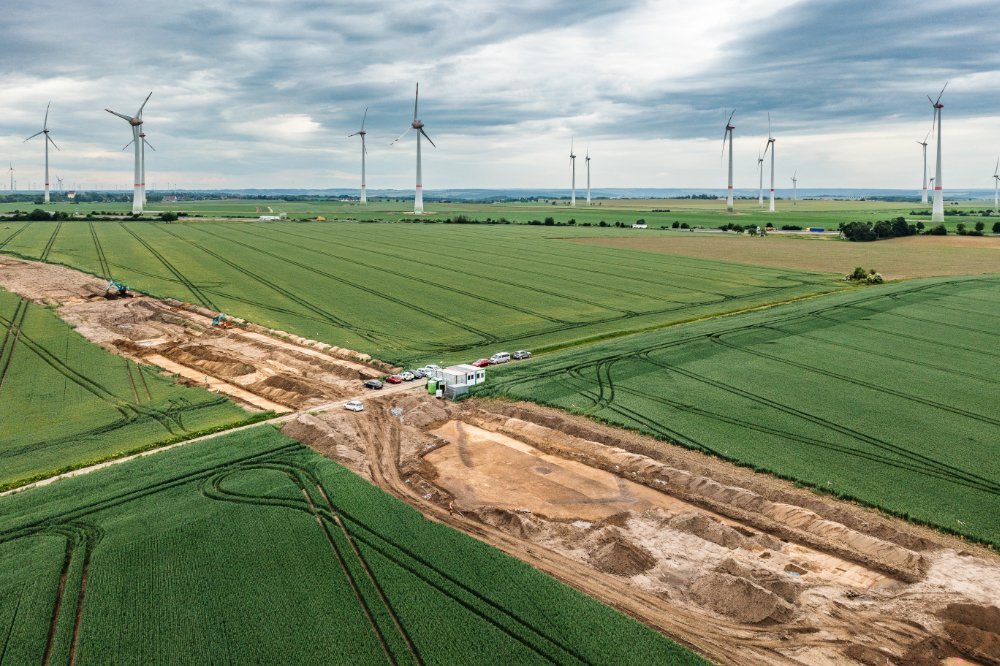
Led by the State Office for Heritage Management and Archaeology of Saxony-Anhalt, and coordinated with grid operator 50Hertz, the ongoing archaeological survey along the 170-kilometer SuedOstLink route has brought to light numerous burial sites. But none are as compelling as the richly ornamented bags found in several graves of young women.

Decorated Bags Made from Leather or Textile and Adorned with Dog Teeth

The bags—whose organic material has long since decomposed—are evidenced by the hundreds of carefully drilled dog teeth that once adorned them. Arranged in overlapping rows like roof shingles, the teeth were likely sewn onto the bag’s front surface. Each bag, approximately 30 centimeters wide and 20 centimeters tall, may have required up to 350 teeth, predominantly from a medium-sized dog breed resembling today’s Small Münsterländer.


📣 Our WhatsApp channel is now LIVE! Stay up-to-date with the latest news and updates, just click here to follow us on WhatsApp and never miss a thing!!


These accessories weren’t mere decoration. Researchers believe they symbolized both status and identity within the Corded Ware society. The extraordinary craftsmanship and rarity suggest the bags were highly personal and non-inheritable items reserved for women of elite social standing. Indeed, similar finds were present in about 20% of female burials at Krauschwitz and the nearby site of Nessa.
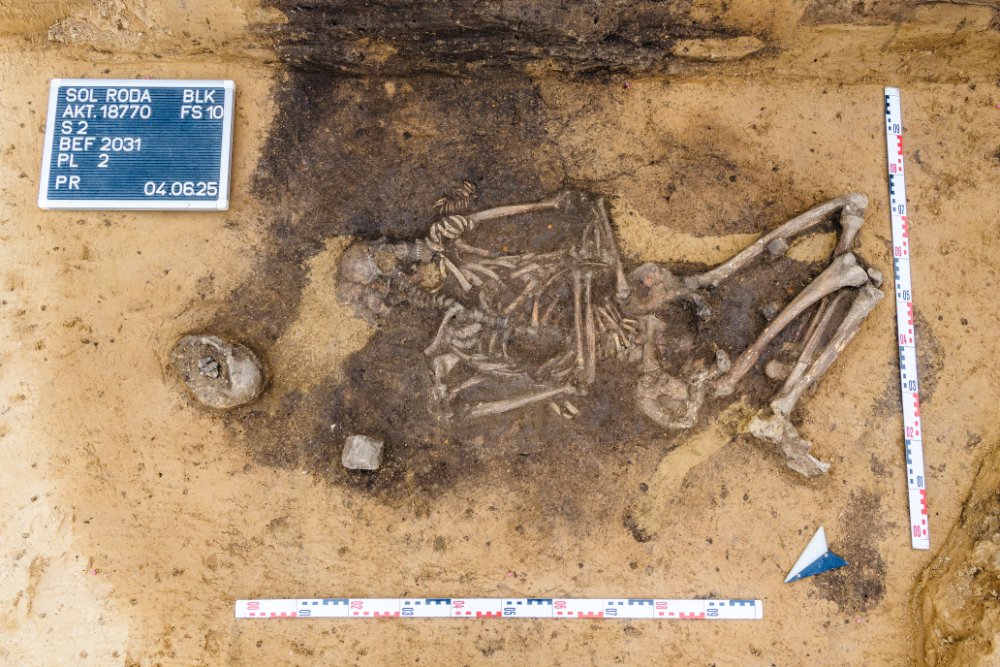
A woman´s grave of the Corded Ware Culture with bag decorated with numerous animal teeth found at Krauschwitz. Credit: Klaus Bentele / State Office for Heritage Management and Archaeology Saxony-Anhalt

Possible Use as Baby Carriers

What truly sets these finds apart, however, is their association with infant remains. In several cases, tiny bones—presumably of newborns or fetuses—were found inside or near the bags. This discovery has led archaeologists to hypothesize that the tooth-adorned bags may have functioned as a form of baby carrier or cradle bag.

The position of the bags in the grave, typically in front of the body, supports the theory that they were worn on the front torso during life. Accompanying textiles, including a sash or scarf embroidered with additional teeth—particularly molars—may have served to shield the infant’s limbs and head. These thoughtful details suggest that the bags were not only ceremonial but also functional, blending maternal care with social symbolism.

In one particularly poignant case, a pregnant woman buried with such a bag may have died during childbirth, with the bag holding the remains of her unborn child. This connection reinforces the idea that these were not generic grave goods but intimate personal items tied to motherhood and identity.

Wider Context: A Sacred Landscape Rich in History

The finds are part of a broader archaeological investigation into the Neolithic and Early Bronze Age history of the area. Alongside the Corded Ware graves, researchers have also uncovered older burial mounds from the Baalberg Culture (ca. 4000 BCE), including trapezoidal wooden structures once covered with loess to form prominent mounds.

This site, located along a ridge north of modern-day Krauschwitz, served as a sacred and strategic location for thousands of years. The reuse of burial grounds by later cultures illustrates a powerful continuity of spiritual significance attached to the land.
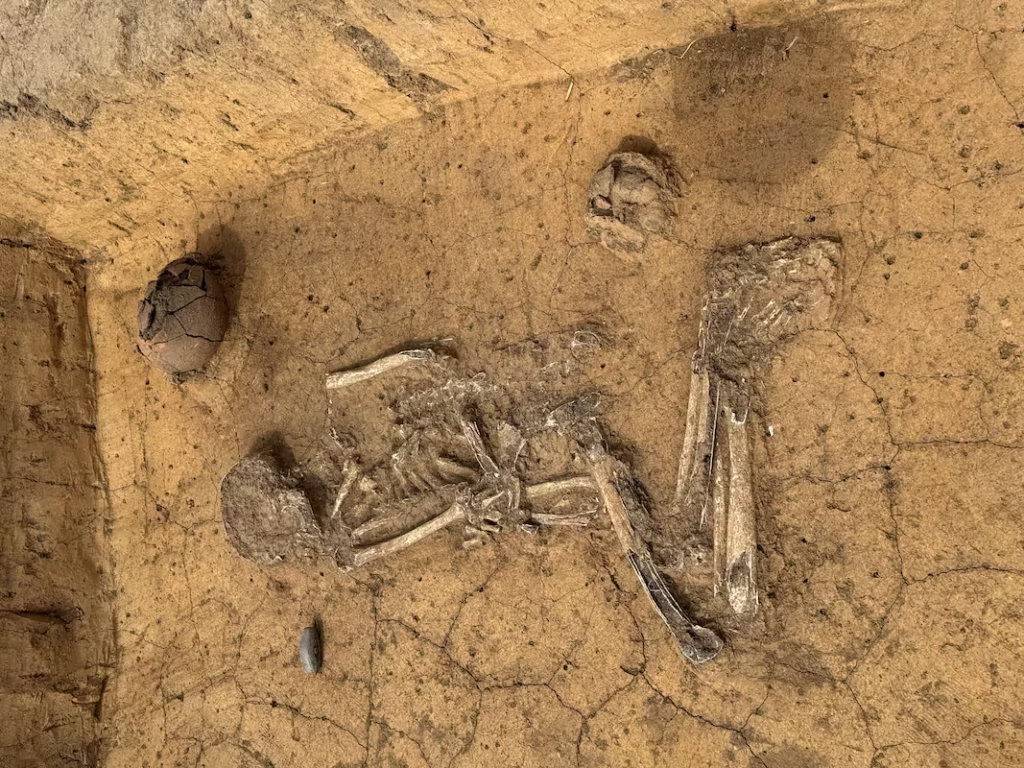
A man’s grave from the Corded Ware Culture, with grave goods including a stone axe and a pottery vessel. Credit: Oliver Dietrich / State Office for Heritage Management and Archaeology Saxony-Anhalt

Preservation and Next Steps

The decorated bags and associated graves are being carefully removed in blocks and transported to conservation labs for detailed analysis. A team of 20 archaeologists is currently working on-site, aiming to complete this phase of the excavation by the end of July. The findings will be thoroughly studied and likely exhibited in future museum displays.

Despite the complexity of the work, coordination between archaeologists and 50Hertz has ensured that both cultural heritage and infrastructure progress go hand in hand. As the SuedOstLink moves toward construction, these discoveries stand as a testament to the deep human history buried beneath modern development.

State Office for Heritage Management and Archaeology of Saxony-Anhalt / State Museum of Prehistory

Related Articles

Archaeologists may have uncovered a 13th-century castle in Shropshire

7 August 2021

7 August 2021

Archaeologists have been working on a mound of land in Wem, Shropshire, that belongs to Soulton Hall, Elizabethan mansion and...

Gate sanctuary discovered during the excavation of Archanes palace in Crete, belonging to the oldest civilisation in Europe

24 October 2024

24 October 2024

Recent excavations at the Archanes Minoan palace in Crete, belonging to the oldest civilisation in Europe, have revealed an important...

A previously unknown Roman fort discovered in Pembrokeshire in Wales

8 August 2024

8 August 2024

A previously unknown Roman fort has been discovered in north Pembrokeshire. The site, which has excited archaeologists, had been hidden...

King Stephen 12th Century rare penny hoard found near Wymondham

21 November 2023

21 November 2023

An unnamed metal detectorist recently discovered a scarce collection of 12th-century silver pennies near the village of Wymondham in the...

500-year-old board game discovered carved into a stone slab in a Polish castle

12 September 2023

12 September 2023

A board game carved into stone was discovered by archaeologists investigating the castle at Ćmielów in the Świętokrzyskie Voivodeship in...

Theater of Perinthos Ancient City to be unearthed

9 August 2021

9 August 2021

The theater area in the Ancient City of Perinthos, whose history dates back to 600 BC, will be unearthed during...

A unique tomb decorated with amber was discovered near Petrozavodsk

26 August 2021

26 August 2021

According to a press release from the Petrozavodsk State University a unique tomb was discovered on the western shore of...

4,000-Year-Old Lion Jaw Bone Unearthed in Kültepe

14 September 2021

14 September 2021

Excavations continue in Kültepe, the starting point of Anatolian written history. During the excavations, a 4,000-year-old lion jawbone was unearthed....

134 ancient settlements discovered north of Hadrian’s Wall

26 May 2022

26 May 2022

134 ancient settlements have been found during a survey of the region north of Hadrian’s Wall in the United Kingdom....

Scotland’s Earliest Known Coin Minted in Edinburgh Discovered by Metal Detectorist

29 December 2025

29 December 2025

A groundbreaking archaeological discovery has revealed the earliest known coin minted in Scotland, shedding new light on the country’s medieval...

The Lost Troy of Roman Britain: How a Chance Discovery in Rutland Unlocked an Ancient Story Forgotten for 1,500 Years

7 December 2025

7 December 2025

A lost Aeschylean version of the Trojan War emerges from the Rutland mosaic, revealing Roman Britain’s surprising cultural ties to...

Early Female Emperors in Japan “Empress Kōken”

2 July 2021

2 July 2021

Born into the aristocratic Fujiwara clan, this extraordinary woman first ascended to the throne as Empress Kōken and became the...

A Roman statue of the sea god Triton discovered near A2, London Road

13 September 2023

13 September 2023

Archaeologists have uncovered a Roman Statue of Triton during excavations in preparation for a housing development in Kent, England. Archaeologists...

Archaeologists discover traces of ancient Jalula, the city that witnessed the famous battle of the same name 1386 years ago

23 November 2023

23 November 2023

The  Iraqi State Board of Antiquities and Heritage (SBAH) has announced the discovery of the boundaries and various structures of...

Archaeologists have found a mysterious prehistoric site, believed to be a 6,500-year-old Stone Age cemetery, near the Arctic Circle

4 December 2023

4 December 2023

Archaeologists have found a mysterious prehistoric site believed to be a 6,500-year-old Stone Age cemetery just 50 miles (80 kilometers)...