
8 December 2025 The Future is the Product of the Past

Ancient Silla Commander’s Rare Armor and Gilt-Bronze Crown Discovered in Gyeongju

“This is a rare moment, showing the public a complete set of a Silla commander’s armor for both man and horse.” With these words, Korea Heritage Service (KHS) Administrator Huh Min captured the magnitude of one of the most remarkable archaeological discoveries in recent Korean history.

In the heart of Gyeongju, the ancient capital of the Silla Kingdom (57 BCE–935 CE), archaeologists have unearthed the remains of a military commander, alongside his full set of armor, horse gear, and fragments of a gilt-bronze crown. The discovery, made beneath the Hwangnam-dong No. 120 mound, marks a groundbreaking moment in the study of early Silla society — offering an unprecedented look at the kingdom’s military, artistry, and burial customs.

Unearthing a Silla Commander’s Tomb

Led by the Korea Heritage Service and the city of Gyeongju, the excavation revealed a wooden-chamber tomb beneath a large stone-covered mound, dating back to the 4th or 5th century CE. Inside the chamber lay the skeleton of a man estimated to have been in his early 30s at death — identified as a Silla commander based on the elite artifacts surrounding him.

The discovery also included the remains of another individual — likely an attendant or chamberlain — buried alongside the commander in what researchers describe as a retainer sacrifice, a burial custom symbolizing loyalty and status during Silla’s formative years.

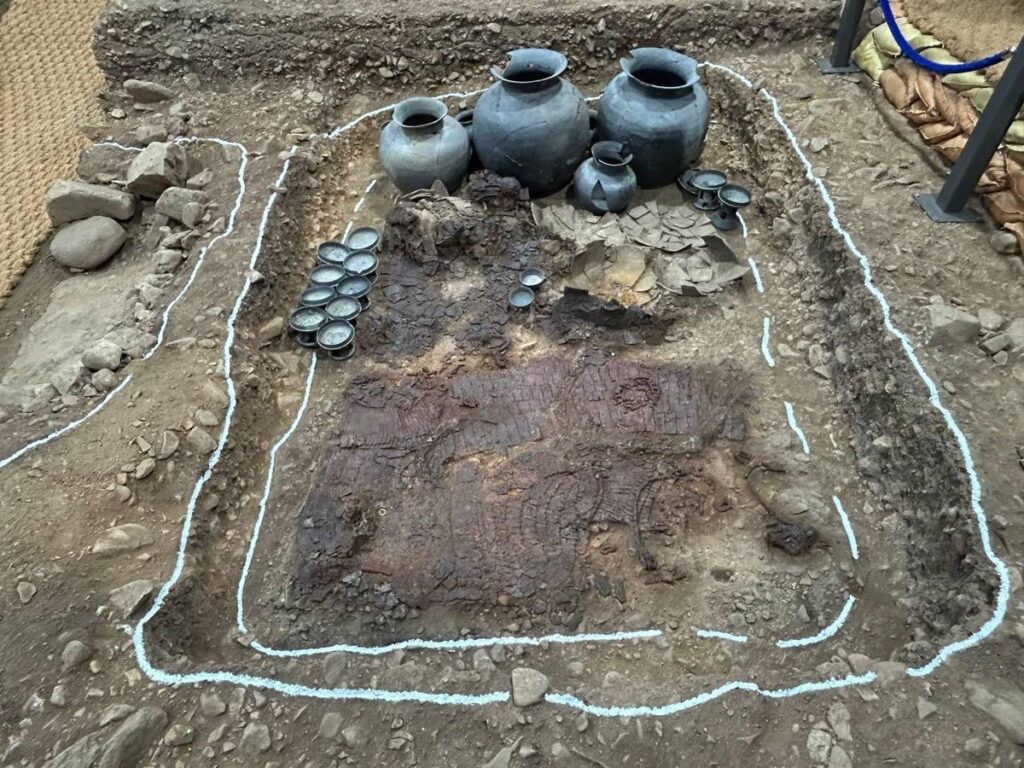
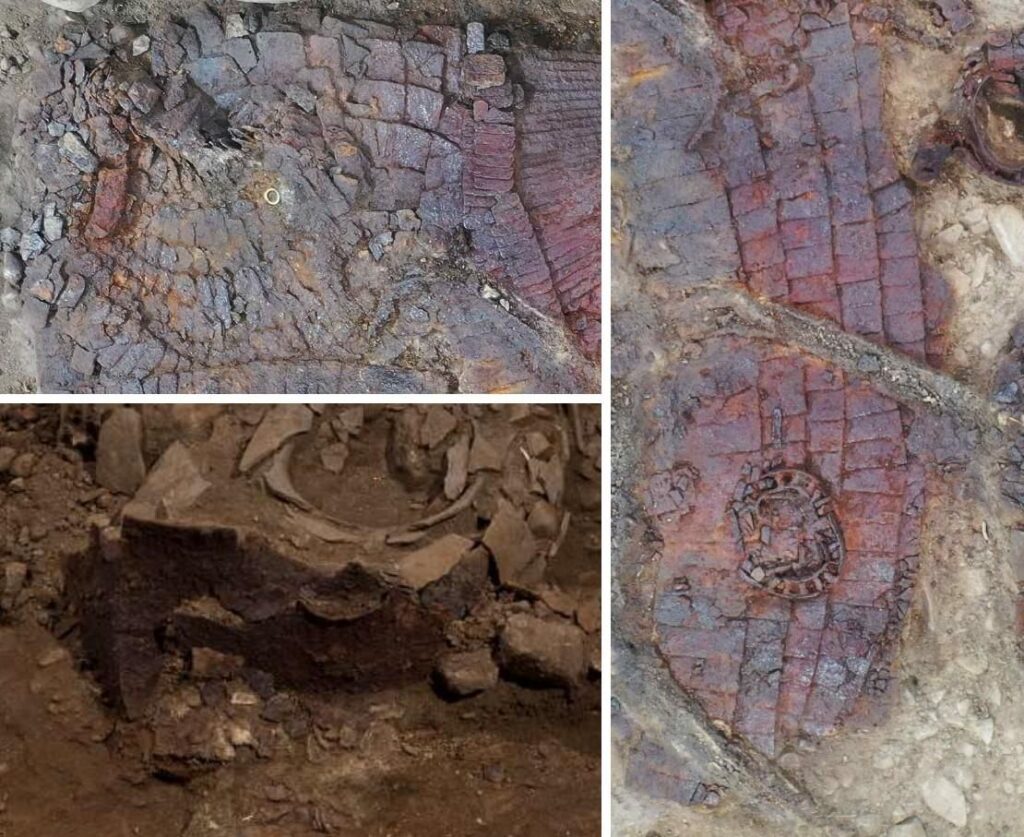
Archaeologists were astonished to find armor sets for both the man and his horse, marking only the second time such a complete set has ever been found from the Silla era. The find provides tangible evidence of Silla’s heavily armored cavalry, known in historical records as the backbone of the kingdom’s expanding military power.


📣 Our WhatsApp channel is now LIVE! Stay up-to-date with the latest news and updates, just click here to follow us on WhatsApp and never miss a thing!!


Armor and helmet sets for both a human and a horse were discovered in remarkable condition — only the second case of horse armor ever found in a Silla tomb, following the Joksaem C10 mound discovery in Gyeongju, North Gyeongsang Province. Credit: Yonhap

A Window into Silla’s Warrior Elite

The commander’s sword, armor, and helmet were preserved in exceptional condition. Experts from the Silla Cultural Heritage Research Institute noted that parts of the armor were made from leather, differing from the iron-dominated designs found in previous discoveries. This innovation suggests attempts to make armor lighter and more mobile — a sign of evolving military tactics in 5th-century Korea.

Researchers say the horse armor, in particular, offers new insight into Silla’s military organization. The craftsmanship and scale of the find point to an elite cavalry unit, likely serving under royal command. “Such discoveries reshape our understanding of how Silla’s warrior class operated — these were not just soldiers but symbols of royal authority,” said Lee Min-hyung, a leading researcher at the site.

Gilt-Bronze Crown Fragments: Signs of Royal Connection

Among the most striking artifacts were fragments of a gilt-bronze crown, believed to be among the oldest of its kind from the Silla period. The crown’s decorative motifs bear resemblance to those of Goguryeo (37 BCE–668 CE), suggesting active cultural exchange between the two powerful kingdoms.

“This crown fragment could shift our understanding of early Silla metalwork and its relationship with neighboring states,” said Kim Hun-suk of the Gyeongju National Research Institute of Cultural Heritage. “We’re seeing artistic and political connections reflected in the very materials of the era.”

Historical Significance of the Silla Kingdom

The Silla Kingdom, one of the Three Kingdoms of Korea, ruled the southeastern Korean Peninsula for nearly a millennium. Founded in 57 BCE, Silla evolved from a tribal confederation into a centralized monarchy that would ultimately unify the Korean Peninsula in 668 CE.

Silla’s capital, Gyeongju, became a hub of art, science, and religion — often referred to as the “Museum Without Walls” for its wealth of ancient tombs, pagodas, and temples. The newly discovered commander’s tomb reinforces Gyeongju’s role as a window into early Korean civilization, illuminating how power, culture, and belief intertwined in the formation of a sophisticated state.
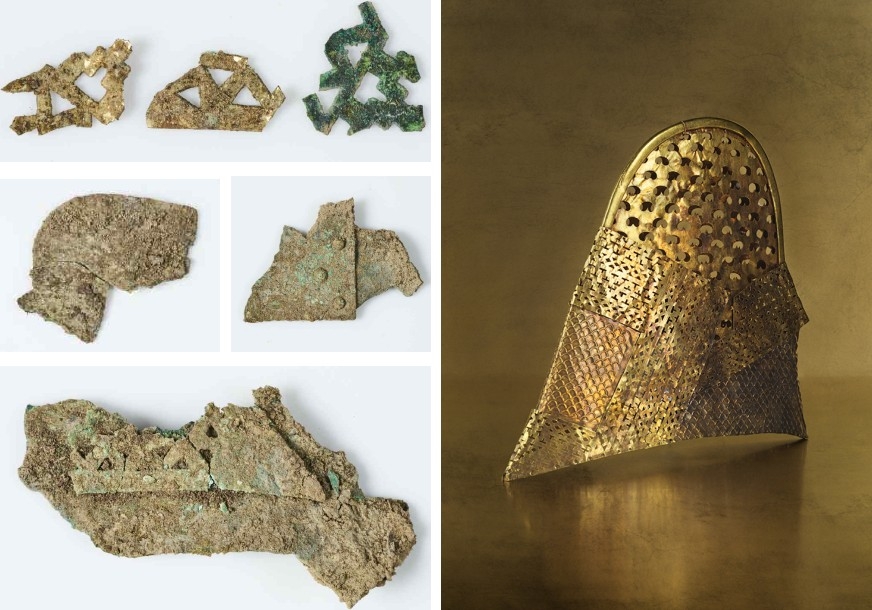
Fragments of a gilt-bronze crown (left), dating to the 4th–5th centuries, were unearthed in an outer coffin tomb beneath a royal burial mound in Hwangnam-dong, Gyeongju. A reconstruction (right) illustrates how the crown may have looked when complete. Credit: Korea Heritage Service

Connecting Past and Present

The timing of the discovery aligns with the 2025 APEC Summit, which Gyeongju will host from October 31 to November 1. To mark the occasion, the excavation site and its artifacts will be open to the public from October 27 to November 1, allowing visitors to witness this rare historical moment firsthand.

Officials hope the exhibit will foster greater international appreciation for Korea’s cultural heritage. “As we open these treasures to the world, we are not just displaying artifacts — we are sharing a story of identity, craftsmanship, and endurance,” said Administrator Huh Min.

A Rare Moment for History and Heritage

This extraordinary find not only deepens understanding of Silla’s political and military structures but also bridges ancient Korea with the modern world. The preserved armor, the intricate gilt-bronze crown, and even the faint traces of human life beneath the soil collectively offer a vivid glimpse into a bygone era of kings, warriors, and artisans.

Indeed, as Huh Min emphasized, “This is a rare moment, showing the public a complete set of a commander’s armor for both man and horse.” More than an archaeological milestone, it is a living testament to the enduring legacy of the Silla Kingdom — a civilization whose echoes continue to shape Korea’s cultural identity today.

Korea Heritage Service

Cover Image Credit: Korea Heritage Service

Related Articles

A Medieval ‘Vampire’ Grave Found in Croatia

1 February 2025

1 February 2025

Research at the Rašaška (or Račeša) site, located in the eastern part of Croatia, revealed a grave with an unusual...

Manot Cave yielded evidence for ritualistic gathering 35,000 years ago, the earliest on the Asian continent

13 January 2025

13 January 2025

Archaeological research at the Manot Cave in what is now the Galilee in northern Israel has uncovered evidence of ritualistic...

Researchers Examine 4,000 Bricks to Solve the Secrets of an Ancient Roman Metropolis of Trier

12 April 2025

12 April 2025

Trier, once a significant economic and political center in the northern provinces of the Roman Empire, is set to be...

Ancient Tombs and 2-Meter Sarcophagus with Hieroglyphics Unearthed Near Aga Khan Mausoleum in Aswan

11 July 2025

11 July 2025

A joint Egyptian-Italian archaeological team has unearthed a significant collection of ancient rock-cut tombs near the Aga Khan Mausoleum on...

Extraordinary discovery for the Western Baltic Sea region: a 400-year-old shipwreck Found at Bottom of German River

3 August 2022

3 August 2022

During a routine measurement at Trave, near Lübeck, in the northern part of Germany,  Kiel-Holtenau Waterways and Shipping Authority (Wasserstraßen-...

The longest inscription in Saudi Arabia turned out to belong to the last king of Babylon

25 July 2021

25 July 2021

The Saudi Commission for Tourism and National Heritage has announced the discovery of a 2,550-year-old inscription etched on basalt stone...

Ancient Hittite Bronze Helmet Unearthed: A Rare Glimpse into the Warrior Culture of a Forgotten Empire

5 June 2025

5 June 2025

3,300-Year-Old War Helmet Reveals the Power, Beliefs, and Craftsmanship of the Hittite Civilization A rare 3,300-year-old bronze helmet discovered in...

Experts believe the 7,000-year-old circular stone structures were once houses, complete with doorways and roofs in Saudi Arabia

16 July 2024

16 July 2024

Archaeologists have excavated eight ancient “standing stone circles” in Saudi Arabia that they say were used as houses. Eight of...

The first Bull Geoglyph discovered in central Asia

29 September 2021

29 September 2021

Archaeologists from the Russian Academy of Sciences’ Institute of History of Material Culture (IIMK RAS) and LLC Krasnoyarsk Geoarchaeology discovered...

Isles of Scilly Iron Age warrior buried with a mirror and sword was probably a woman

27 July 2023

27 July 2023

Archaeologists conducted a DNA analysis of the tooth enamel of a person who died more than two millennia ago on...

1,600-year-old Hunnic double burial found in Poland

15 June 2024

15 June 2024

In 2018, archaeologists uncovered a 1,600-year-old double burial in the village of Czulice near Krakow, Poland, containing the remains of...

The Amazon rainforest was once home to ancient cities – A vast network of 2,500-year-old garden cities

12 January 2024

12 January 2024

Aerial surveys have revealed the largest 2,500-year-old ancient cities in the Amazon, hidden for thousands of years by lush vegetation...

A cave complex with hieroglyphs and Varangian symbols discovered in center of Ukraine

19 November 2022

19 November 2022

An ancient cave complex thought to date from Kievan Rus’ has been discovered in central Kyiv at Voznesensky Uzvoz. Dmytro...

Archaeologists reveal 4,000-year-old rock-cut tomb, artifacts in Saqqara

8 January 2024

8 January 2024

A team of Egyptian and Japanese archaeologists has unveiled a rock-cut tomb believed to be more than 4,000 years old...

Iznik Archaeology Museum reveals 2,500-year-old love letter

16 January 2023

16 January 2023

İznik is an ancient habitation that hosts various civilizations due to its fertile lands, trade routes, and many other reasons....