
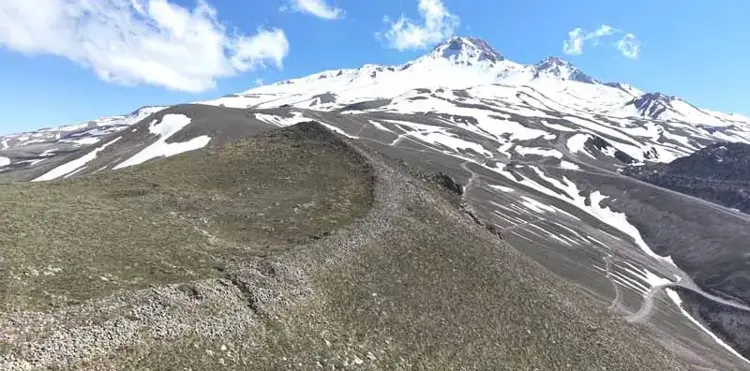
Snow melting on Lifos Mountain in central Türkiye has exposed the outlines of a vast ancient complex, revealing walls, settlement traces, and water structures on a high volcanic peak overlooking Kayseri and Mount Erciyes.
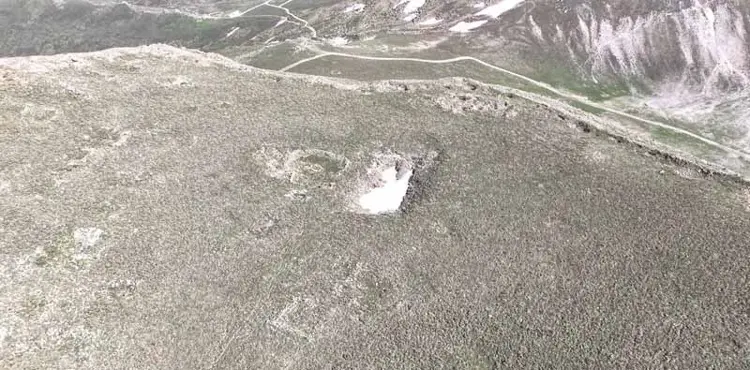
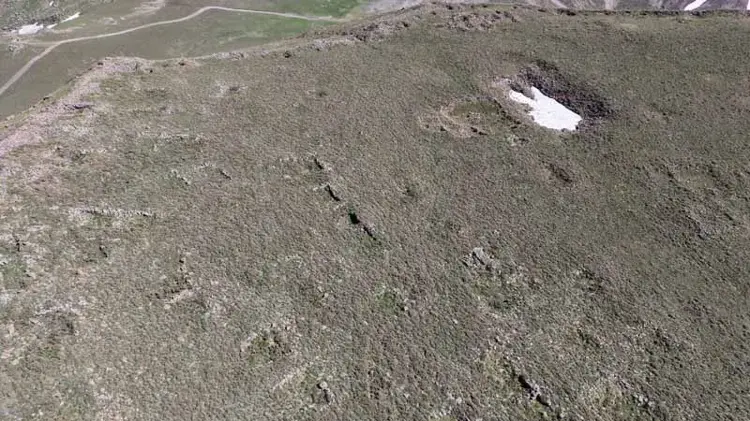
The remains lie near the summit of Lifos Mountain, a 2,509-meter peak north of Mount Erciyes, within the borders of Hacılar district in Kayseri province. Drone footage taken after the seasonal snowmelt shows a large fortified area enclosing roughly 74,300 square meters. Inside the walled zone are traces of buildings, cisterns, and possible residential spaces.
Local historian and author Halit Erkiletlioğlu has described the site as one of Kayseri’s most mysterious archaeological places. He argues that the complex may have functioned as a pagan sanctuary or “temple city,” possibly connected with the cult of Zeus. According to his interpretation, worshippers may have climbed to the mountain settlement as part of a pilgrimage tradition, seeking purification and ritual contact with the divine.
The claim has not yet been confirmed by systematic excavation. Still, the visible remains point to a site of unusual scale and ambition for such a high-altitude location.
A fortified complex above Kayseri
The structure is not a simple hilltop ruin. Erkiletlioğlu says the perimeter wall runs for about one kilometer and may originally have reached three to four meters in height. The wall was built without mortar and appears to have enclosed the summit plateau in a planned defensive system.
Earlier local descriptions of Lifos Mountain also refer to a crater-like summit with walls, towers, cisterns, stone dwellings and arched tomb structures. The crater itself is described as roughly 500 meters north to south and 300 meters east to west, with towers placed at intervals of about 66 meters along the fortification line.
That detail matters. A site of this size would have required labor, planning, and a reason strong enough to justify construction at more than 2,500 meters above sea level. The presence of cisterns also suggests that people did not merely pass through the mountain. Water storage points to repeated, perhaps seasonal, occupation.
Sanctuary, fortress or both?
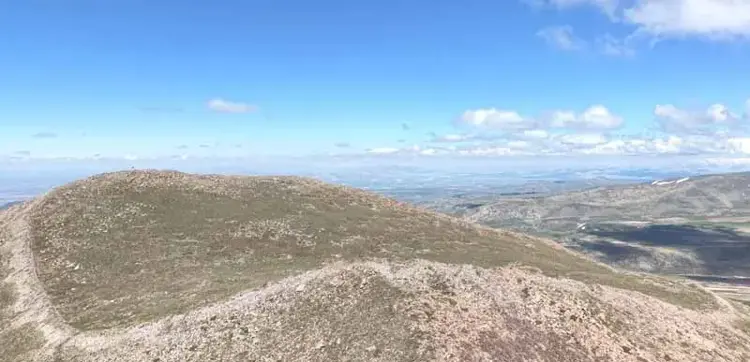
The interpretation of Lifos as a sanctuary remains open. Its high position, enclosed layout, and association with Mount Erciyes make the idea plausible, but not proven. The same features may also fit a fortified lookout, especially because Lifos controls the route toward Tekir Plateau, one of the important passages on the Erciyes massif.
In antiquity, religious and strategic functions were often not separate. A mountain sanctuary could also guard a route. A fortified settlement could also shelter ritual activity. Lifos may have combined both roles, using the natural authority of the volcanic landscape while controlling movement between the Kayseri plain and the highlands.
The site’s exposed position supports this dual reading. Its northern side is steep and difficult to access, while the southern approach is more manageable through paths. From the summit, the view extends over Kayseri and the surrounding volcanic terrain. That visibility would have carried both practical and symbolic power.
Erciyes as a sacred mountain
Mount Erciyes, ancient Argaeus or Argaios, was one of the defining landmarks of ancient Cappadocia. Rising to 3,917 meters, the dormant volcano dominates the Kayseri plain and appears frequently in the region’s ancient coinage. In the Roman period, coins from Caesarea in Cappadocia often depicted the mountain, sometimes with temple-like forms on or near its summit.
This makes the Lifos remains more than an isolated mountain ruin. They belong to a wider cultural landscape in which Erciyes was not only a geographic marker, but also a symbol of power, identity, and sacred height.
Ancient communities often chose elevated places for worship because height created a physical and visual link with the divine. On Lifos, that idea would have been especially strong. The peak stands close to Erciyes, facing the great volcanic mass that shaped the region’s economy, routes, and imagination.
A region shaped by ancient settlements
Kayseri’s archaeological importance reaches far beyond Lifos. About 20 kilometers northeast of the modern city lies Kültepe-Kanesh, one of the most important Bronze Age sites in Anatolia. It was the capital of the ancient Kingdom of Kanesh and the center of the Assyrian trade colony network in the early second millennium BC.
Kültepe has yielded tens of thousands of cuneiform tablets, including some of the earliest written documents from Anatolia. These records show that the Kayseri plain was already part of a complex commercial world linking Anatolia, Syria, and Mesopotamia more than 4,000 years ago.
That background gives Lifos additional interest. The mountain complex cannot yet be dated securely without excavation, but its location places it within a region where settlement, trade, religion and political authority overlapped for millennia. From Bronze Age Kanesh to Roman Caesarea, Kayseri was never a peripheral landscape. It was a crossroads.
Urgent need for archaeological protection
The most immediate concern is preservation. Erkiletlioğlu warns that the ruins have been damaged by treasure hunters and says the area should be protected before more evidence is lost. Visible walls, cisterns and building foundations can reveal much, but only if they are documented scientifically.
A controlled archaeological survey could establish the site’s chronology, construction phases, and function. Excavation may clarify whether Lifos was primarily a sanctuary, a fortified settlement, a mountain refuge, a pilgrimage center or a combination of these roles.
For now, the snowmelt has done what archaeology has not yet fully done: it has made Lifos visible again. Above Kayseri, on a volcanic peak facing Erciyes, the remains of a large walled complex are asking a question that can no longer be ignored.
Was Lifos Mountain one of ancient Cappadocia’s forgotten sacred places?
Cover Image Credit: DHA
