
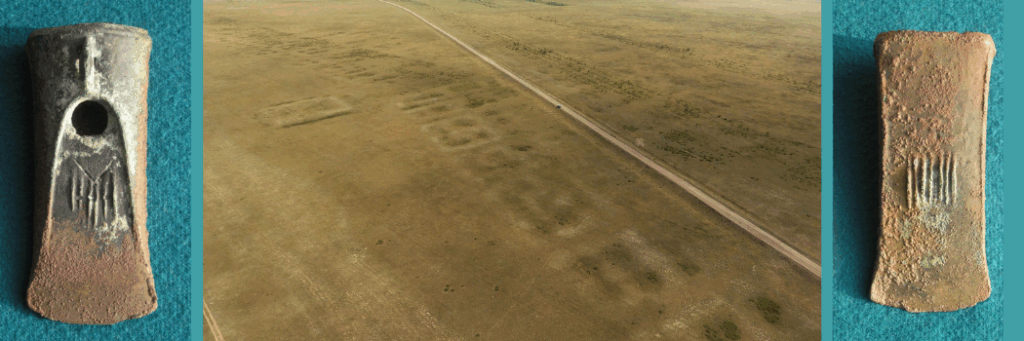
In a discovery poised to reshape our understanding of early urbanism in Central Asia, an international team of archaeologists has uncovered the remains of a vast Bronze Age settlement on the Kazakh Steppe. The newly investigated site—known as Semiyarka—is now recognized as one of the largest and most sophisticated settlements of its time, offering the first clear evidence of large-scale tin-bronze production in the Eurasian steppe more than 3,500 years ago.
Located on a dramatic promontory above the Irtysh River in northeastern Kazakhstan, Semiyarka spans an astonishing 140 hectares, making it the largest known settlement of its kind in the region. Long considered an area dominated by mobile pastoral societies, the steppe has rarely produced evidence of permanent, planned settlements from this era. The findings at Semiyarka now challenge those assumptions and place the region at the center of an advanced Bronze Age metallurgical network.
The project, led by researchers from Durham University, University College London (UCL), and Toraighyrov University, represents the first comprehensive study of Semiyarka since its initial identification in the early 2000s. Their results appear in Antiquity Project Gallery and in a recent detailed research paper that further explores the site’s architectural, cultural, and technological significance.
A Planned Bronze Age Settlement Hidden in the Steppe
What makes Semiyarka truly extraordinary is its unexpected level of planning. Archaeological teams uncovered long rows of rectangular earthen mounds—once the foundations of multi-room buildings—revealing an organized urban layout that starkly contrasts with the widely held assumption that steppe societies of this period were largely nomadic.
At the center of the settlement stands a significantly larger building that may have functioned as a communal or ceremonial structure, hinting at complex social organization.
Professor Dan Lawrence of Durham University noted the significance of the discovery: “The scale and structure of Semiyarka are unlike anything else we’ve seen in the steppe zone. The rectilinear compounds and the potentially monumental building show that Bronze Age communities here were developing sophisticated, planned settlements similar to those of their contemporaries in more traditionally ‘urban’ parts of the ancient world.”
The site’s name, Semiyarka, meaning “Seven Ravines,” reflects the dramatic landscape of valleys it overlooks. Crucially, its strategic position near rich copper and tin sources in the Altai Mountains would have placed it at the heart of regional metal production and trade networks.
Evidence of an Industrial-Scale Tin-Bronze Economy
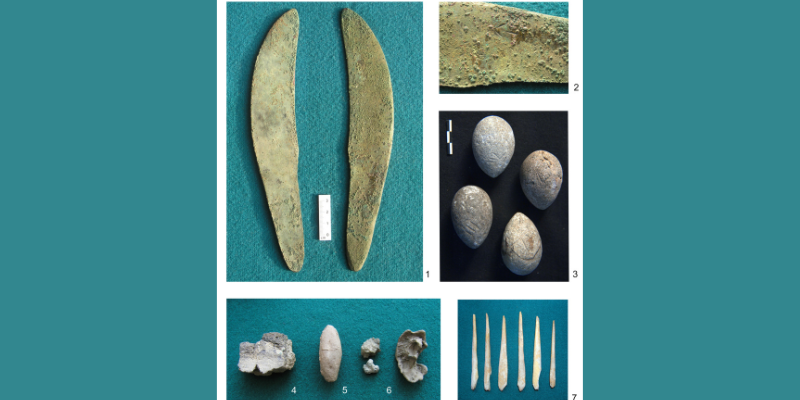
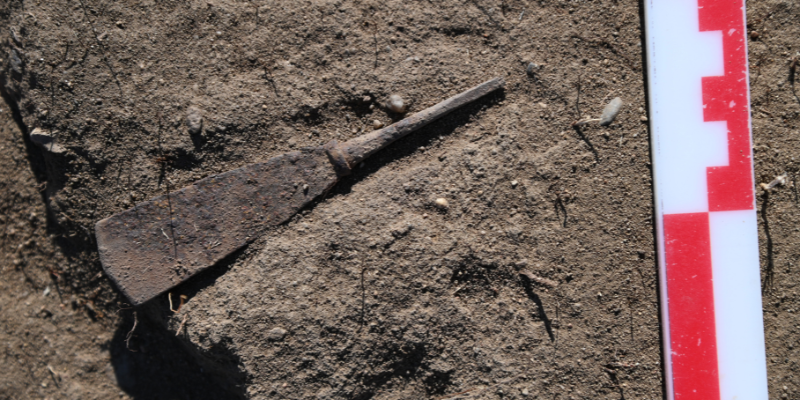
Perhaps the most remarkable finding is the identification of a dedicated industrial zone on the southeastern edge of the settlement. Here, archaeologists uncovered a dense concentration of slag, crucibles, ore fragments, and bronze artifacts—the strongest evidence yet of extensive tin-bronze production in the Eurasian steppe.
SEM analysis of 35 metallurgical samples from the site confirms that residents produced both copper and high-tin bronze, with alloys reaching up to 12 percent tin. This level of metallurgical sophistication suggests a controlled, centralised production system rather than small-scale household crafting. Many of the ores correspond to the copper and tin deposits of East Kazakhstan’s Altai region, supporting the theory that Semiyarka served as a major hub in long-distance resource networks.
Dr Miljana Radivojević of UCL emphasised the importance of this technological breakthrough: “This is one of the most remarkable archaeological discoveries in this region for decades. Semiyarka changes the way we think about steppe societies. It shows that mobile communities could build and sustain permanent, organised settlements centred on a likely large-scale industry—a true ‘urban hub’ of the steppe.”
Material Culture Reveals Regional Connections
Beyond its remarkable scale and metallurgy, Semiyarka has yielded an abundance of ceramic fragments representing at least 114 vessels. Most belong to the Alekseevka–Sargary cultural tradition, while a smaller portion reflects interaction with the Cherkaskul culture of western Siberia. The absence of later traditions, such as Begazy-Dandybaev ceramics, supports a foundation date around 1600 BCE, consistent with early Late Bronze Age occupation.
Surface surveys also revealed an expansive low-density artifact scatter extending beyond the architectural core, suggesting seasonal activity or secondary occupation zones surrounding the main settlement. Metal artifacts clustered in the western half of the site, while metallurgical debris concentrated in the southeast, reinforcing the interpretation of a structured industrial sector.
Transforming Our Understanding of Bronze Age Urbanism
Before this study, few sites across Kazakhstan and Siberia exhibited comparable levels of planning, architecture, or industrial production. While settlements up to 30 hectares have been documented elsewhere, Semiyarka—with its 140-hectare footprint—surpasses them in both scale and organization.
Preliminary investigations once labeled it a “proto-city,” but new research suggests it was far more than that: a fully developed center of regional power, trade, and metallurgical innovation.
Future excavations will aim to reveal more about the site’s social structure, chronology, and role within the broader Eurasian steppe networks. Researchers believe that Semiyarka may ultimately redefine our understanding of urban development in nomadic and semi-nomadic societies—a topic long overlooked in global archaeological narratives.
A Landmark Discovery for Central Asian Archaeology
Funded by the British Academy, the Kazakh Ministry for Science and Higher Education, and the DREAM Project supported by ERC/UKRI, this research underscores the growing recognition of Kazakhstan’s archaeological significance.
As scientific teams prepare for deeper excavations, Semiyarka stands as a monumental testament to the ingenuity and adaptability of Bronze Age communities. Its scale, complexity, and industrial capabilities reveal a dynamic picture of life on the steppe—one in which innovation thrived, trade flourished, and early urbanism took root in one of the world’s most expansive and unexpected landscapes.
Radivojević, M., Lawrence, D., Merz, V. K., Merz, I. V., Demidkova, E., Woolston-Houshold, M., … Brown, P. J. (2025). A major city of the Kazakh Steppe? Investigating Semiyarka’s Bronze Age legacy. Antiquity, 1–9. doi:10.15184/aqy.2025.10244
Cover Image Credit: An aerial view of Semiyarka, flanked on either side by bronze axe heads discovered at the site. Durham University
