
12 November 2025 The Future is the Product of the Past

Lost Egyptian City Unveils Ancient Tower Houses: A Glimpse into Early Urban Innovation

A recent archaeological excavation in Egypt’s Nile Delta has uncovered the remains of a long-lost city featuring rare and substantial tower houses—multistory mudbrick structures that reveal sophisticated urban development strategies during the Late and Ptolemaic periods.

These ruins offer invaluable clues into how ancient Egyptians adapted to rapid population growth and complex city life over 2,000 years ago.

The city, known in ancient times as Imet or Buto, was uncovered near modern-day Tell el-Fara’in, around 10 kilometers south of the famous site of Tanis.

A joint excavation led by the University of Manchester and the University of Sadat City used advanced satellite imagery and remote sensing to identify and uncover key parts of the site, including a network of multistory tower houses.

Tower Houses: Solutions for an Expanding Population

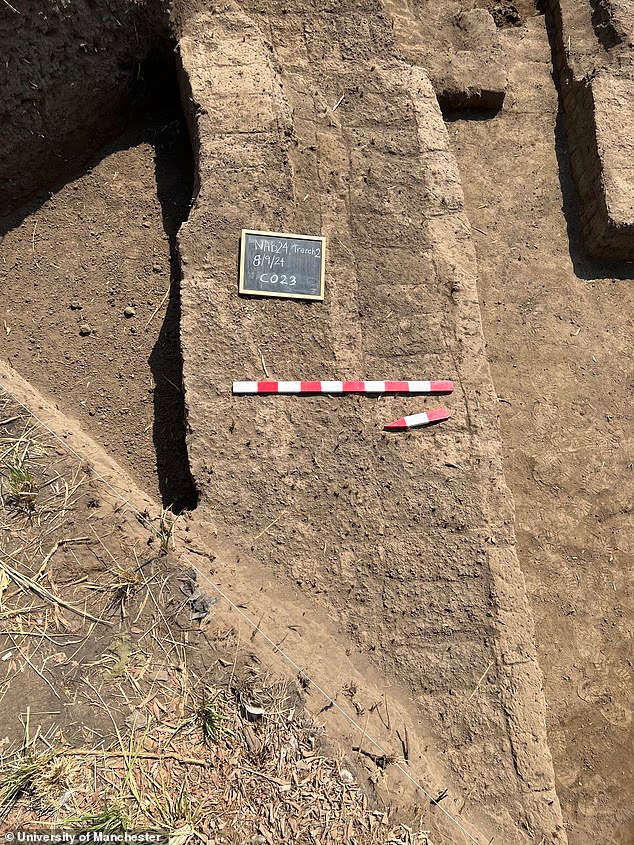
At the heart of the discovery are the tower houses—robust, multilevel structures designed to house a growing population in an increasingly urbanized Nile Delta. Constructed from ancient mudbricks and supported by thick foundation walls, these buildings reflect a sophisticated approach to urban density and architectural engineering rarely seen in other parts of Egypt.


📣 Our WhatsApp channel is now LIVE! Stay up-to-date with the latest news and updates, just click here to follow us on WhatsApp and never miss a thing!!


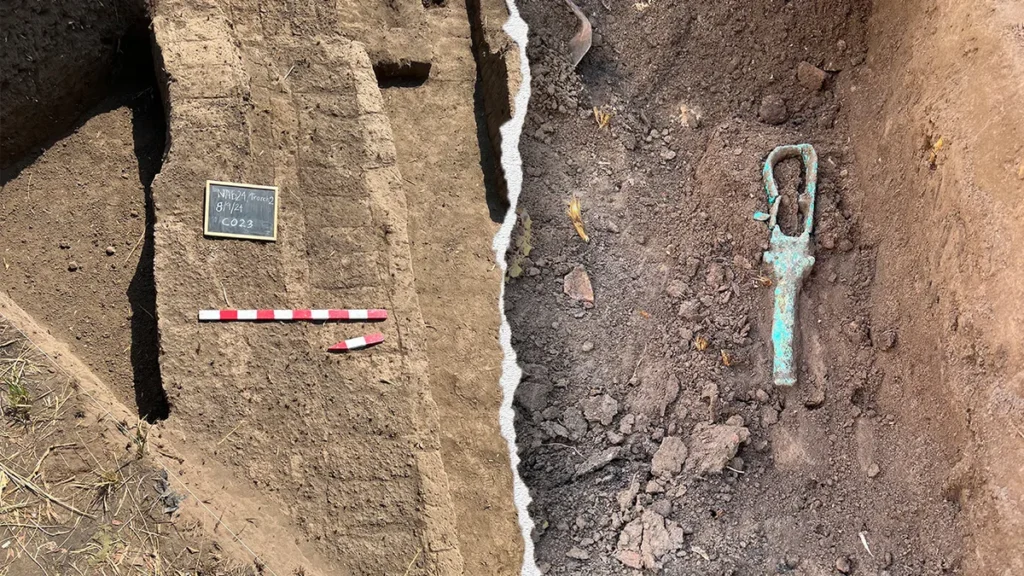
Archaeologists have uncovered the remains of the long-lost Egyptian city of Imet. Revealing the foundations of 2,500-year-old multi-storey 'tower houses' and temple structures. Credit: University of Manchester
Archaeologists have uncovered the remains of the long-lost Egyptian city of Imet. Revealing the foundations of 2,500-year-old multi-storey ‘tower houses’ and temple structures. Credit: University of Manchester

“These tower houses are mainly found in the Nile Delta between the Late Period and the Roman era, and they are rare elsewhere in Egypt,” explained Dr. Nicky Nielsen of the University of Manchester, who directed the excavation. “Their presence shows that Imet was not only a densely built city but also one with a complex urban infrastructure.”

The discovery underscores how ancient Egyptians responded to space constraints and rising population levels with vertical housing solutions—an approach that mirrors modern urban strategies today.

A Thriving Economic and Religious Hub

Imet was more than just a residential center. The excavation also uncovered granaries, animal pens, and a ceremonial road that once connected to the temple of Wadjet, the city’s patron goddess. These findings point to a bustling local economy and vibrant religious activity.

One of the major structures identified was a large building with a limestone-plastered floor and massive pillars dating back to the mid-Ptolemaic Period. This building was constructed across the ceremonial route to the temple, which suggests significant changes in urban planning and possibly religious practice over time.

“The processional road had fallen out of use by the mid-Ptolemaic era,” said Nielsen, “which may indicate shifts in religious customs and temple significance during that period.”
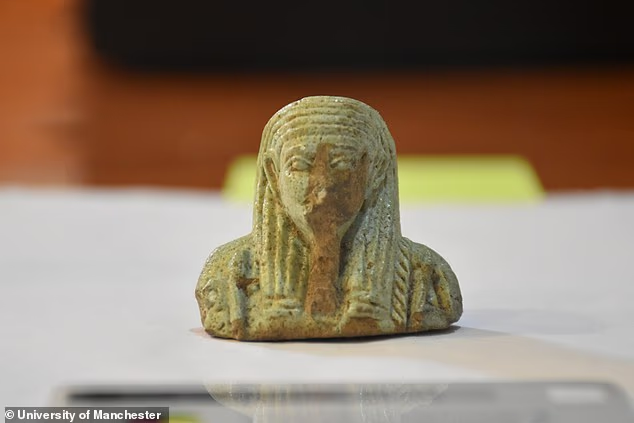
Archaeologists found a glazed ceramic funerary figurine called an ushabti.  Credit: University of Manchester
Archaeologists found a glazed ceramic funerary figurine called an ushabti. Credit: University of Manchester

Artifacts from Everyday Life

The excavation yielded several artifacts that offer a window into the daily lives and spiritual practices of the city’s former inhabitants. Among the most notable discoveries was a copper sistrum, a ceremonial rattle associated with the goddess Hathor, found lying outside a collapsed tower house. Researchers believe it fell from one of the upper floors during the building’s abandonment.

Other significant artifacts included a green faience ushabti, a funerary figurine dating from between 664 and 525 BC, and a carved stone slab depicting the child god Harpocrates, surrounded by protective symbols.

“These finds add important context to our understanding of how people lived, worshipped, and built their communities in ancient Egypt,” said Nielsen. “They remind us that archaeology isn’t just about monumental temples—it’s also about everyday life.”
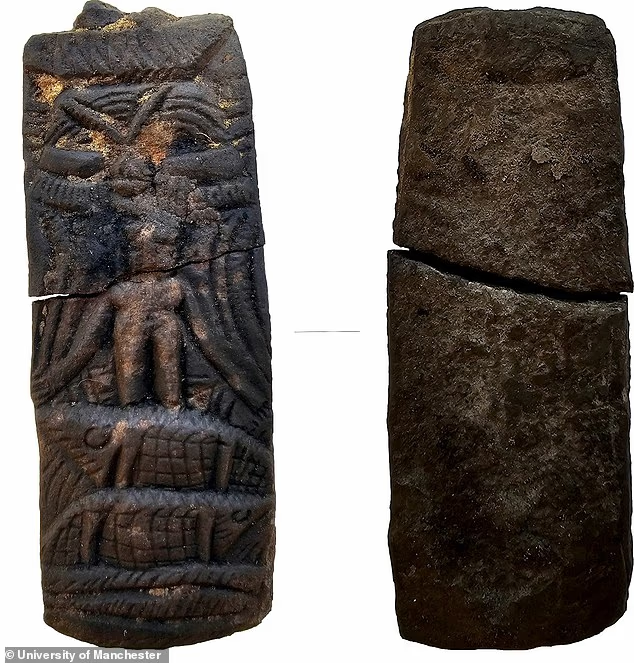
These stela are carved with images of the god Harpocrates and protective imagery and likely date back to around the fourth century BC. Credit: University of Manchester

A New Focus for Delta Archaeology

For decades, Egyptian archaeology has focused on temples, tombs, and the afterlife. However, the discovery of tower houses at Imet is helping shift attention to settlement archaeology and domestic architecture.

“This site is becoming one of the most important for understanding urban life in the Nile Delta during the Late Period,” said the University of Manchester in a statement. “The presence of multistory tower houses reveals a city designed for growth, efficiency, and spiritual integration.”

As excavation continues, researchers hope to uncover even more evidence of how these vertical structures contributed to the city’s resilience, functionality, and cultural identity.

The discovery of Imet’s tower houses is not only rewriting what we know about ancient Egyptian city life but also offering timeless lessons about how humans adapt to growing urban landscapes—then and now.

Nielsen, N., Hussein, H., Nikolova, D. T., Tichindelean, M., & Thomsen, K. (2025). Preliminary Report on the 2024 Autumn Season of the Tell Nabasha Project. Ägypten und Levante, 34, 67-82. https://doi.org/10.1553/AEundL34s69

Cover Image Credit: University of Manchester

Related Articles

3,000-year-old weavings discovered in Alaska’s Alutiiq settlement

3 September 2023

3 September 2023

Archaeologists have uncovered fragments of woven grass artifacts estimated to be 3,000 years old during excavations at an ancestral sod...

Researchers believe mass immigration to Orkney during the Bronze Age was mostly led by women

8 February 2022

8 February 2022

Researchers believe mass immigration to Orkney during the Bronze Age was mostly led by women.  Mass migration to Orkney during...

11,000-Year-Old Settlement Unearthed: Saudi Arabia Reveals Oldest Human Settlement in Arabian Peninsula

27 September 2025

27 September 2025

The Saudi Heritage Commission has announced, in partnership with Japanese scholars from Kanazawa University, the discovery of the oldest known...

Oregon may be home to oldest human occupied site in North America

12 July 2023

12 July 2023

Where and when the first humans appeared in North America is a contentious issue that many disagree on, and this...

Bom Jesus: The Oldest and Most Valuable Shipwreck Found in the Namibian Desert

20 March 2025

20 March 2025

In a remarkable archaeological discovery, the Bom Jesus (The Good Jesus), a Portuguese ship that sank over 500 years ago,...

Iron Age Children’s a Unique Funerary Building Discovered in Oman

3 March 2024

3 March 2024

Archaeologists have uncovered a unique Iron Age children’s funerary building at the Manaqi archaeological site in Rustaq, South Al Batinah...

Southeast Asia’s oldest stringed instrument may be a 2,000-year-old antler

21 February 2023

21 February 2023

Archaeologists unearth a 2,000-year-old stringed instrument made from deer antler in southern Vietnam. This unusual deer antler may be one...

12,000-Year-Old rock art may depict extinct giants of the ice age

13 March 2022

13 March 2022

South America was filled with ice age animals more than 12,000 years ago, including car-sized ground sloths, elephantine herbivores, and...

Beyond ‘Man the Hunter’: Stone Age Burials in Latvia Reveal Gender Equality

12 September 2025

12 September 2025

Zvejnieki cemetery in Latvia, one of Europe’s largest Stone Age burial grounds, has revealed remarkable insights into equality, ritual, and...

4,000-year-old cylinder seal found in Blaundos excavations

29 September 2022

29 September 2022

A 4,000-year-old cylinder seal was found during the excavations of the ancient city of Blaundus (or Blaundos, as it is...

800-year-old Jin dynasty palace complex found in Beijing Olympic Village

9 February 2022

9 February 2022

While building the athletes’ Olympic Village for this year’s Winter Games in Beijing, China found the remains of an ancient...

The Gallo-Roman Sanctuary Unearthed in France

30 June 2024

30 June 2024

During a recent archaeological excavation in the old Hôtel Dieu neighborhood of Rennes in north-western France, archaeologists discovered the remains...

The Entire Genome Of 35,000-Year-Old Skull From Romania Sequenced “Peştera Muierii 1”

24 May 2021

24 May 2021

Researchers have successfully sequenced the whole genome from the skull of Peştera Muierii 1, women who lived in today’s Romania...

Oldest Direct Evidence for Honey Collecting in Africa

18 April 2021

18 April 2021

Honey is an important food source that has been considered a very important healing source in the history of civilizations....

Collapsed 18th-Century Tomb Uncovers Hidden Crypt Beneath Historic Churchyard

12 November 2025

12 November 2025

A mysterious underground crypt has been revealed after the sudden collapse of an 18th-century tomb in a centuries-old English churchyard....