
21 January 2026 The Future is the Product of the Past

Wildfire Uncovers Lost Biblical Village of Bethsaida on the Sea of Galilee

In a surprising twist of fate, a wildfire that swept through Israel’s Betiha Nature Reserve in late July has unveiled significant archaeological remains believed to be the biblical village of Bethsaida.

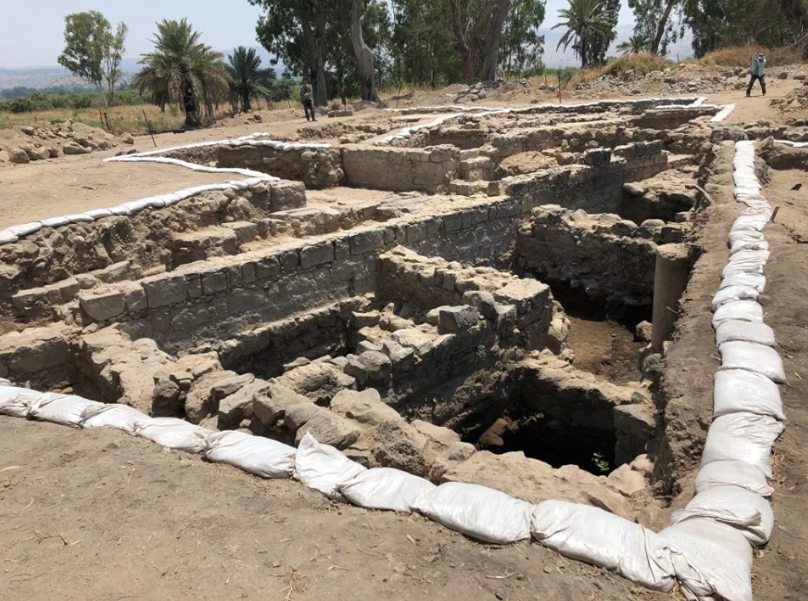
Long thought to be lost to time, this site, located along the northern shore of the Sea of Galilee, has been under excavation since 2016 at the official approval of the Israel Nature and Parks Authority. The recent blaze, while devastating to local flora and wildlife, has provided archaeologists with an unprecedented view of structures buried for centuries.

A Village Revealed by Fire

The wildfire, which raged for over 17 hours near Amnun Beach, forced the temporary closure of Highway 87 and sent beachgoers fleeing. When archaeologists returned to the blackened landscape, they discovered hundreds of small mounds scattered across the site of el-Araj.

“Each of these mounds is potentially an ancient room,” explains Mordechai Aviam, director of the excavation from Kinneret College. The cleared land exposed stone blocks, fragments, and even a pillar drum, suggesting the presence of public buildings alongside residential areas.

El-Araj has long been under investigation as a potential site for Bethsaida, historically recognized as the hometown of apostles Peter, Andrew, and Philip. Until recently, the village’s precise location had been debated, with the nearby site of e-Tell traditionally accepted despite its distance from the lake and elevated terrain — characteristics inconsistent with a first-century fishing village.


📣 Our WhatsApp channel is now LIVE! Stay up-to-date with the latest news and updates, just click here to follow us on WhatsApp and never miss a thing!!


Excavations at el-Araj, however, have revealed fishing tools, Roman-era pottery, and remnants of a Roman bathhouse, all pointing to a thriving lakeside community in the time of Jesus.
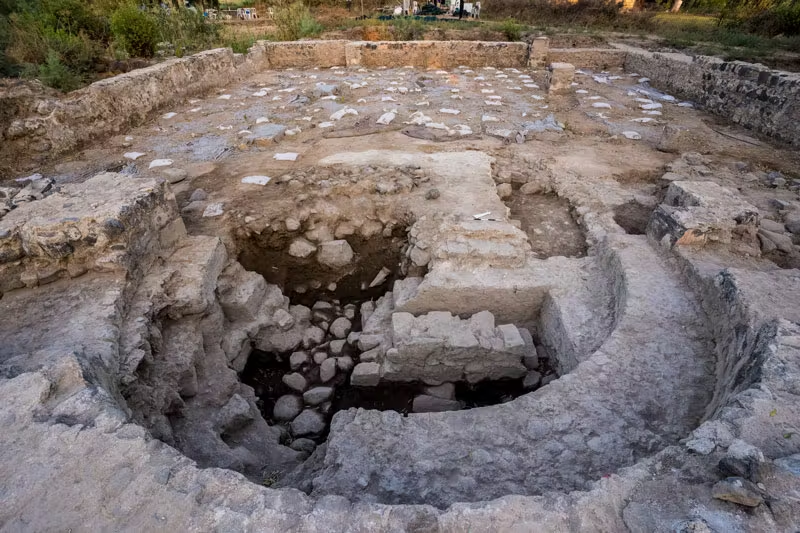
Two walls set perpendicular to one another beneath the apse of a Byzantine church. One of the walls dates to the first century AD, while the second dates to the second or third century AD. Credit: Museum of the Bible

Layers of History Beneath the Ash

The archaeological site at el-Araj is layered with history. Beneath the surface lies the Roman-era settlement, topped by a Byzantine church and monastery from the 5th century. Crusaders later repurposed the church into a sugar factory in the 12th or 13th century.

Excavation director Aviam explains that uncovering the Roman layer — the period contemporary with Jesus and his apostles — requires meticulously documenting and sometimes removing the upper layers of Byzantine and Crusader structures.

In a statement to Haaretz’s Ruth Schuster, Aviam said, “The fire, while tragic, has allowed us to survey areas that were previously inaccessible due to thick vegetation.

Among the finds, one of the most remarkable discoveries was an early inscription associated with the Apostle Peter. Volunteers uncovered ancient Greek letters hinting at Peter’s presence, reinforcing the identification of el-Araj as his hometown.

The site’s artifacts and architectural remains collectively provide a more accurate representation of a first-century fishing village than e-Tell, supporting the long-standing biblical accounts.
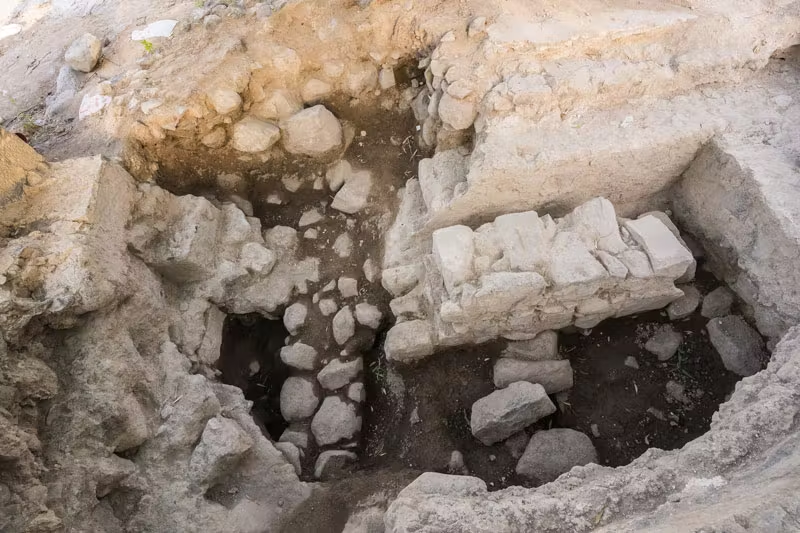
Close-up of the two walls. The lower wall to the left dates to the first century AD. The wall running perpendicular from it to the right dates to the second or third century AD. Credit: Museum of the Bible

International Collaboration and Volunteer Efforts

The excavation project at el-Araj has attracted volunteers from around the world, including Hong Kong, under the supervision of R. Steven Notley, dean of Religious Studies at Pillar College, Newark. Among the youngest participants is Yohan Wong, who has been visiting the site since he was two years old.

Families and volunteers play an active role in unearthing artifacts, cleaning mosaics, and documenting findings, creating a vibrant, hands-on learning environment.

Despite the intense heat and post-fire conditions, the team remains dedicated. Archaeologist Achia Kohn-Tavor highlights the significance of recent discoveries, including fragments of limestone vessels typical of Second Temple-period Jewish homes, further supporting the site’s identification as Bethsaida.
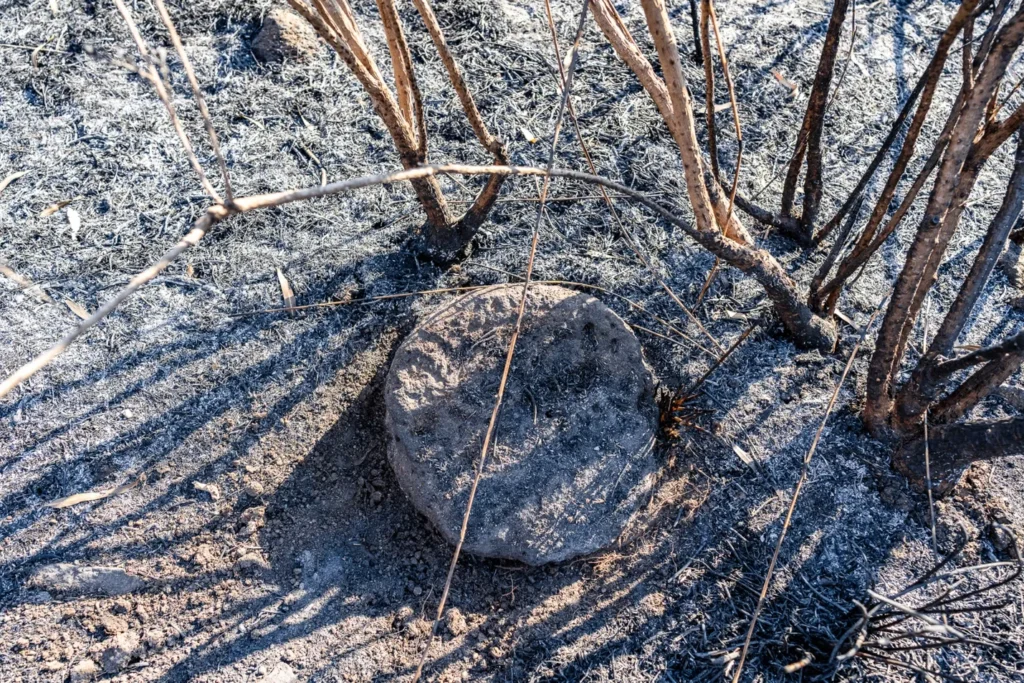
The pillar drum, August 2025. Credit: Mordechai Aviam

The Fire’s Silver Lining

While the wildfire destroyed much of the reserve’s vegetation, it inadvertently enhanced the archaeological work. The cleared land allowed researchers to locate structures more efficiently and plan future excavation strategies. Remarkably, the early Byzantine church and its protective coverings were spared from the flames, preserving vital evidence of the site’s layered history.

“The fire was an unfortunate event, but it has given us a rare opportunity to study the site with minimal obstruction,” Aviam notes.

The excavation’s next steps focus on uncovering additional Roman-era homes and public buildings, which could provide further insights into the daily lives of Bethsaida’s inhabitants and the community that shaped early Christianity.
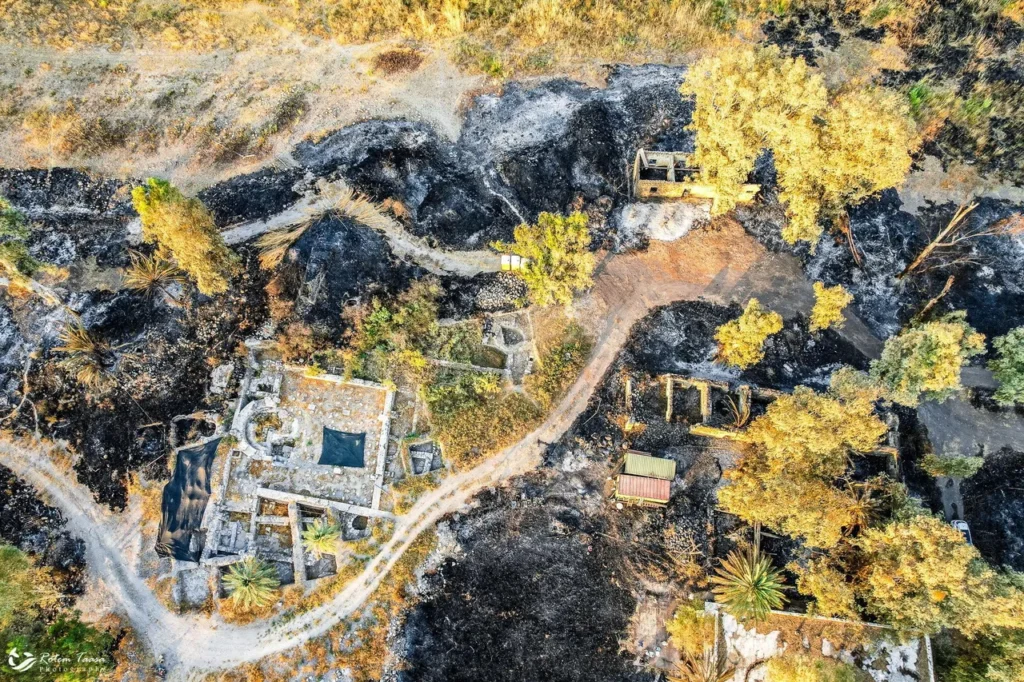

The early Byzantine church is located at the lower left of the image; the wildfire approached the structure but did not penetrate its perimeter.
Credit: Rotem Taasa
The early Byzantine church is located at the lower left of the image; the wildfire approached the structure but did not penetrate its perimeter. Credit: Rotem Taasa

A Glimpse Into the Past

El-Araj stands as a testament to resilience — both human and environmental. Green shoots already emerge from the blackened earth, signaling life’s return.

Meanwhile, archaeologists continue to peel back centuries of history, one layer at a time, offering the world a tangible connection to biblical times. With each new discovery, the lost village of Bethsaida slowly reclaims its place in history, revealing stories that have been buried under soil, ash, and time for nearly two millennia.

Museum Of The Bible

Cover Image Credit: The main excavation site (Area A) at el-Araj. Photo Credit: El-Araj Excavation Project

Related Articles

Gold from the ancient cities of Troy, Poliochni, and Ur had the same Origin

3 December 2022

3 December 2022

Using an innovative mobile laser method, scientists determined that gold found in ancient Troy, Poliochini, and Ur had the same...

Archaeologists unearth first archaeological evidence about Anatolia’s mysterious Kaska community, sworn enemies of the Hittites

16 January 2025

16 January 2025

In the course of the excavations conducted by Zonguldak Bülent Ecevit University‘s Department of Archaeology, artifacts from the Late Bronze...

A 7,500-year-old settlement has been discovered in Turkey’s Domuztepe Mound

11 September 2021

11 September 2021

During the most recent excavations at Domuztepe Mound in the Türkoğlu district of southern Turkey’s Kahramanmaraş province, a settlement and...

Ancient Yayoi Period Settlement Discovered on Tokyo Condo Development Site

10 December 2023

10 December 2023

Excavations at the former site of the British Embassy in Tokyo’s Chiyoda Ward have uncovered the remains of a Yayoi...

Pharaonic Hieroglyphic Inscription of Ramses III Found in Southern Jordan

20 April 2025

20 April 2025

In a remarkable archaeological breakthrough, a hieroglyphic inscription bearing the royal cartouche of Pharaoh Ramses III (1186–1155 BC) has been...

Urartian-Era Fortress with 50 Rooms Discovered at 3,000 Meters in Eastern Türkiye

5 August 2025

5 August 2025

Archaeologists uncover a massive high-altitude fortress believed to date back to the Iron Age, with ties to the ancient Urartian...

The 3200-year-old Mycenaean figure that brought Ephesus together with the Hittite civilization: Found in the excavations of Ayasuluk Tepe

11 June 2022

11 June 2022

A 3,200-year-old Mycenaean figurine that could change the perspective on the history of civilization in Western Anatolia during the Bronze...

A farmer picking up ‘trash’ in field in Norway discovered a rare Viking Sword

1 June 2024

1 June 2024

A farmer and his son found a rare Viking sword on his family farm in Suldal, Norway. Archaeologists say this...

Unique 1,850-Year-Old Roman Thermal Structure Unearthed in Antalya’s Ancient City of Myra

9 January 2026

9 January 2026

Archaeologists in southern Türkiye have uncovered an extraordinary 1,850-year-old Roman thermal structure in the ancient city of Myra, a discovery...

Obsidian Research in Alberta Uncovers Evidence of Extensive Long-Distance Trade Among Indigenous Peoples Before European Contact

31 March 2025

31 March 2025

Recent research into obsidian artifacts in Alberta, a province located in western Canada, has unveiled significant evidence of long-distance trade...

A stunning fresco depicting Helen of Troy is revealed during excavations at the ancient Roman city

11 April 2024

11 April 2024

Archeologists have uncovered remarkably preserved ‘fresco’ paintings on a wall in the banqueting room of a large house along Via...

An Ampulla was discovered for the first time in the ancient city of Dara, Turkey

11 January 2022

11 January 2022

An ampulla was found for the first time in the ancient city of Dara, located in the province of Mardin...

7500-year-old idol of Goddess Asherah located in Israel

22 May 2022

22 May 2022

Archaeologists excavating an ancient cemetery in Israel have discovered an idol they believe belongs to the goddess Ashera at a...

Apocalypse Ship of the Vikings

26 April 2021

26 April 2021

Researchers discovered a stone boat made by Vikings and surprising gifts inside a cave in Iceland. Aside from the cave,...

Export barred on roundel manuscript gifted to Queen Elizabeth I by Archbishop

12 September 2022

12 September 2022

A rare presentation manuscript that Archbishop of Canterbury Matthew Parker gave to Queen Elizabeth I in 1573 has been sold...