
8 November 2025 The Future is the Product of the Past

Unique 9th–10th Century Chain-Mail and Helmet Unearthed at Rustavi Fortress, Georgia

Archaeologists uncover a rare medieval helmet and chain-mail shirt — the only known combat artifacts of their kind in the South Caucasus.

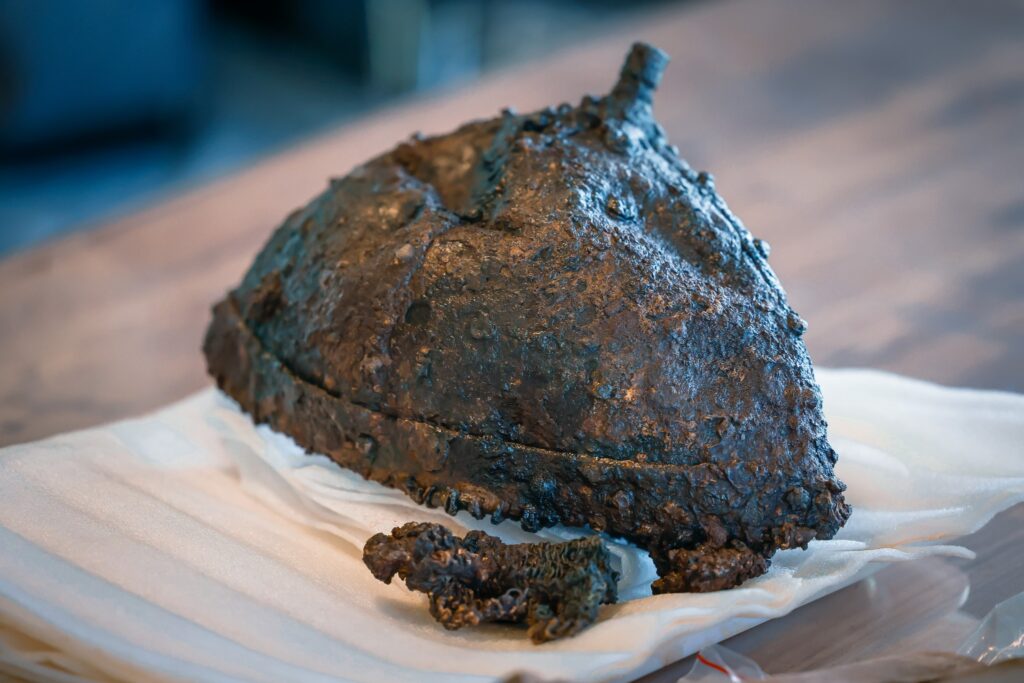
A team of Georgian archaeologists has made a landmark discovery at Rustavi Fortress, one of the oldest fortifications in the South Caucasus. Excavations conducted in the fortress’s sixth chamber revealed a well-preserved iron helmet with a muzzle guard and a chain-mail shirt dated to the 9th–10th centuries — the only known example of such armour ever found in the region.

According to Nazibrola Pachikashvili, director of the Rustavi Museum and head of the excavation, the find represents a turning point for Georgia’s medieval military archaeology. “We discovered an iron helmet complete with its facial guard, and nearby a full chain-mail cuirass made of interconnected rings. This is an unprecedented discovery for Georgia,” she said.

The excavation, organized by Rustavi Municipality and launched in July 2025, aims to investigate the 9th–12th century palace complex inside the fortress. Over 100 people — including archaeologists, university students, and volunteers — are participating in the ongoing project.
Credit: Rustavi History Museum

A Fortress with Deep Roots

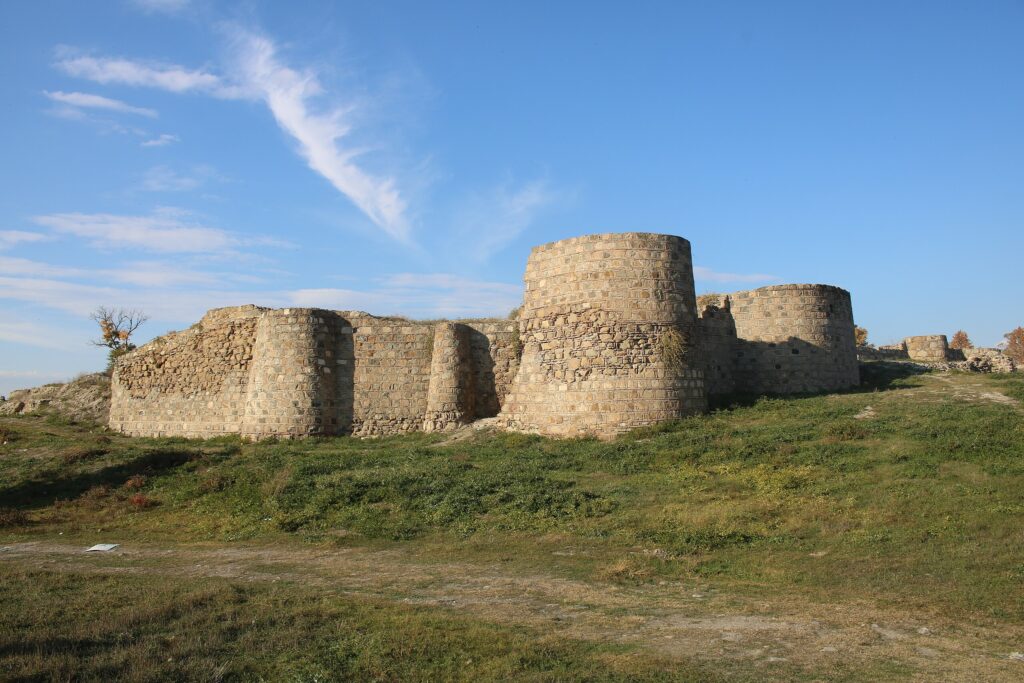
Rustavi Fortress, situated about 25 kilometres southeast of Tbilisi, overlooks the Kura River and has been occupied since the Middle Bronze Age. Historical sources list Rustavi among the earliest urban settlements in the ancient Kingdom of Iberia, alongside Mtskheta, Uplistsikhe, and Urbnisi.


📣 Our WhatsApp channel is now LIVE! Stay up-to-date with the latest news and updates, just click here to follow us on WhatsApp and never miss a thing!!


The fortress was originally constructed to protect the southeastern approach to Tbilisi and underwent three major reconstruction phases: in the 5th–8th, 9th–11th, and 12th–13th centuries. Uniquely, fragments of frescoes still survive on its interior walls — a rare feature for Georgian fortifications and evidence of the site’s ceremonial as well as defensive role.

Archaeologists uncover a rare medieval chain-mail shirt — the only known combat artifacts of their kind in the South Caucasus. Credit: Rustavi History Museum

Significance of the Discovery

Experts suggest the armour may have belonged to an elite soldier or commander stationed at Rustavi. The iron helmet, featuring a detachable muzzle plate, reflects advanced craftsmanship and design possibly influenced by Byzantine or Persian models. The chain-mail shirt, composed of thousands of interlinked iron rings, is in exceptional condition considering the area’s humid soil.

The discovery also helps fill a major gap in the archaeological record. Very few examples of early medieval armour survive anywhere in the Caucasus, and none have been documented with this level of completeness. The find provides direct material evidence of how warfare technology evolved during the formative centuries of Georgia’s feudal states — an era marked by Arab, Byzantine, and local interactions.

Archaeologists are now conducting metallurgical analysis to determine the alloy composition and manufacturing techniques. Early observations indicate the items may have been locally produced, showing that Georgian armourers of the time possessed high technical skills comparable to those of their regional counterparts.

Cultural and Academic Impact

Beyond its military relevance, the find highlights Rustavi’s long-standing role as both a cultural and political center. The municipality plans to establish an open-air museum within the fortress complex, allowing visitors to view the excavation zones and learn about the site’s evolution over three millennia.

The newly uncovered armor will be conserved and later displayed at the Rustavi Museum. “This discovery brings us closer to the people who defended these walls a thousand years ago,” said one of the archaeologists involved. “It connects Georgia’s living heritage with its martial past.”

The chain-mail and helmet from Rustavi Fortress now stand as silent witnesses to a turbulent medieval frontier, embodying both craftsmanship and resilience — a rare survival from the era when Georgia’s identity was forged amid shifting empires.

Rustavi History Museum

Cover Image Credit: Mehman Ibragimov- Wikipedia

Related Articles

World’s Only Ancient Wooden Twin-Hulled Boats Unearthed in Vietnam

20 May 2025

20 May 2025

A groundbreaking archaeological discovery in Bac Ninh province, northern Vietnam, has brought to light two remarkably well-preserved ancient wooden boats,...

Roman Era Mosaic Unearthed in Illegal Excavation Near Zile Castle

13 May 2025

13 May 2025

A stunning mosaic has been unearthed during an illegal excavation near Zile Castle, located in the Tokat province of Türkiye,...

Poland’s largest megalithic cemetery discovered

3 March 2021

3 March 2021

Archaeologists excavated in Poland discovered a large megalithic complex, including dozens of tombs dating back 5,500 years. The site was...

Fossil found at the edge of the Tibetan Plateau reveals an owl active during the day 6 million years ago

29 March 2022

29 March 2022

The incredibly well-preserved fossil skeleton of an extinct owl that lived was discovered on the edge of the Tibetan Plateau,...

Coin hoard found in fireplace ‘belonging to Scottish clan chief’ murdered at infamous Glencoe Massacre

17 October 2023

17 October 2023 1

Coins believed to have belonged to a Scottish clan chief murdered in an infamous 17th-century Glencoe massacre, have been found...

Unexpected Origins of Mysterious Mummies Buried in Boats in a Chinese Desert

17 February 2024

17 February 2024

In 1990, hundreds of mummified bodies were found buried in boats in an inhospitable desert area in the Xinjiang Uyghur...

At a dig site in western Turkey, a centuries-old Byzantine fortress will be revealed

24 December 2021

24 December 2021

Excavation of vast Byzantine-era fortifications considered to be about 900 years old has begun at a dig site in western...

Archaeologists in Derbyshire have unearthed a 9th century Anglo Saxon house

15 July 2021

15 July 2021

A nearly complete Anglo-Saxon house, considered to date from the early ninth century and might have been the abode of...

Millennia-Old İron Production Facilities Found in Iran

2 May 2021

2 May 2021

Archaeologists have uncovered many millennia-old iron manufacturing sites in a historical village in southcentral Iran. A local tourism official declared...

6th-Century BC Houses and Earthquake Evidence Discovered in Davti Blur, an Urartian Fortress City in Armenia

28 January 2025

28 January 2025

An Armenian-Polish archaeological team has uncovered remnants of 6th-century BC houses, a cremation cemetery, and signs of a significant earthquake...

A first-of-its-kind Ayyanar stone idol found in Vellore, India

25 June 2022

25 June 2022

An Ayyanar stone idol, the first of its kind in Vellore, was discovered at Thandalai Krishnapuram (TK Puram) in Tamil...

Excavations at the ‘Westminster Abbey of Wales’ Yielded a Few Surprises: a lost Aqueduct and a Buried Celtic Treasure

12 March 2024

12 March 2024

Archaeologists working in Wales revealed recently they may have discovered a Celtic monastery at the site of a 12th-century Cistercian...

Archaeological Complex from the Bulgar-Golden Horde Period Discovered in Tatarstan

22 March 2025

22 March 2025

Recent archaeological research conducted in the Alekseevski municipal district, located in the Republic of Tatarstan, has uncovered an archaeological complex...

Burial Cave in Israel May Belong to Herodian Princess Salome: From Royal Tomb to Christian and Islamic Pilgrimage Site

6 July 2025

6 July 2025

A recently reexamined Second Temple-period burial cave in southern Israel—long revered as the resting place of a Christian saint—may actually...

New Type of Amphora Found in 5th-Century Roman Shipwreck

28 April 2024

28 April 2024

The first in-depth analysis of the cargo of a 4th-century Roman shipwreck found off the coast of Mallorca in 2019...

Comments
Leave a Reply

Your email address will not be published. Required fields are marked *