
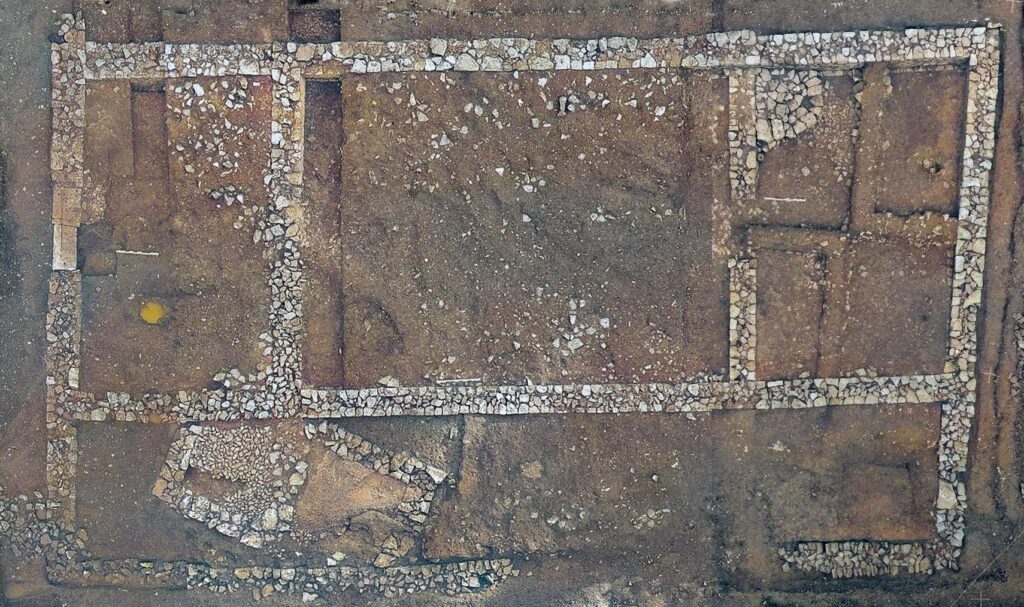
On a hilltop overlooking the French countryside, archaeologists have uncovered the remains of an early medieval complex that may have served as a palace for a powerful ruling family. The site includes substantial stone buildings, an early Christian church, and evidence of Roman-style underfloor heating.
The discovery comes from the Montagne de Saint-Laurent at Mesmont, about 20 kilometers west of Dijon in Burgundy. Excavations led by archaeologist Antoine Guicheteau have revealed a settlement that flourished between the fifth and early eighth centuries, during a period when the collapse of Roman rule was reshaping political life across the region.
The substantial buildings emerging from the excavations suggest that Mesmont became an important center for the local elite as new forms of power took shape in the former Roman territories.
A Palace Above the Ouche Valley
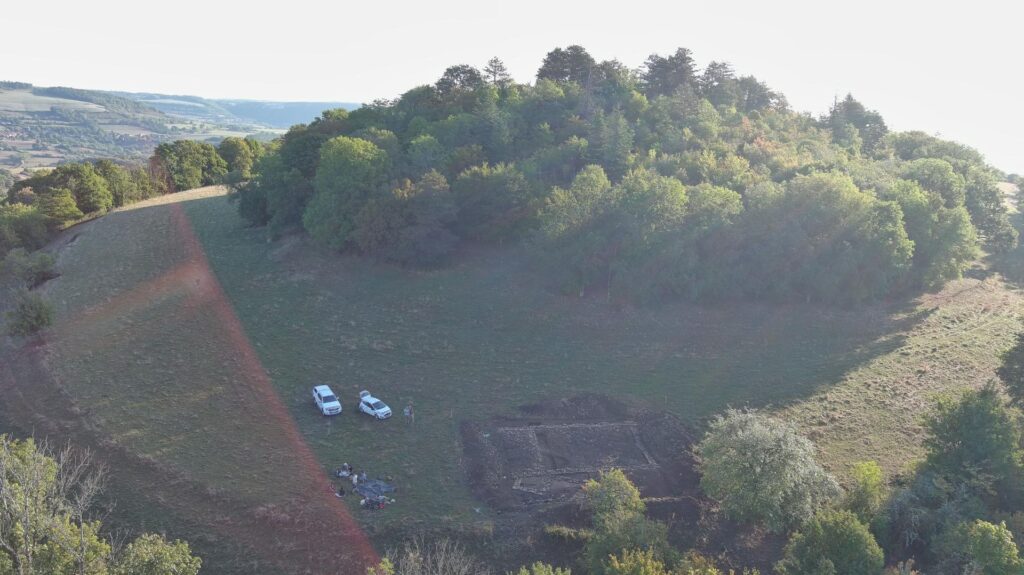
High above the Ouche Valley, the Montagne de Saint-Laurent overlooks a wide stretch of the Burgundian countryside. Its broad summit offered ample space for a settlement, while steep slopes provided natural protection and clear views of the surrounding landscape.
Archaeologists have explored the hill since the nineteenth century, but excavations that began in 2019 have revealed a much more important settlement than previously thought. Far from being a simple hilltop refuge, Mesmont was home to wealthy families, religious buildings and a community that appears to have played an important role in governing the surrounding region.
The latest excavations have exposed a stone building measuring approximately 15 by 12 meters beside the remains of an early Christian church. Its thick walls and carefully prepared mortar suggest a substantial construction, possibly with an upper floor.
South of the church, archaeologists uncovered another large building stretching more than 20 meters in length. Its full width remains unknown, as excavations have yet to reveal the entire structure.
Together, the buildings formed a complex covering several hundred square meters. Their position close to the church suggests that the religious and residential areas formed part of a larger center associated with people of considerable wealth and influence.
Roman Engineering in an Early Medieval Residence
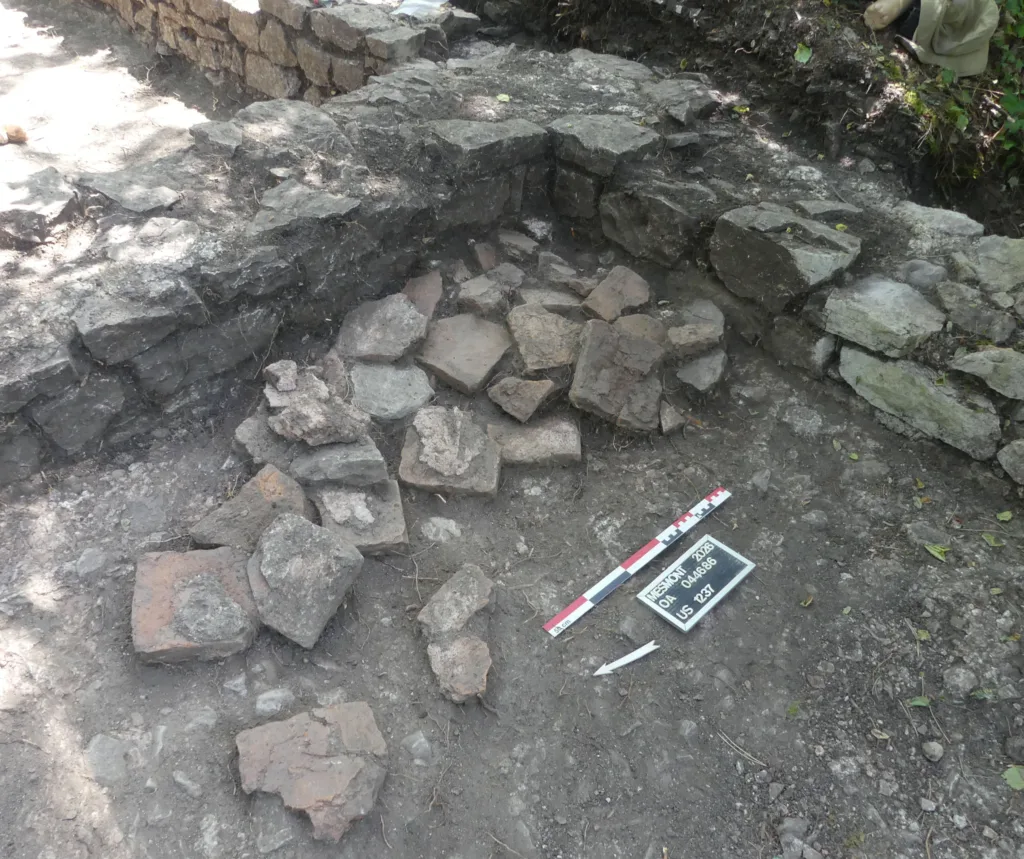
The buildings also revealed traces of a heating system familiar from Roman baths and wealthy homes. Archaeologists found small stone pillars, fragments of ceramic pipes, and remains of raised floors, all part of a hypocaust system that carried warm air beneath the floors to heat the rooms above.
Such a heating system was costly to build and maintain, suggesting that the people who lived here enjoyed a level of comfort beyond the reach of most early medieval households.
The heating remains are particularly interesting because the settlement developed during a period often associated with the decline of Roman institutions in western Europe. At Mesmont, builders continued to draw on Roman construction techniques while creating residences for a changing society.
Earlier excavations on the plateau had already identified a fifth-century building with a heated floor, later replaced by a more substantial residence during the sixth and seventh centuries. The later structure extended approximately 22 meters and included a central room, adjoining spaces and a front gallery.
Archaeologists also found weapons and clothing accessories in the residential area, suggesting that wealthy and influential families once lived here.
An Early Christian Church at the Center
The possible palace stood beside another impressive building: an early Christian church whose origins may reach back to the fifth century.
The church measures approximately 27.5 meters in length and 12.4 meters across its widest section. Its layout includes an apse, while excavations have identified architectural features associated with Christian worship, including traces of a possible wooden screen separating the sanctuary from the congregation.
The church was not only large but probably impressive in appearance as well. Since 2019, archaeologists have recovered more than 500 fragments of glass, including around 50 that may have come from its windows. Fragments of lighting equipment and glass vessels suggest a carefully furnished interior.
The church stood at the heart of a settlement where religious and everyday life were closely connected. Its location beside the large residential buildings reflects the important place Christianity held in early medieval Burgundy, as churches became closely associated with local centers of authority.
At Mesmont, the emerging archaeological plan offers a rare opportunity to examine that relationship through the buildings themselves.
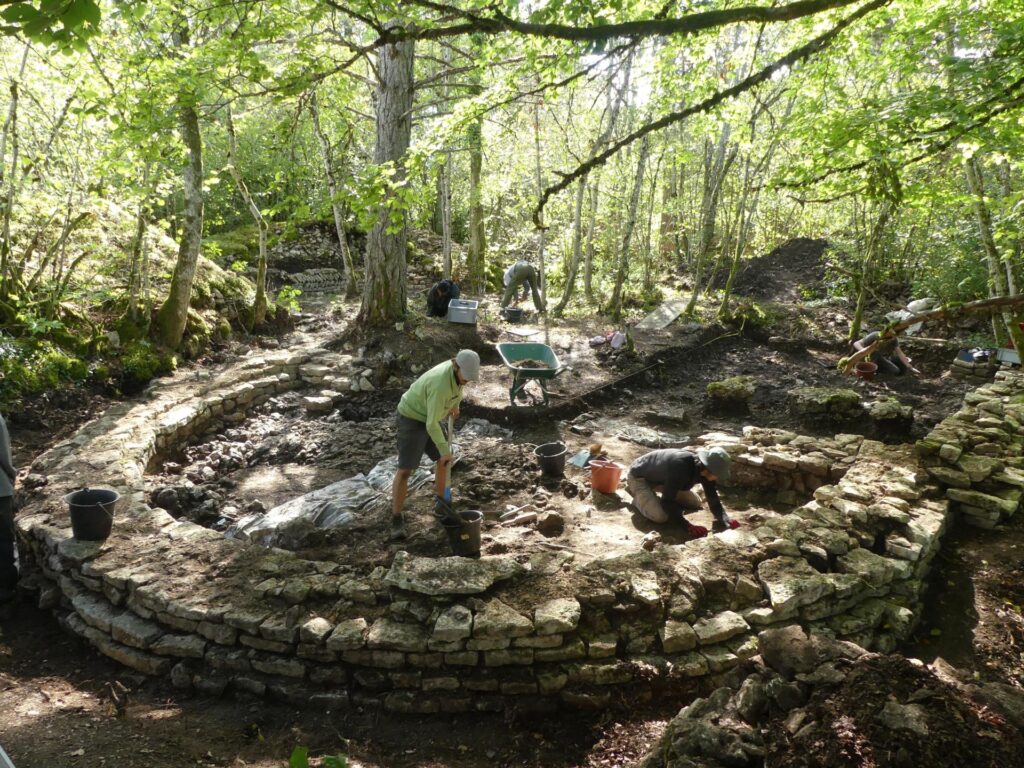
The apse and choir of the early Christian church at Montagne de Saint-Laurent in Mesmont, France, during excavations in 2022.
Credit: A. Guicheteau / Inrap
Mesmont’s Place in Early Medieval Burgundy
Following the collapse of the Western Roman Empire in the fifth century, Burgundy entered a period of political change. The Burgundians established a kingdom in the region, which later came under Frankish control in 534. Yet Roman traditions did not disappear overnight. Many continued to shape local life, from building techniques to religious practices and administration.
Mesmont developed within this changing world. Medieval records associate the area with the pagus Magnimontensis, an administrative district that suggests the settlement held an important position in the region. Historical sources also mention prominent religious figures connected with the area, including Gregory of Langres and his grandson Eustace.
Pottery finds and radiocarbon dating indicate that people occupied the hilltop from the fifth to the early eighth century. By then, the settlement appears to have declined, possibly as activity shifted toward nearby Sombernon.
Excavations at Mesmont are continuing, with archaeologists working to understand how the buildings were used and how the settlement developed over time.
