
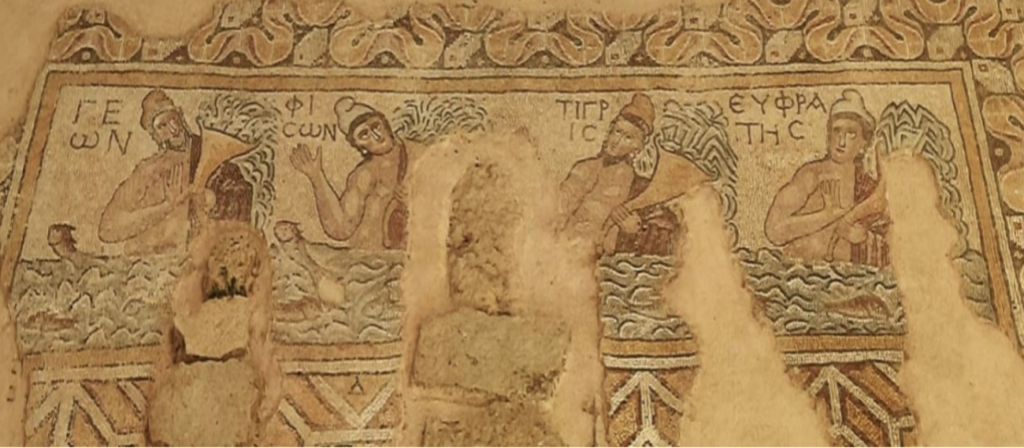
A new study of ancient church mosaics in Türkiye suggests that four rivers flowing from the biblical Garden of Eden may carry a deeper message about human virtues and spiritual salvation. The remarkable mosaics, considered the only known example of their kind in Anatolia, reveal how early Christians transformed sacred texts into elaborate works of art.
At the ancient city of Hadrianoupolis, in Türkiye’s northern Karabük province, a church floor preserves an unusual scene: four human figures representing the rivers of Paradise, each identified by name in Greek. The figures hold horns of plenty from which water flows into a shared pool, bringing to life a passage from the Book of Genesis.
The mosaics have been known to archaeologists for years, but a study published in 2026 offers a fresh interpretation of their religious significance. Researchers Nurgül Özer Uras and Mustafa Göregen argue that the composition may have conveyed moral teachings to worshippers rather than simply illustrating the biblical description of Eden.
Their research, published in Medeniyet Belleten, combines archaeological evidence with ancient Jewish and Christian interpretations of scripture to examine the symbolic meaning of one of Anatolia’s most distinctive early Byzantine mosaics.
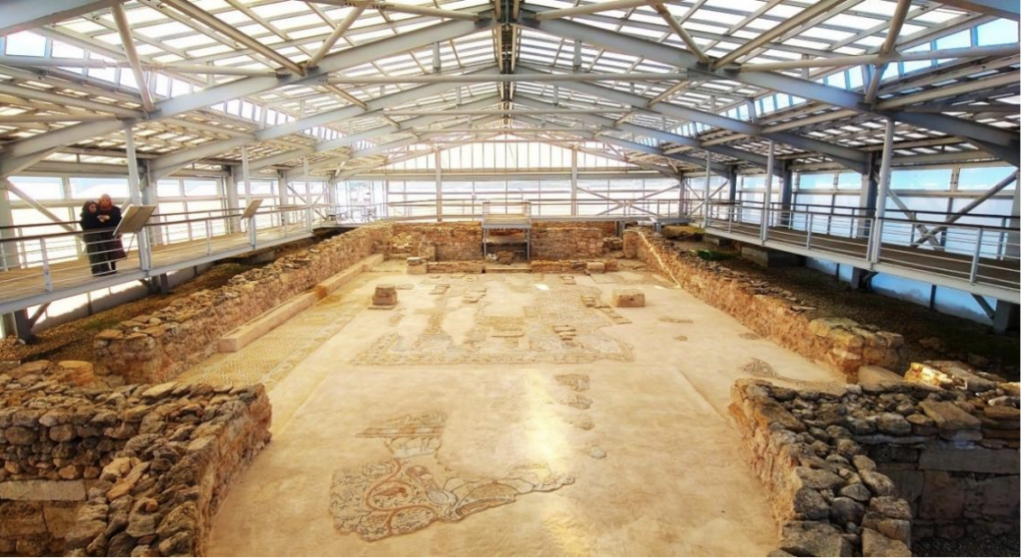
General view of the Church of the Four Rivers at Hadrianoupolis, Türkiye, showing its preserved mosaics and architectural remains. Credit: Özer Uras & Göregen (2026), Medeniyet Belleten.
Four Rivers Flowing From the Garden of Eden
The central mosaic depicts four rivers named in the Book of Genesis (2:10–14): Pishon, Gihon, Tigris, and Euphrates. The biblical passage describes the waters of Paradise:
“A river flowed out of Eden to water the garden, and there it divided and became four rivers.” (Genesis 2:10, ESV)
At Hadrianoupolis, the artists represented these waterways as human figures rather than geographical features. Greek inscriptions identify each river, leaving little doubt about the subject of the composition.
The figures wear Phrygian-style caps and garments resembling those seen in classical Greek art. Two are bearded, while the others appear clean-shaven. Each holds a cornucopia, or horn of plenty, from which water pours into a basin decorated with fish.
These details are important because they connect the biblical narrative with an older artistic tradition. In Greek and Roman art, rivers frequently appeared as human-like deities associated with fertility, prosperity, and the natural world.
The Hadrianoupolis artists adopted this familiar visual language but placed it within a Christian religious setting. The result was an image that combined classical artistic conventions with a story from the Old Testament.
Earlier archaeological studies have described the composition as the only known example of its particular kind in Anatolia, although other early Christian churches around the Mediterranean also featured the four rivers of Paradise.
The Four Rivers May Represent Four Human Virtues
The study’s most intriguing argument concerns a possible second meaning hidden within the familiar biblical scene.
Early Jewish and Christian thinkers did not always interpret the rivers of Eden as physical waterways. Some understood them as symbols of spiritual qualities that guided human behavior and brought believers closer to God.
The researchers draw particular attention to Philo of Alexandria and Ambrose of Milan, who associated the four rivers with the cardinal virtues: prudence, courage, temperance, and justice.
Under this interpretation, Pishon represented prudence, Gihon courage, Tigris temperance, and Euphrates justice. The flowing waters could therefore communicate moral principles as well as describe the geography of Paradise.
For Christians entering the church, the mosaic may have offered a visual reminder of the virtues associated with a righteous life. Its placement on the floor would have brought this message into the physical space where worshippers gathered and participated in religious ceremonies.
Read alongside the writings of early Christian thinkers, the four rivers take on a meaning that extends beyond the biblical landscape, turning the image of Paradise into a lesson about how believers should live.
Nevertheless, the comparison with early Christian writings suggests that the images could have carried meanings familiar to educated religious communities of the period.
Pagan Traditions and Christian Symbols on the Same Floor
The study also examines how Christianity inherited and transformed visual traditions from the ancient Mediterranean world.
The river figures resemble classical personifications, yet their flowing water and accompanying fish acquire additional meaning in a Christian setting. The researchers connect these motifs with baptism, purification, divine abundance, and the promise of spiritual renewal.
Water held particular importance in early Christianity because of its association with baptism and the forgiveness of sins. The image of rivers flowing from Paradise could therefore evoke both the biblical account of creation and the Christian understanding of salvation.
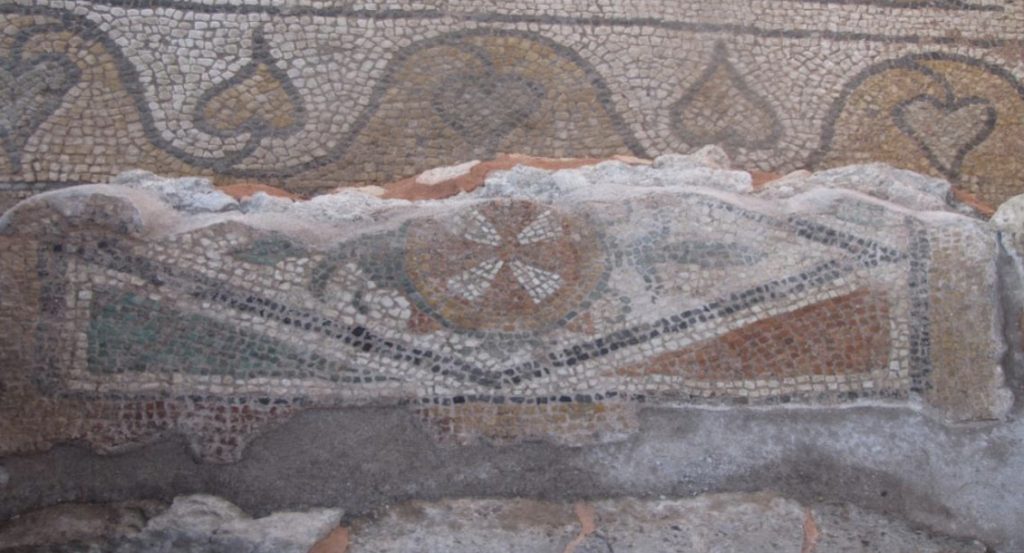
Other decorations within the church reinforce the richness of its religious imagery. A mosaic near the southeastern entrance contains a cross-shaped motif that the researchers interpret as apotropaic, meaning it was intended to ward off evil.
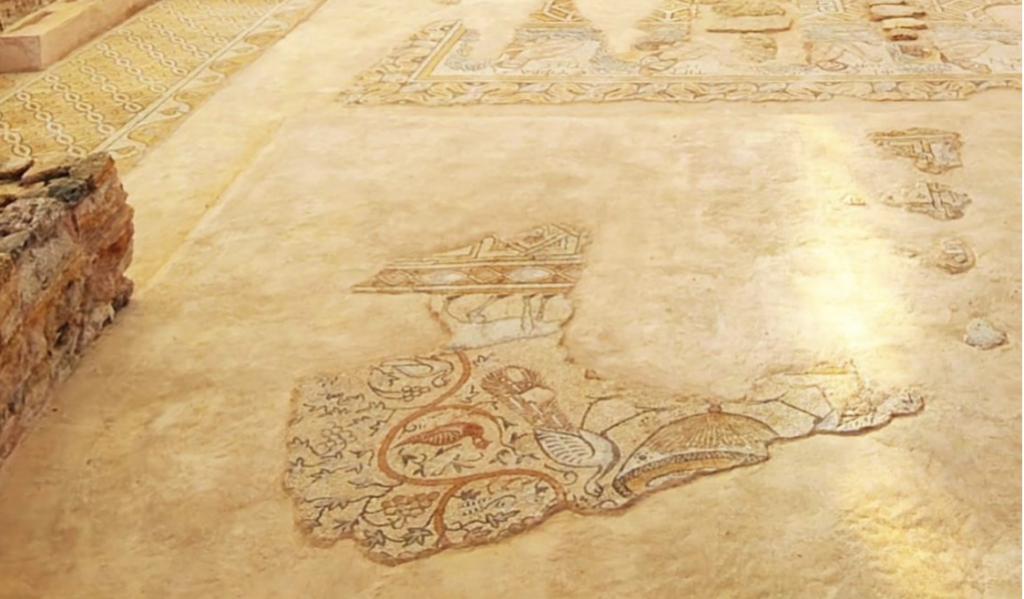
Such protective symbolism had precedents in pre-Christian religious traditions. Its presence in an early Byzantine church illustrates how older beliefs and artistic forms could continue within a different religious framework. Another mosaic depicts a peacock within a refrigerium scene, a motif associated with eternal life and the hope of salvation in early Christian art.
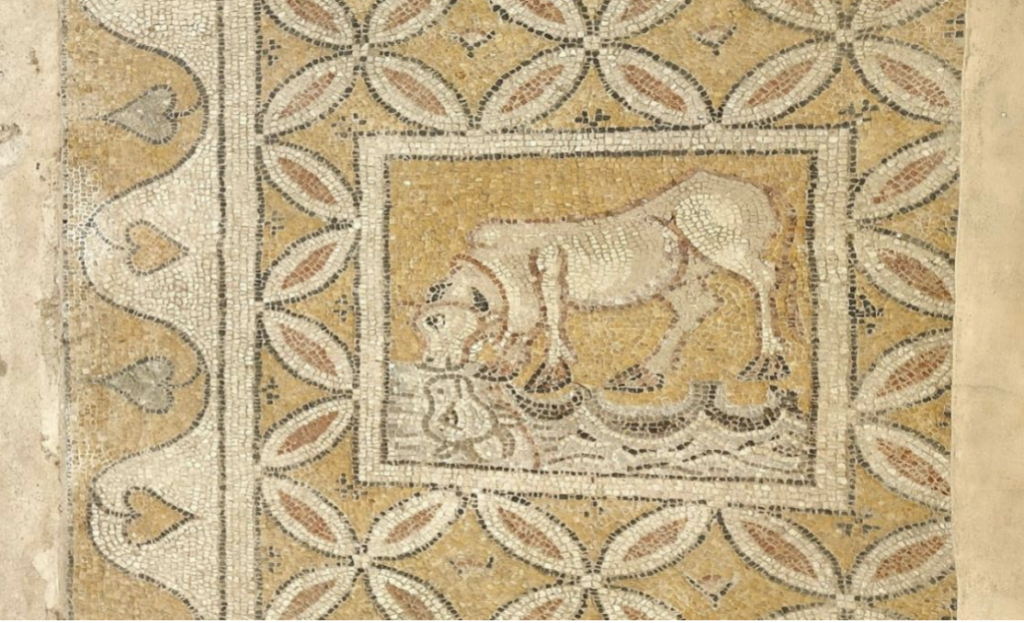
The church also contains geometric patterns, floral designs, and animal figures. Among them is a bull drinking from a pool of water, accompanied by a Greek dedication naming two individuals, Himerius and Valentina, whose gift contributed to the decoration of the building.
These inscriptions offer something the symbolic images cannot: a direct connection to people involved in the church’s history.
A Remarkable Church in an Ancient Anatolian City
Hadrianoupolis lies near the modern town of Eskipazar, in the historical region of Paphlagonia. During the Late Roman and Early Byzantine periods, the settlement developed into an important regional center with churches, baths, residential buildings, and burial grounds.
Archaeological investigations began in 2003 and have since revealed substantial remains of the ancient city. Among its religious buildings, the Church of the Four Rivers stands out for its size and the craftsmanship of its surviving floor mosaics.
Researchers generally date the church to the fifth or sixth century AD, although its precise construction date remains uncertain. Archaeological evidence also indicates that the building underwent alterations following an episode of destruction.
In a later phase, parts of the church complex served as burial areas. Graves dated in previous studies to approximately the seventh through ninth centuries contained human remains alongside personal objects, including rings, earrings, bracelets, and brooches.
The four-river theme was not exclusive to Hadrianoupolis. Comparable representations appeared in early Christian churches at Tegea in Greece, Madaba and Umm er-Rasas in Jordan, Qasr Libya in Libya, and Ohrid in present-day North Macedonia.
What distinguishes the Anatolian example is its detailed combination of named river personifications, classical imagery, and Christian symbolism within a single surviving composition.
The research instead offers a way to understand how a Christian community in Byzantine Anatolia may have imagined Paradise and expressed its religious teachings through art.
Nearly fifteen centuries later, the mosaics still preserve the names of the four rivers. Their possible connection to the virtues of prudence, courage, temperance, and justice suggests that the church floor may have communicated a message extending far beyond the waters of Eden.
Özer Uras, N., & Göregen, M. (2026). Arkeoloji, Din ve Sanatın Kesişimi: Hadrianoupolis / Dört Nehir Kilisesi Mozaiklerinde Yaratılış, 2:10-14’ün İkonografik ve Teolojik Yorumu. Medeniyet Kültürel Araştırmalar Belleteni, 6(10), 43-61. https://doi.org/10.60051/medbel.1887549
