
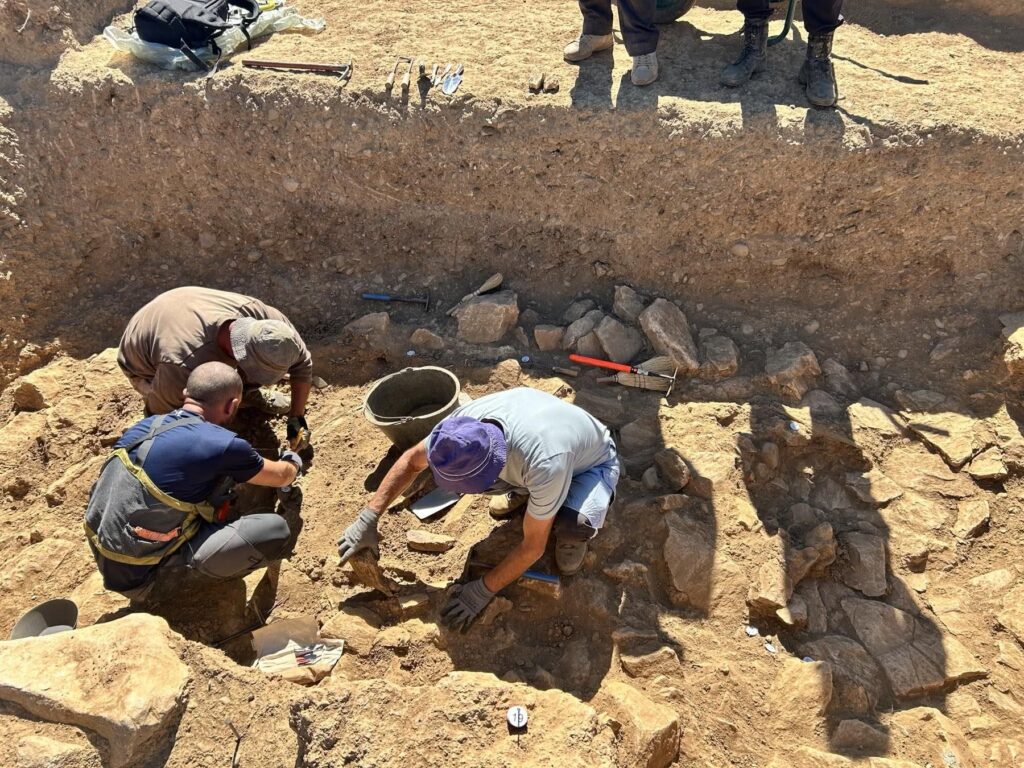
Archaeologists in North Macedonia have uncovered a richly furnished 2,600-year-old burial containing a bronze helmet, shield, sword, spears and gold objects, providing some of the clearest evidence yet that a powerful elite used the area around Lake Ohrid during the Archaic period.
The grave was discovered at the Rasnica necropolis near the village of Koroshishta, close to Struga. Archaeologists say the burial appears to be older than another spectacular tomb found at the same site in 2024. Together, the two discoveries are transforming Rasnica from what might once have seemed an isolated rich burial into a substantial cemetery with exceptional potential for understanding the people who controlled this part of the Balkans in the sixth century
BCE.
A warrior was buried with his entire military kit
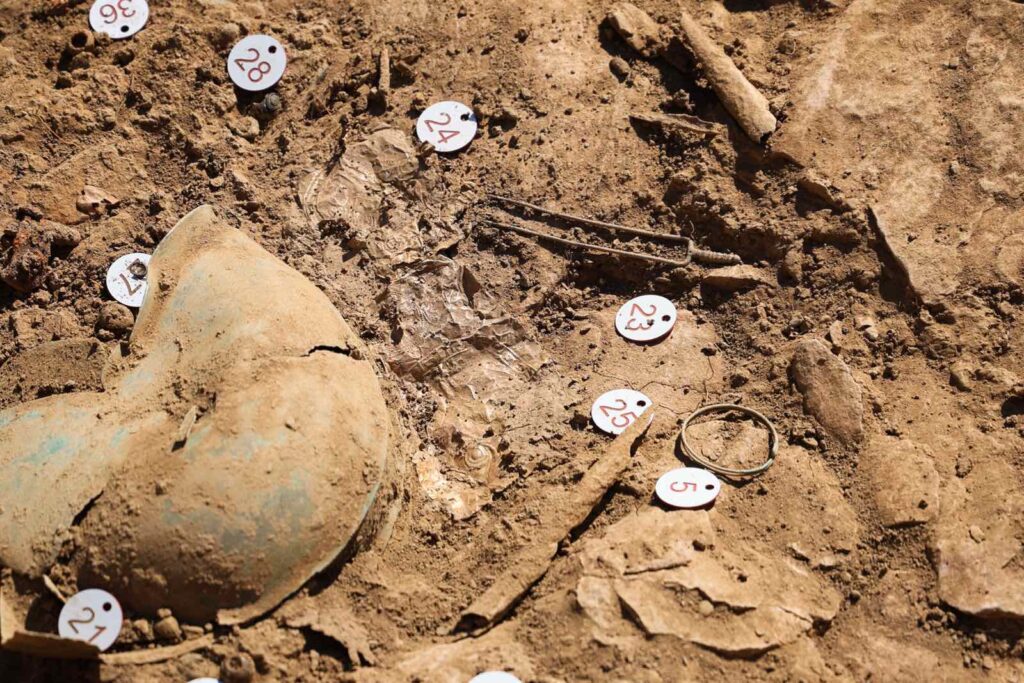
The newly excavated grave contained an unusually complete assemblage of military equipment. Archaeologists recovered a bronze helmet, a shield, a sword, and several spears alongside bronze vessels, a silver pin, amber and glass beads, a gold ring, and other objects made from valuable materials.
Project director Pero Ardžanliev of the National Archaeological Museum described the burial as an exceptionally rich Archaic grave in which the deceased had been laid to rest with a complete set of weapons. The combination of military equipment, jewelry, and prestige goods strongly suggests that the individual occupied a prominent position within the community.
For now, however, archaeologists are being careful about the person’s identity. Although the assemblage has led them to describe the find as a warrior burial, anthropological analysis of the skeleton has not yet established the deceased’s biological sex or age. Researchers also hope to determine whether the person suffered from any diseases and whether there was a biological relationship with the individual buried in the rich tomb discovered at Rasnica two years earlier.
The museum says the burial and its complete weapon assemblage will allow researchers to examine more precisely the status, identity and military role of some of the people buried at Rasnica.
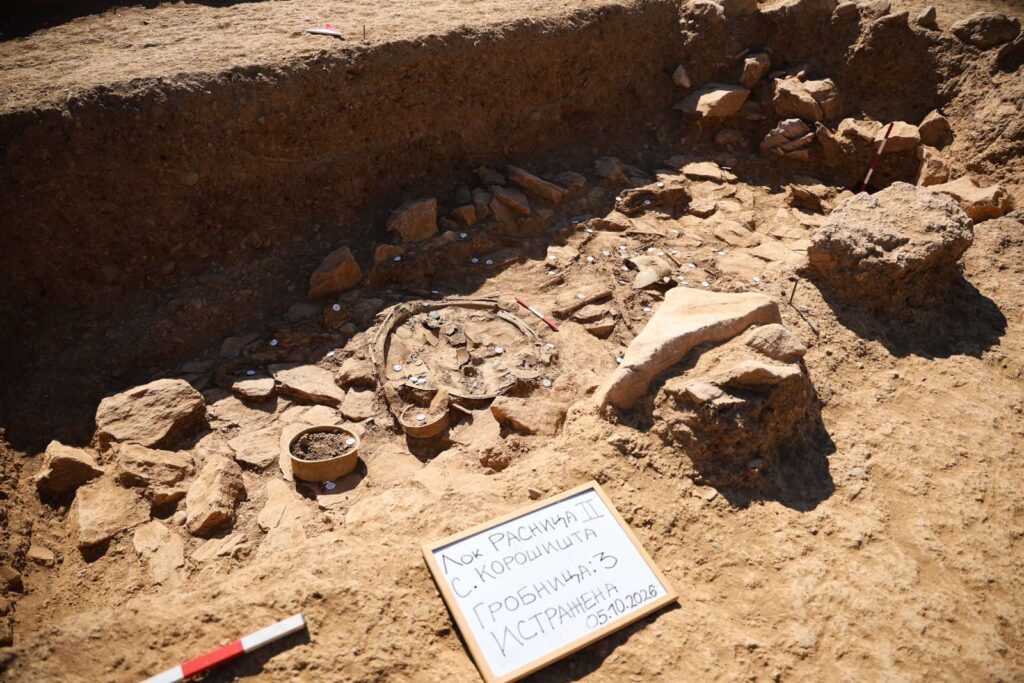
General view of the newly uncovered warrior burial at the Rasnica necropolis near Koroshishta, showing the grave during excavation. Credit: SDK.MK
A sheet of gold may have covered the dead person’s face
One object could make the new burial even more remarkable. Archaeologists found a thin sheet of gold beside the shield and believe it may originally have covered the face of the deceased.
If that interpretation is confirmed, the object would represent a form of gold funerary mask or face covering. The foil is extremely delicate and has yet to undergo conservation, so researchers are withholding a more precise identification until specialists can examine its original shape and construction in the laboratory.
That caution matters because gold coverings placed over the face, eyes or mouth form one of the most distinctive features of elite burial traditions in parts of the Balkans during the Archaic period. Rasnica lies only around five kilometers from Trebeništa, the famous necropolis whose extraordinarily wealthy graves produced gold funerary masks, jewelry, weapons and imported vessels.
Ardžanliev noted that preliminary observations may even place the newly discovered Rasnica gold foil earlier than comparable material from Trebeništa. More work will be needed before archaeologists can establish exactly how the two cemeteries relate to one another.
The New Grave Builds on a Major 2024 Discovery
Rasnica had already attracted major archaeological interest two years earlier, when excavations revealed a monumental burial complex measuring roughly seven by 4.5 meters and containing more than 100 artifacts from the Late Archaic period. The assemblage included a bronze helmet decorated with gold applications, a bronze shield, gold rings and foils, amber and glass beads, silver pins, a silver kantharos, bronze vessels and terracotta figurines.
Many of those objects had close parallels at Trebeništa, the famous elite necropolis located only a few kilometers away. Rasnica, however, offers archaeologists something particularly valuable: a modern excavation context in which the position of the objects, the construction of the graves and the relationship between different elements of the burial ritual can all be recorded in detail.
That context has become even more important with the 2026 discovery. The National Archaeological Museum says the new burial provides further confirmation that Rasnica functioned as an Archaic-period necropolis during the sixth century BCE and offers new evidence for studying the status, identity and military role of some of the people buried there.
An elite landscape around Lake Ohrid
Rasnica does not stand alone. Archaeologists have long known that the Ohrid-Struga region contained a network of wealthy Archaic cemeteries. Besides Trebeništa, burials of the period have been investigated at Radolišta and nearby Delogožda, showing that affluent communities occupied the region well before the rise of the better-known kingdoms and cities of the Classical and Hellenistic periods.
The sixth century BCE was a period of intense movement of goods, technologies and ideas through the Balkans. Objects found in elite graves around the Ohrid basin combine local burial customs with prestigious items and artistic traditions circulating through Macedonia, the Aegean and wider Mediterranean world.
That wider setting also explains why amber, precious metals, sophisticated bronze vessels and elaborate weaponry matter. These were not simply possessions placed beside the dead. Together they expressed status, connections and identity at a time when communities in the central Balkans were becoming increasingly integrated into long-distance exchange networks.
The precise cultural and political identity of the people buried at Rasnica remains a subject for archaeological research. The new discoveries are therefore more useful when treated as evidence of a powerful local elite than when forced into later ethnic or national categories that did not necessarily exist in the same form 2,600 years ago.
Two rich graves have changed the picture
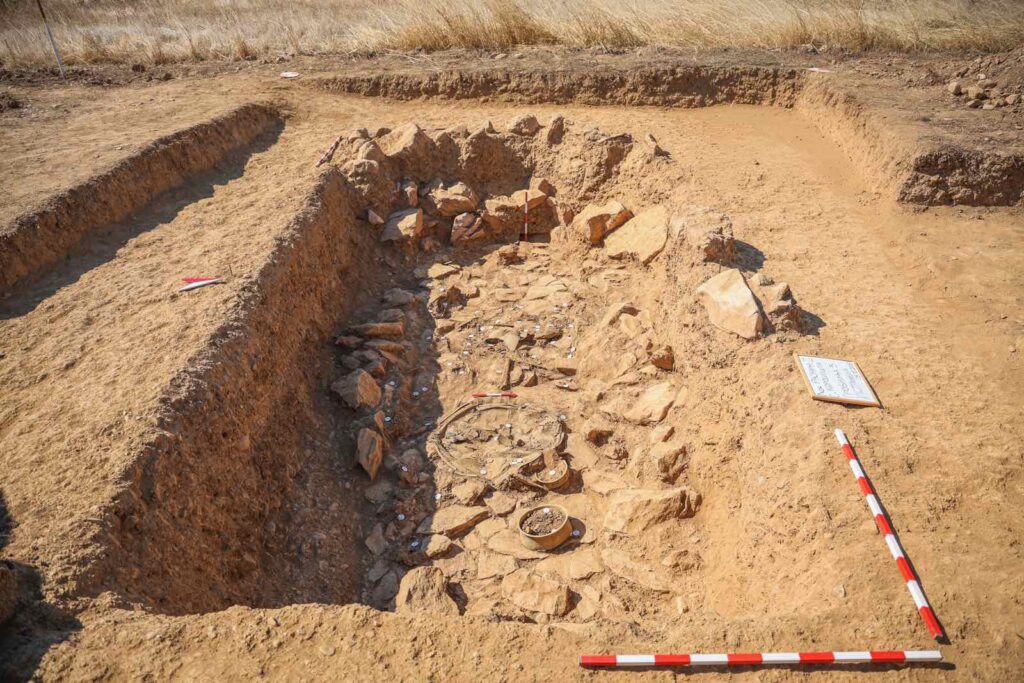
For archaeologists, the latest discovery resolves one important question while creating many others. The extraordinary 2024 tomb can no longer easily be interpreted as an isolated event. A second rich burial, apparently even older and equipped with an almost complete set of weapons, demonstrates that Rasnica formed part of a much larger funerary complex.
The National Archaeological Museum now wants the excavations to continue as a long-term systematic project. Heritage authorities have also indicated that they will seek sustained government funding for excavation, conservation and study of the site.
The museum now describes Koroshishta as one of North Macedonia’s most significant newly discovered archaeological complexes from the Archaic period.
What remains beneath the surrounding ground may ultimately prove more important than the gold already recovered. With two exceptional graves now documented in their archaeological context, Rasnica is emerging as one of the key sites for understanding wealth, warfare and elite burial traditions in the central Balkans during the sixth century BCE.
