
A life-size figure carved into a granite outcrop in northern Sudan has become the focal point of a much larger archaeological story. The mysterious image may portray an ancient Nubian ruler, but centuries after its creation, a Christian community built a church around the same rock, preserving the carving at the heart of a new sacred landscape.
Researchers working in the Miseeda area of the Mahas region have now placed the monument within a history that stretches from prehistoric communities to medieval Christianity and modern local folklore. Their survey documented nearly 300 archaeological sites around the Third Cataract of the Nile, revealing a landscape that repeatedly attracted settlement, ritual activity and new meanings over thousands of years.
A mysterious ruler carved into the rock
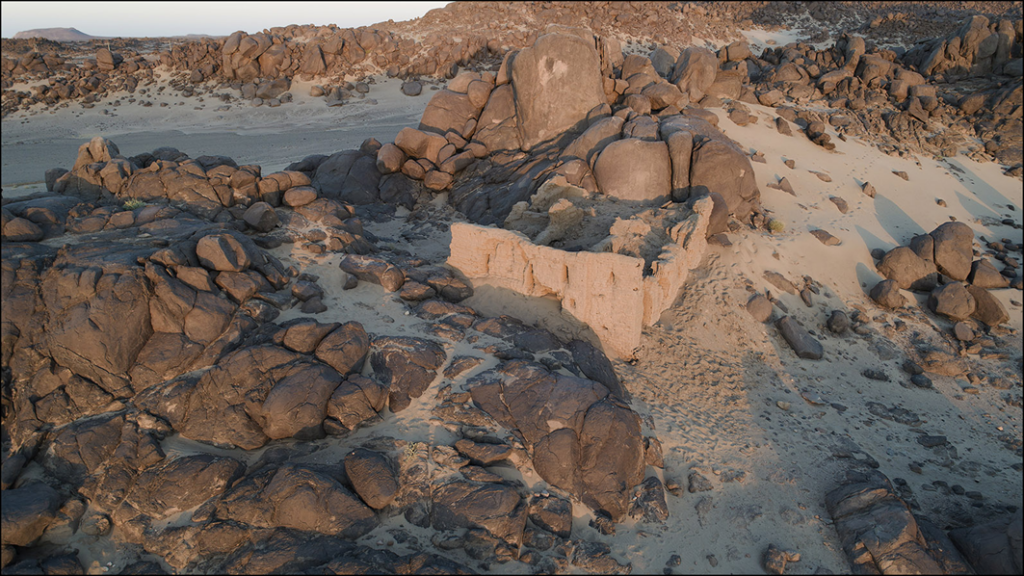
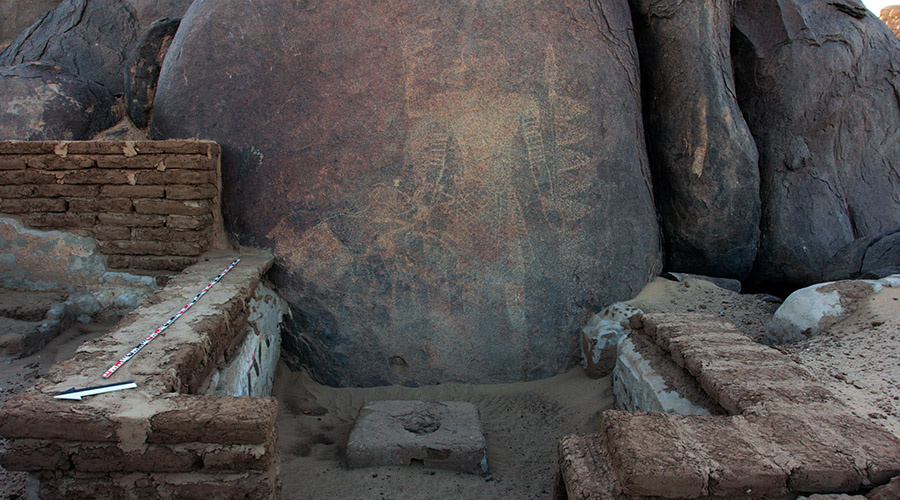
The most striking feature stands at site MAS.021, where a large human figure dominates the surface of a granite boulder. Researchers describe the image as life-size and suggest that it may represent a Nubian ruler from the Kerma or Kushite cultural sphere, although its precise date remains uncertain.
Monumental royal rock carvings remain unusual in Nubia. The researchers compare the Miseeda image with a representation of the Meroitic king Sherkarer at Gebel Qeili, where a monumental carving has been interpreted as an expression of royal authority near the edge of the kingdom. The comparison raises the possibility that the Miseeda figure also marked a politically or culturally important frontier zone, but the team stresses that more precise dating will be necessary before reaching firmer conclusions.
The surrounding rock surfaces add another layer to the story. Archaeologists recorded large images of a lion, an elephant and what may be a rhinoceros, along with smaller cattle figures. Other carvings include Christian crosses, ships and human figures whose dates remain uncertain, suggesting that successive communities repeatedly returned to the same rocky landscape and added their own symbols.
A Christian church rose around an older monument
Around the seventh century, a Christian community constructed a church at the site, incorporating the much older carved rock into its setting. Rather than erasing the earlier image, the new religious landscape appears to have formed around a place that had already held social or symbolic importance for generations.
The surrounding rock art strengthens that interpretation. Several carvings from the Christian period feature crosses and other motifs associated with the new faith, and some appear to direct attention toward the church itself. Pottery found in the area also connects Miseeda with the early Christian kingdoms of Nubia, including wares associated with Nobadia and early Makuria.
This makes the site more than a simple case of one monument replacing another. Instead, the evidence points to a long process in which older places acquired new meanings while remaining important within the local landscape.
A frontier shaped by thousands of years of movement
The wider survey shows that Miseeda formed part of a much larger cultural crossroads. Researchers identified periods of particularly intense activity during the Mesolithic, the Late Neolithic and Pre-Kerma phases, and the Christian era. Material from the Classic Kerma through Kushite periods appears less frequently, although the monumental petroglyph provides one of the most conspicuous traces from that broader span.
Ceramic evidence also reflects the region’s position between northern and southern Nubia. Pre-Kerma and Kerma pottery combines elements associated with both traditions, while later material reveals changing regional connections over time. The researchers interpret Mahas not as an isolated peripheral zone, but as a frontier where communities, technologies and cultural practices repeatedly met and changed.
Their interdisciplinary project combines archaeological survey, rock-art analysis, ethnographic research and geographic information systems. By examining these different forms of evidence together, the team aims to reconstruct how the same landscape continued to matter even as political systems and religious traditions changed.
From sacred place to stories of curses and spirits
The history of Miseeda did not end with the medieval church. Local oral traditions still connect the archaeological landscape with stories about gold, spirits, miraculous places, and curses. The church, nearby ruins, and water-associated sacred locations remain part of a network of stories that preserves older associations even as their meanings shift.
According to the ethnographic research, local people once regarded the church and the nearby Diffi Allirki fortress as both miraculous and dangerous places. Pilgrimages and ritual offerings took place there, although the church’s sacred status has gradually faded. Today, people also know it by names including “Beit Kitchiner” and “Beit Sheitan,” the latter meaning “House of the Devil.”
That changing reputation may be one of the most revealing aspects of the site. A rock that may once have carried an image of political authority later became part of a Christian sacred centre and eventually entered a world of local stories about supernatural forces.
At Miseeda, archaeology does not preserve a single frozen moment. It records how one place could accumulate new meanings for thousands of years, while an ancient figure carved into stone remained physically present through every transformation.
Ciesielska, J. A., Drzewiecki, M., Innemée, K. C., Kurcz, M., de Lellis-Danys, K., Osypiński, P., … Zielińska, D. (2026). Miseeda: between kingdoms, through epochs—reconstructing a history of the Mahas region (Sudan). Antiquity, 1–8. doi:10.15184/aqy.2026.10427
