
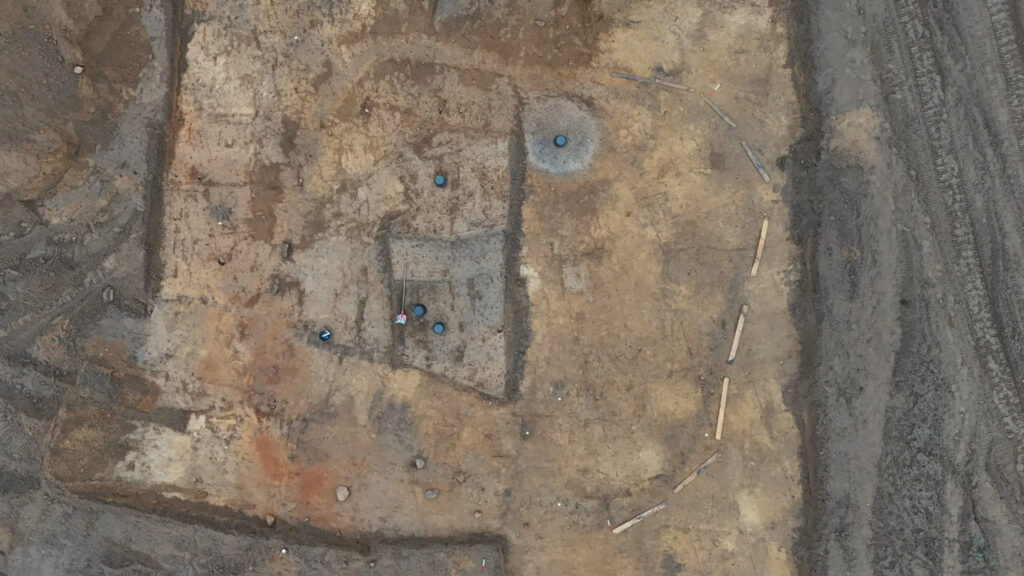
Archaeologists in Germany have uncovered an unusually large, nearly square structure dating from the Bronze Age near the famous King’s Tomb at Seddin. Striking pottery finds and numerous burned animal bones in the surrounding area clearly distinguish this area from the previously known settlement. The building’s original function remains unclear.
The discovery, announced on October 14 by the Brandenburg State Office for Monument Preservation and Archaeological State Museum (BLDAM), adds a new chapter to research into one of northern Europe’s most remarkable Late Bronze Age landscapes.
An Unusual Building in a Bronze Age Settlement
Structures from the Late Bronze Age—across all regions and architectural styles—are invariably rectangular in shape. However, this is not the case at Seddin: archaeologists exposed the foundations of a building measuring 10.6 meters from north to south and 11.4 meters from east to west.
The building was therefore almost square in shape and even wider than the structure known as the “King’s Hall.” Across the region, Late Bronze Age communities generally constructed long, rectangular buildings. Square structures were exceptionally uncommon, making the Seddin discovery an architectural rarity.
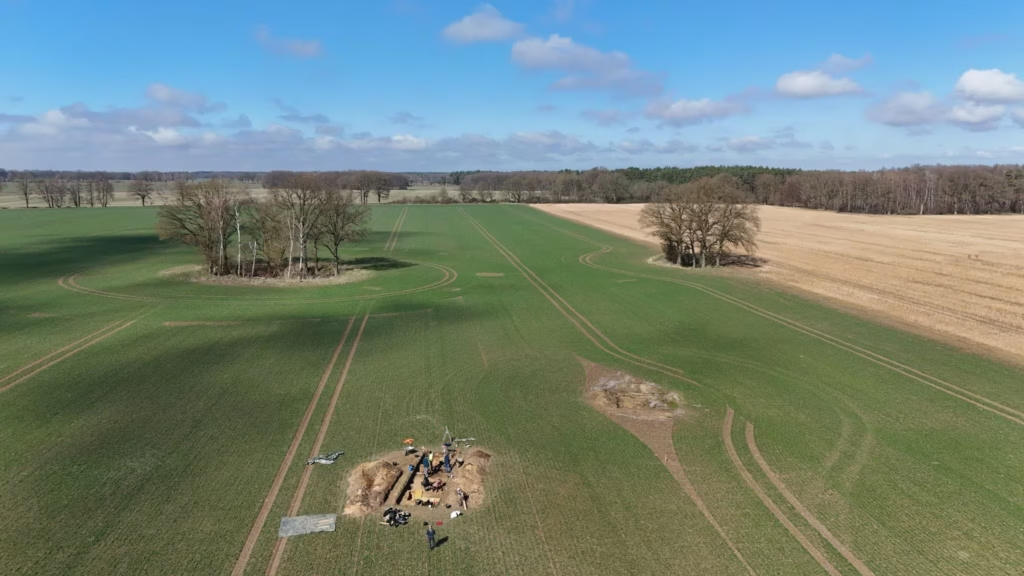
The building occupied a prominent position on a slight rise overlooking the surrounding terrain. Its walls followed a construction technique involving narrow foundation trenches containing stones, similar to the method used for another monumental building at Seddin known as the King’s Hall.
Although its dimensions do not make it the largest building at the settlement, the newly discovered structure is wider than the King’s Hall. Its position and unusual architecture suggest that it may have served a particular purpose within the community.
Its position and unusual architecture suggest that it may have served a particular purpose within the community.
Giant Pottery Vessels and Burned Animal Bones
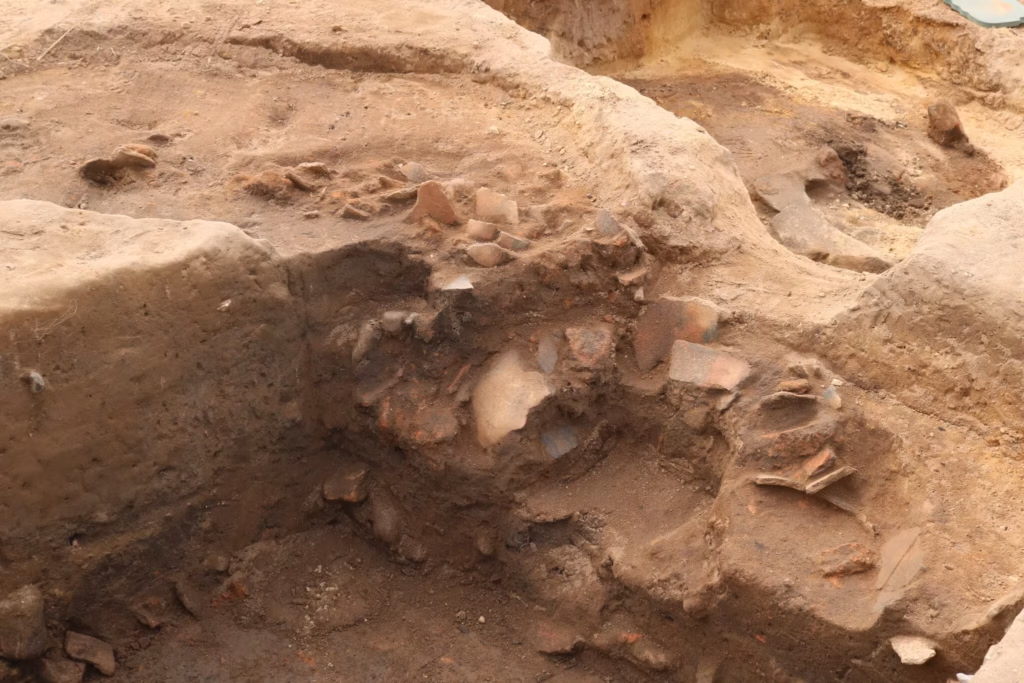
Excavations over the past ten years have yielded relatively few ceramic finds in Seddin. The finds consisted primarily of shards from bowls, tureens, double cones, and storage vessels of standard sizes.
A different picture has now emerged in the vicinity of the square building. Large quantities of pottery were uncovered there. Some vessels have rim diameters of more than 50 centimeters, making them significantly larger than the storage vessels known to date, which have diameters of 30 to 40 centimeters.
Such unusually large containers may have helped serve food and drink to sizable gatherings. Their presence raises the possibility that the building played a role in communal meals or special celebrations rather than ordinary household activities.
The animal bones offer an even more striking contrast. Across a decade of earlier excavations, researchers recovered just two animal bones from the settlement. Around the square building, however, every larger pit examined so far has contained fragments of burned animal remains.
Investigators suspect that people deliberately burned the animal remains. One explanation involves large meals followed by the burning of discarded bones. Another possibility is that participants sacrificed whole animals during ceremonies.
A Connection to the Legendary King Hinz
The newly uncovered building lies approximately 900 meters from the celebrated Royal Tomb of Seddin, a monumental burial mound associated with the legendary figure known as King Hinz.
Discovered in 1899, the enormous burial mound dates to around 800 BCE and contained the cremated remains of three people, along with bronze weapons, vessels, and other valuable objects. Archaeologists believe the elaborate burial belonged to an important member of the region’s elite.
The tomb takes its name from a local legend about King Hinz, a powerful ruler said to have been buried inside three nested coffins.
When the burial chamber was opened, archaeologists discovered a bronze urn containing human remains inside a larger pottery vessel, a remarkable resemblance to the old story. Yet there is no evidence that King Hinz was a historical figure or that the man buried there was an actual king.
Excavations in 2023 revealed another remarkable structure nearby: the so-called King’s Hall, regarded as the largest known hall of the Nordic Bronze Age. Radiocarbon evidence places that building in the tenth to ninth centuries BCE, slightly earlier than the burial mound.
The square building now adds another element to this picture. Pottery evidence and available radiocarbon dates suggest that it was in use around the same time as the burial associated with King Hinz.
The discovery therefore raises an intriguing question: did the communities responsible for Seddin’s monumental burial also maintain special places for gatherings, feasting and ceremonial activities?
A Temple or a Place for Communal Feasts?
Researchers believe the square building may have served as a templum, a space used for ceremonies. Its unusual shape, prominent location, oversized pottery, and concentrations of burned animal bones all support the interpretation of a building with a special role.
Yet none of these clues establishes that it was a temple. Large communal meals, ceremonies and other gatherings could have left similar archaeological traces, and the evidence does not yet identify a particular religious practice.
For more than a century, the Royal Tomb has dominated the story of Seddin. The latest discovery shifts attention toward the people who lived nearby and the activities that brought them together. Whether the square building hosted ceremonies, feasts, or both, its remains suggest that Bronze Age life around the royal burial mound was more complex than archaeologists previously understood.
The continuing investigations form part of a collaborative project between BLDAM and the University of Göttingen, which has been examining the settlement around Seddin’s famous burial monument.
Brandenburg State Office for Monument Preservation and Archaeological State Museum (BLDAM)
