
15 February 2026 The Future is the Product of the Past

Exceptional Discovery in the Ionian Sea: Newly Revealed Roman Shipwreck Found off Gallipoli, Italy

Located in southern Italy’s Puglia region, on the Ionian coast of the Salento Peninsula (not to be confused with Gallipoli in Türkiye), the historic port town of Gallipoli is now at the center of an extraordinary underwater archaeological discovery. In a recent Facebook announcement, the Italian Ministry of Culture confirmed the new discovery of a remarkably well-preserved Roman merchant shipwreck resting on the seabed off the city’s coastline.

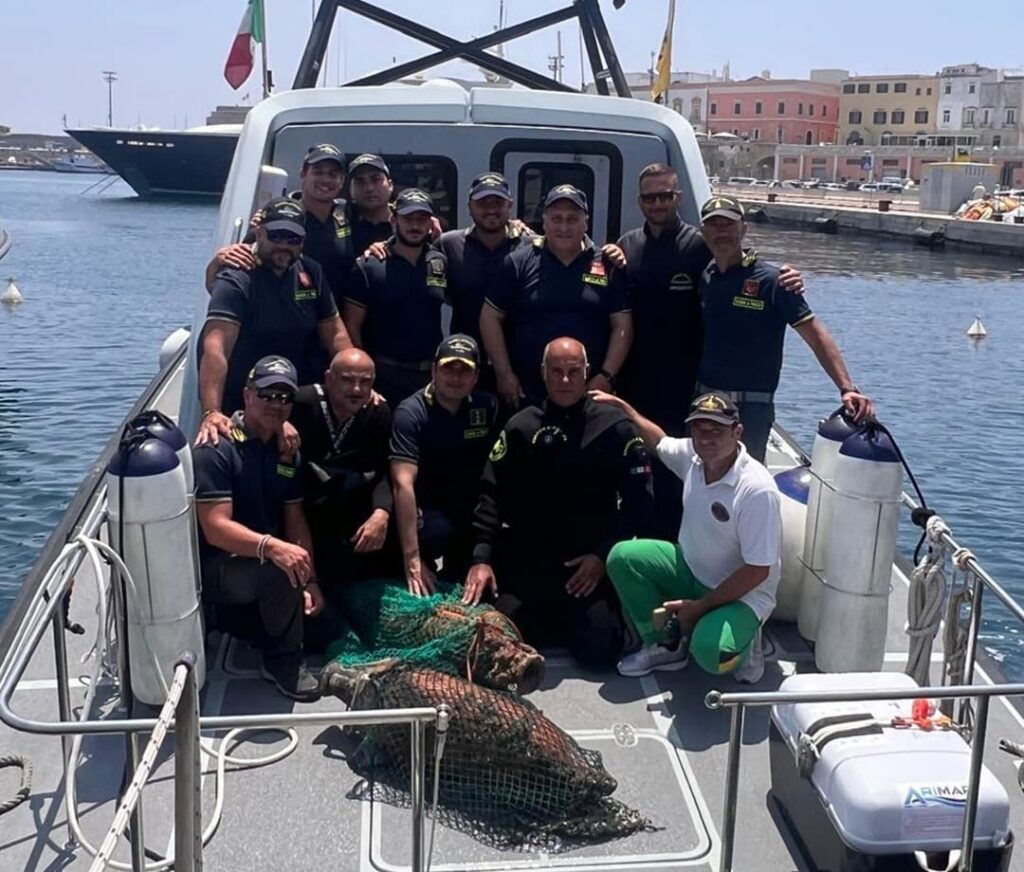
Although the shipwreck was identified in June 2025, Italian authorities intentionally kept the find confidential for several months to protect the site from looting and to preserve its exceptional scientific value. During this period, the wreck was continuously monitored by the Italian Guardia di Finanza, in close coordination with the Archaeological Superintendency for Fine Arts and Landscape (ABAP).

A Roman Merchant Ship Frozen on the Seabed

The newly revealed shipwreck is identified as a large navis oneraria, a Roman commercial vessel used for long-distance maritime trade. Resting on the seabed at considerable depth off the Gallipoli coastline, the ship is described as being exceptionally well preserved, with its cargo still clearly visible.

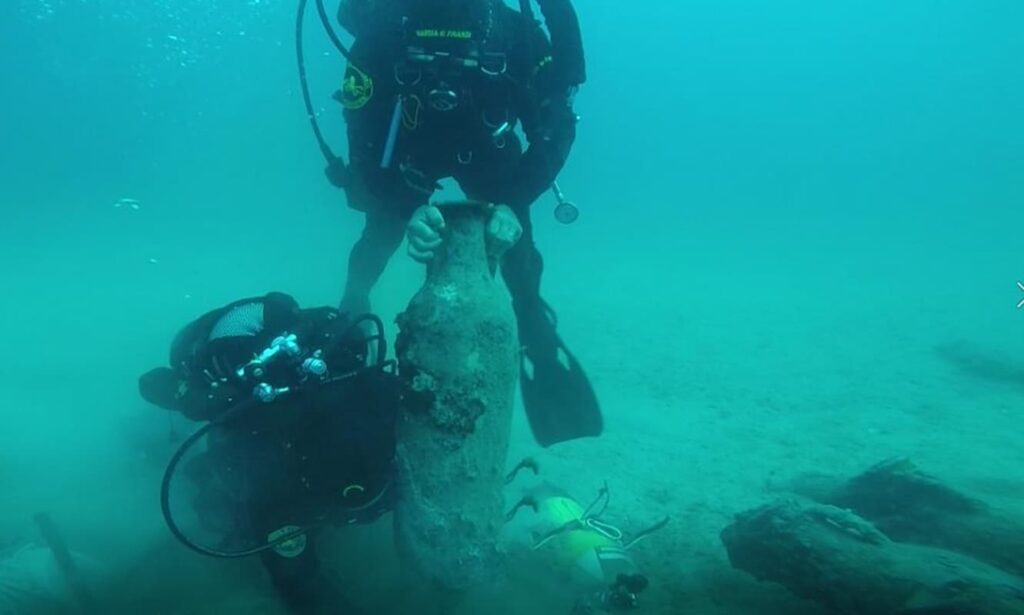
What makes the discovery particularly significant is the nature of the cargo: amphorae filled with garum, the fermented fish sauce that was one of the most prized and expensive commodities of the Roman world. Garum was not only a staple of Roman cuisine but also a luxury product, traded across the empire from Hispania to Gaul and beyond.

A Discovery Kept Secret to Protect a Priceless Site

According to the Ministry of Culture, secrecy was essential in the months following the discovery. Underwater archaeological sites are especially vulnerable to illegal salvage, and the presence of a cargo as valuable as garum amphorae posed a high risk of looting.


📣 Our WhatsApp channel is now LIVE! Stay up-to-date with the latest news and updates, just click here to follow us on WhatsApp and never miss a thing!!


Throughout this period, the area was continuously monitored by maritime patrols, while preliminary assessments were carried out by specialists to evaluate the condition of the wreck and its archaeological potential. Only after securing the site and defining a protection strategy did authorities decide to make the discovery public.
Some of the garum-filled amphorae recovered from the seabed at the newly discovered Roman shipwreck off Gallipoli, in southern Italy’s Ionian Sea. Credit: Italian Ministry of Culture

New Insights into Roman Trade and Daily Life

The garum cargo provides a direct and rare testimony of commercial exchanges in the Roman Mediterranean. Archaeologists believe the ship was part of an extensive trade network supplying elite markets with luxury food products, offering new opportunities to study Roman economic systems, consumption habits, and daily life during the imperial period.

Experts underline that finds of this scale and state of preservation are uncommon. The arrangement of the amphorae on the seabed still traces the original outline of the vessel, allowing researchers to reconstruct shipbuilding techniques, cargo organization, and maritime routes with unprecedented accuracy.

A Strategic Area for Ancient Navigation

The waters off Gallipoli and the wider Salento coast were a strategic maritime corridor in antiquity, connecting the eastern and western Mediterranean. However, the same routes were also dangerous, exposed to sudden storms and complex coastal morphology, which often led to shipwrecks.

This latest discovery confirms the Ionian Sea as one of the richest underwater archaeological areas in southern Italy, reinforcing the need for long-term protection and research initiatives.

Toward Excavation and Preservation

The Ministry of Culture has announced that the discovery will now be followed by systematic documentation, advanced underwater surveys, and the planning of future excavation and conservation activities. These efforts aim not only to protect the wreck but also to make its historical value accessible through research, exhibitions, and public communication.

“A submerged heritage that returns to tell its story,” the Ministry stated in its announcement—one that promises to deepen our understanding of Roman civilization and its vast maritime world.

Cover Image Credit: Italian Ministry of Culture Via Facebook

Related Articles

Norwegian couple found a Viking Age Grave And Sword in their garden

3 July 2023

3 July 2023

While trying to expand their home, a Norwegian couple found a Viking Age grave and sword in their garden. It’s...

Shackled skeleton identified as rare evidence of slavery found in Rutland

7 June 2021

7 June 2021

In Rutland, archaeologists discovered an ‘unusual’ skeleton of a Roman slave, who might have been a criminal sentenced to death....

The Historical Building Next To The Million Stone Will Sell

6 February 2021

6 February 2021

Everyone has heard of the Million Stone, which was built during the Byzantine Empire and accepted as the zero points...

Thousands of Ancient Tombs Discovered in Xian

23 February 2021

23 February 2021

According to the Shaanxi Provincial Archaeological Institute, more than 4,600 ancient cultural remains were discovered during the expansion project of...

Archaeologists discovered an enigmatic complex of rooms, interiors of which covered with figural scenes unique to Christian art

7 April 2023

7 April 2023

Archaeologists of the Polish Center of Mediterranean Archaeology at the University of Warsaw discovered an enigmatic complex of rooms made...

Rare 1,900-Year-Old Aramaic Inscription Discovered in Dead Sea Cave Near Ein Gedi

11 August 2025

11 August 2025

Archaeologists have uncovered a rare 1,900-year-old Aramaic inscription in a Dead Sea cave near Ein Gedi, possibly linked to the...

An Elite Nubian Woman’s Burial, Dating Back 4,000 Years, Reveals the Oldest Evidence of Tumpline Use

15 April 2025

15 April 2025

A recent study analyzing 30 ancient skeletons from the Abu Fatima cemetery in Nubia, Sudan, has revealed that women in...

1,500-Year-Old Stained Glass and Mosaics Discovered at Harran Cathedral Excavation in Türkiye

7 February 2025

7 February 2025

Recent excavations at the historic Harran archaeological site, which is included on UNESCO’s World Heritage Tentative List, have yielded rare...

Cuneiform Clues Reveal Körzüt as “The Sacred City of Haldi,” in Urartu Kingdom

6 August 2025

6 August 2025

Excavations in eastern Türkiye uncover a major religious center of the Urartian Kingdom—The Sacred City of Haldi, shedding new light...

A Decorated Block with Decapitated Gaul Found for the First Time in Toul, France

22 July 2024

22 July 2024

A Corinthian-style carved block that was once part of the entablature of a monumental Gallo-Roman public building has been discovered...

Tipasa’s Underwater Secrets: Algeria’s Hunt for a Lost Ancient City

1 September 2025

1 September 2025

Algeria has launched a new underwater archaeological campaign off the coast of Tipasa, a UNESCO World Heritage Site celebrated for...

Archaeologists conducting excavations at the Roman Fort of Apsaros in Georgia, found evidence of the Legion X Fretensis

27 May 2023

27 May 2023

Polish scientists discovered that Legion X Fretensis, known for its brutal suppression of Jewish uprisings, was stationed in the early...

New Discoveries Made in World’s Oldest Ancient Shipyard

11 June 2024

11 June 2024

Associate Professor Hakan Öniz, who discovered the world’s largest and oldest shipyard dating back to the Bronze Age in 2015...

A 3,600-Year-Old Bronze Minoan Dagger Discovered in Antalya Underwater Excavation

29 August 2024

29 August 2024

A bronze dagger with silver rivets that dates to the Minoan civilization approximately 3,600 years ago was discovered during an...

A mosaic made by the freed slave to thank God was found in the church excavation

10 January 2022

10 January 2022

During the season excavation of the 6th-century Holy Apostles Church, located in an orange grove in the Arsuz district of...

Comments
Leave a Reply

Your email address will not be published. Required fields are marked *