
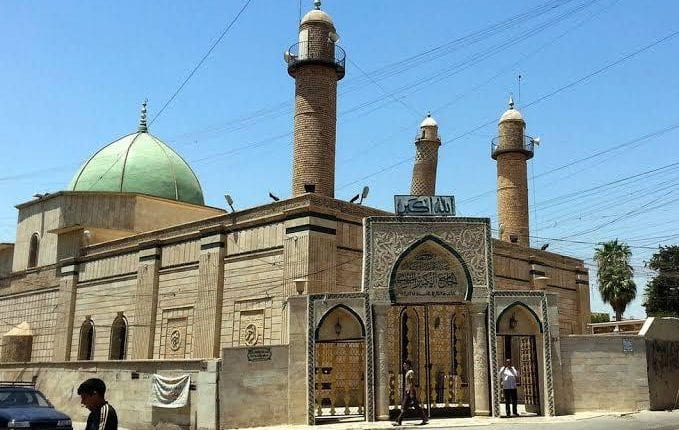
UNESCO recently announced that the El Nouri mosque, which was bombed by ISIL(The Islamic State of Iraq and the Levant), will be restored within the scope of the Old City. He chose an Egyptian firm to restore the mosque.
The design, which won an international competition, was not liked by Iraqi experts. Iraqi experts question why the Design ignored the city’s unique heritage and why an Iraqi architect was not selected for the project.
Architects and archaeologists called the cubist redesign “inspired by the Gulf” a modernist carbuncle.
Mosul city residents want the beloved mosque complex to be rebuilt with domes and arches in accordance with the architectural style of the Old City.
“It’s not Mosul, it looks exactly like Sharjah,” said Rasha Al Qeedi, a senior analyst for the Newlines Institute for Strategy and Policy, referring to the Gulf emirate renowned for its contemporary architecture, including the Zaha Hadid-designed Bee’ah Headquarters.
“You see here the UAE influence,” said Al Qeedi, who is from Mosul. “But it did not require redesign.”
El Nouri mosque was recognized as the place where Abu Bakr al-Baghdadi declared himself caliph in 2014. Three years later, as Iraqi security forces fought a punitive nine-month battle to regain Mosul, besieged Islamic State fighters demolished the mosque complex with explosives rather than allowing it to be recovered.
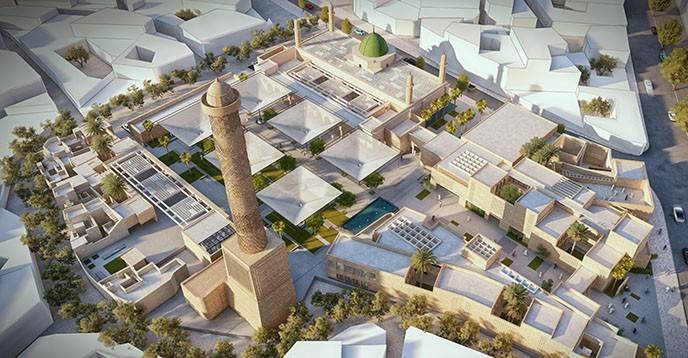
Al Nouri was renowned locally for its 12th-century leaning minaret. Named Al Hadba or “humpback”, the tower in time became the symbol of the entire city.
The historical value of the Old City’s vernacular architecture should be paramount in rebuilding, said Mosul archaeologist Junaid Al-Fakhri.
“Al Nouri mosque is part of Mosul’s DNA,” he said. “The mosque and the minaret are archaeological and historical sites that must be preserved, and no detail should be changed that reduces their archaeological value.”
He questioned why a more traditional restoration was not selected, such as the entry submitted by Mosul architect Husnya Jirgis, who wrote in her application that she wanted to maintain the mosque’s “original character and authenticity”.
The winning Egyptian team said their submission “primarily addresses the need for social cohesion and revival of souls”.
UNESCO said the nine jurors on the selection panel included two Iraqis and that they consulted with representatives from the Iraqi prime minister’s office and the Ministry of Culture.
Paolo Fontani, the head of UNESCO in Iraq, said the mosque’s iconic minaret will be rebuilt as it was before, as will the prayer hall, which will be reconstructed using modern building materials to improve lighting and cooling.
This part will be “a little more forward-looking,” Mr. Fontani said of its architectural style. “There was nothing there before, there was a parking lot, we’re not destroying anything.”
“It’s a mix of modernity and tradition and this is what the jury liked,” he said.
Source: The Age
