6 January 2026 The Future is the Product of the Past

Sensational Discovery: Miniature Gold Box Lock from Roman Era Found

The detectorist Constantin Fried has unearthed a miniature gold box lock dating back to the Roman era in Petershagen, located on the border between Lower Saxony and North Rhine-Westphalia.

According to the Landscape Association of Westphalia-Lippe (LWL), the lock is estimated to be from the 3rd to 4th century AD and is made of pure gold, marking it as a unique and sensational find for researchers.

The tiny lock, measuring just 1.2 by 1.1 centimeters, was examined using a neutron computed tomography scanner at the Paul Scherrer Institute in Villigen, Switzerland.

This advanced imaging technique provided researchers with a detailed view of the lock’s interior. Although the external key and chain were missing from the find in Petershagen, the 3D images revealed gold rivets and links inside the lock.
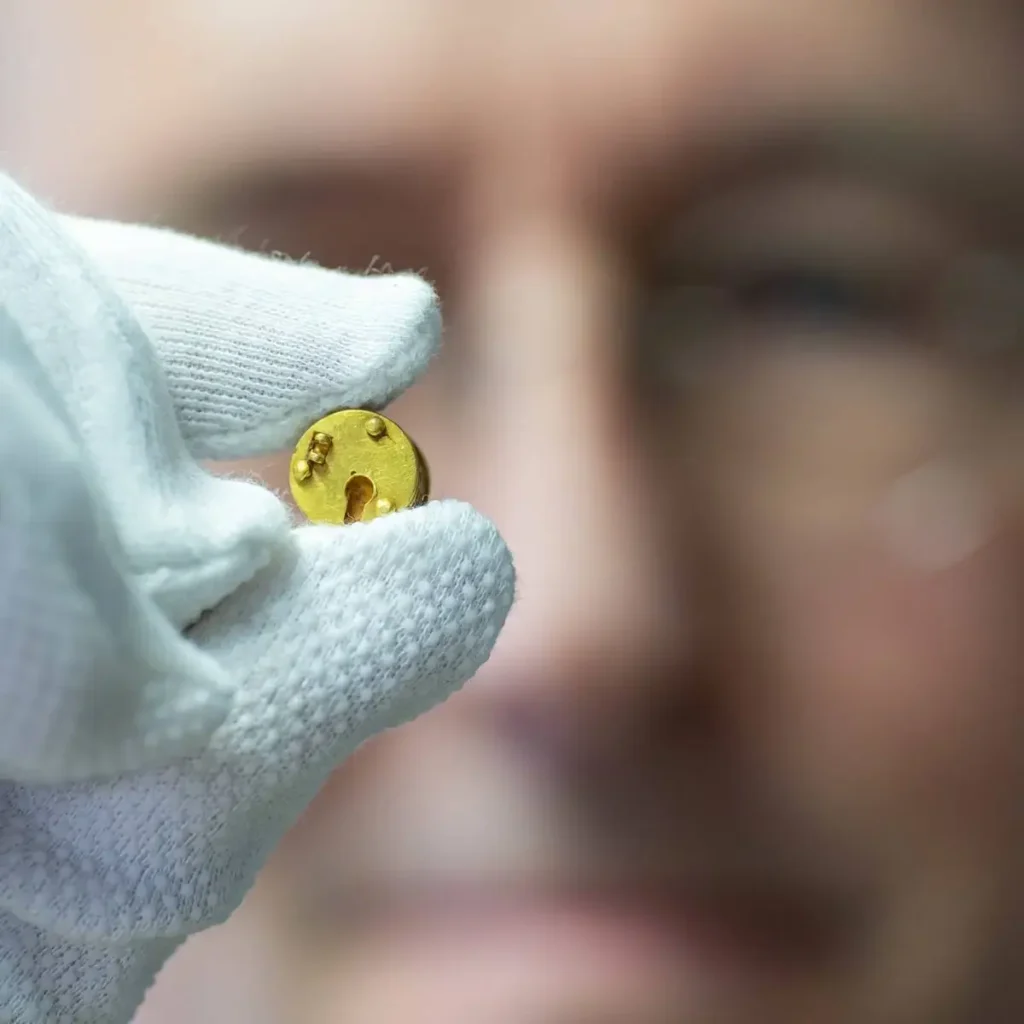
Image credit: Landscape Association of Westphalia-Lippe (LWL)

This evidence confirms that the lock was functional approximately 1,600 years ago. Thanks to the insights gained from the CT scan, the LWL was able to create a 4:1 scale replica of the lock.


📣 Our WhatsApp channel is now LIVE! Stay up-to-date with the latest news and updates, just click here to follow us on WhatsApp and never miss a thing!!


The chief archaeologist of the LWL, Michael Rind, speculates that “perhaps a member of a local elite brought this exquisite piece back as a souvenir or gift upon returning from military service in Rome,” given that similar but larger locks existed during the Roman period.

The LWL notes that many scientific questions remain unanswered. It is unclear how such an extremely small object could have been crafted without the modern tools we have today, such as artificial light or magnifying glasses.

Rind poses the question, “Was this a one-off creation, or are there similar precious miniatures that have yet to be discovered?” He emphasized that the extraordinary find from Petershagen showcases the high level of craftsmanship in provincial Roman metalworking and locksmithing.

LWL

Cover Image credit: Landscape Association of Westphalia-Lippe (LWL)
Related Articles

Archaeologists identify three new Roman camps in Arabia

27 April 2023

27 April 2023

Through remote sensing analysis, archaeologists have identified three new Roman fortified camps throughout northern Arabia. Their study, released today in...

Freshwater and marine shells used as ornaments 30,000 years ago discovered in Spain

7 June 2023

7 June 2023

In Malaga’s Cueva de Ardales, up to 13 freshwater and marine shells that were carefully transformed by humans between 25,000...

In the ancient city of Syedra: a unique mosaic with the 12 labors of Heracles depicted on a single panel found

25 July 2022

25 July 2022

During the excavations in the ancient city of Syedra in the Alanya district of Antalya, approximately 164 square meters of...

In French Necropolis 21 Roman “curse tablets” discovered including one written in the extinct Celtic language of Gaulish

18 January 2025

18 January 2025

During the excavation of an eighteenth-century hospital in north-western France by researchers from the Orléans Archaeological Service, a 2,000-year-old necropolis...

“Secret” Excavations in Luxembourg Reveal 141 Roman Gold Coins from Nine Roman Emperors

13 January 2025

13 January 2025

Archaeologists uncovered a Roman gold coin hoard of 141 Roman gold coins dating to the second half of the 4th...

Danish museum says Vikings had stained glass Windows

15 October 2023

15 October 2023

New research shows that  Viking Age windows were created using stained glass in the 9th century, contrary to popular belief...

World’s Oldest Arrow Poison Discovered in South Africa, Dating Back 7,000 Years

27 January 2025

27 January 2025

In a groundbreaking discovery, archaeologists excavating Kruger Cave in South Africa have identified what may be the oldest confirmed multi-component...

The ruins of a thousand-year-old Buddhist Temple will be opened to the public in Kyrgyzstan

13 September 2022

13 September 2022

The unearthed remains of an ancient Buddhist temple in Kyrgyzstan will open to the public in mid-September as part of...

Neo-Assyrian underground complex discovered under a house in southeastern Turkey

11 May 2022

11 May 2022

An underground Iron Age complex has been found in Turkey that may have been used by a fertility cult during...

4,000-Year-Old Seal Found at Tavşanlı Mound in Western Türkiye

17 August 2024

17 August 2024

4,000-year-old seal were found at the Tavşanlı Mound (or Tavşanlı Höyük) in Türkiye’s Kütahya province—located in the west of the...

Underwater Archaeologists discovered World’s Largest and Oldest ancient shipyard on Dana Island, Türkiye

31 October 2023

31 October 2023

The ruins of the world’s largest and oldest ancient shipyard were found in the north of the island of Dana,...

Archaeologists Discover 2,000-Year-Old Jug in Tajikistan Bearing Woman’s Name

4 July 2025

4 July 2025

In a discovery of rare historical and cultural significance, archaeologists in southern Tajikistan have uncovered a 2,000-year-old clay jug bearing...

Part of The ‘Missing Link’ in Human Migration may have been Found in Kaldar Cave

3 April 2021

3 April 2021

Kaldar cave is an important archaeological site that provides evidence for the transition from the Middle and Upper Paleolithic Ages...

Archaeologists discover three extraordinary 1,800-year-old residential-style tombs featuring rooms and windows, Filled with Han Dynasty Treasures

19 May 2024

19 May 2024

Archaeologists discovered three remarkable 1,800-year-old, residential-style tombs featuring rooms and windows, where a wealthy family was laid to rest alongside...

Excavations at the site in the coastal city of São Luís, Brazil uncovered thousands of artifacts left by ancient peoples up to 9,000 years ago

4 February 2024

4 February 2024

Archaeologists unearthed 43 human skeletons and more than 100,000 artifacts at an excavation site in the coastal city of São...