
A groundbreaking archaeological discovery in the Krumlov Forest is shedding new light on prehistoric life, revealing a startling glimpse into ancient mining, female labor, and ritual burial practices dating back over 6,000 years.
Researchers have unearthed the remains of two women and a newborn buried deep within Shaft No. 4—part of one of the largest prehistoric chert mining complexes in Europe. The burials, associated with the Late Lengyel culture (4340–4050 BCE), offer a rare and detailed window into the harsh realities and complex rituals of Neolithic society.
Hidden Beneath Centuries: A Ritual Mine Burial
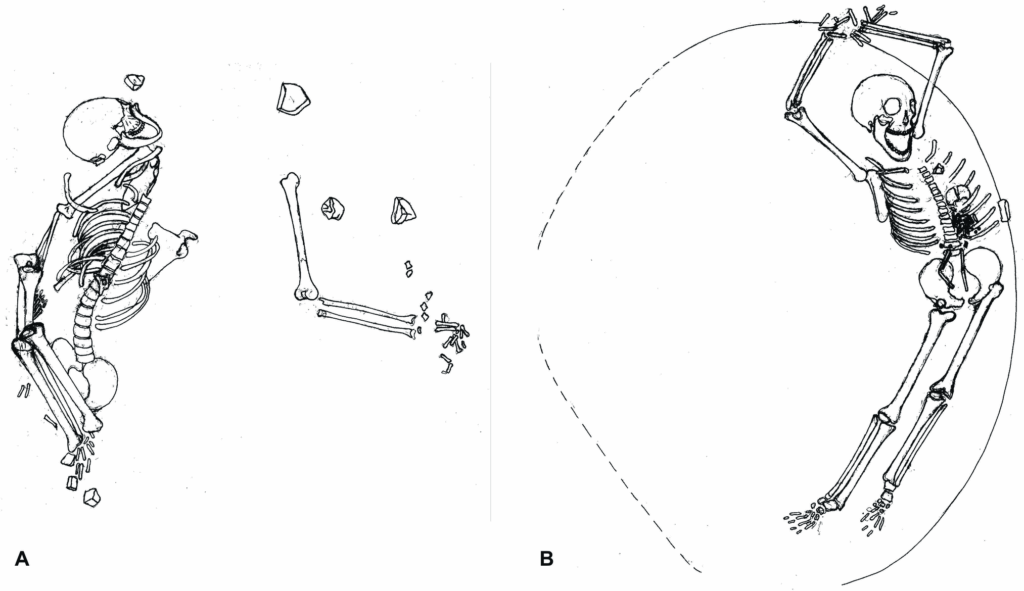
Excavations at the site revealed the skeletons of two adult females and a full-term newborn. One of the most intriguing aspects of the find is the apparent ritual nature of the burial. The upper skeleton lay with a newborn placed gently on her chest, while a dog skull and additional bones were arranged nearby—elements suggesting symbolic significance rather than a standard interment.
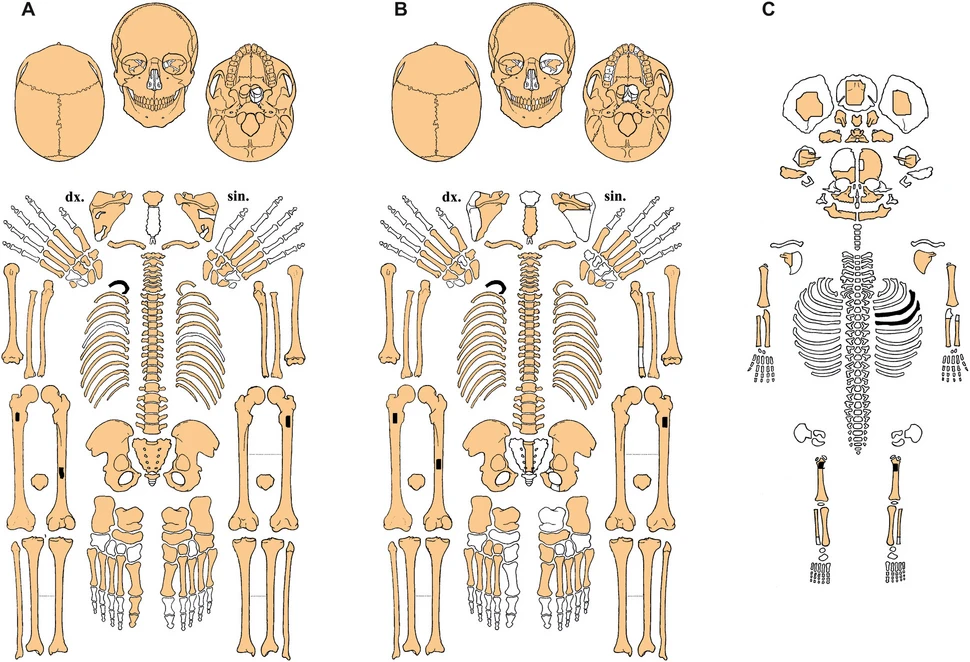
Carbon dating confirmed the age of the remains, placing them squarely in the transitional period between the Neolithic and Eneolithic eras. Both women were short in stature (around 146–148 cm) and showed signs of childhood malnutrition. However, their adult skeletons revealed pronounced muscular attachments and vertebral damage—evidence of a physically demanding life.
Females in the Mines: Victims or Workers?
This discovery challenges long-held assumptions about gender roles in prehistoric mining. “Both women showed significant spinal stress, Schmorl’s nodes, and even spondylolysis,” said Dr. Zdeněk Tvrdý, lead anthropologist on the study. “These are consistent with carrying heavy loads, possibly while working in a forward-bent posture typical of mining.”
One of the skeletons (H2a) exhibited a poorly healed fracture in the ulna, forming a pseudoarthrosis—strongly suggesting the woman continued labor despite a significant injury. The researchers suggest these females were likely not passive ritual offerings, but active laborers in the mine, potentially forced into hard labor due to their physical frailty and social status.
DNA and Diet: Who Were These Women?
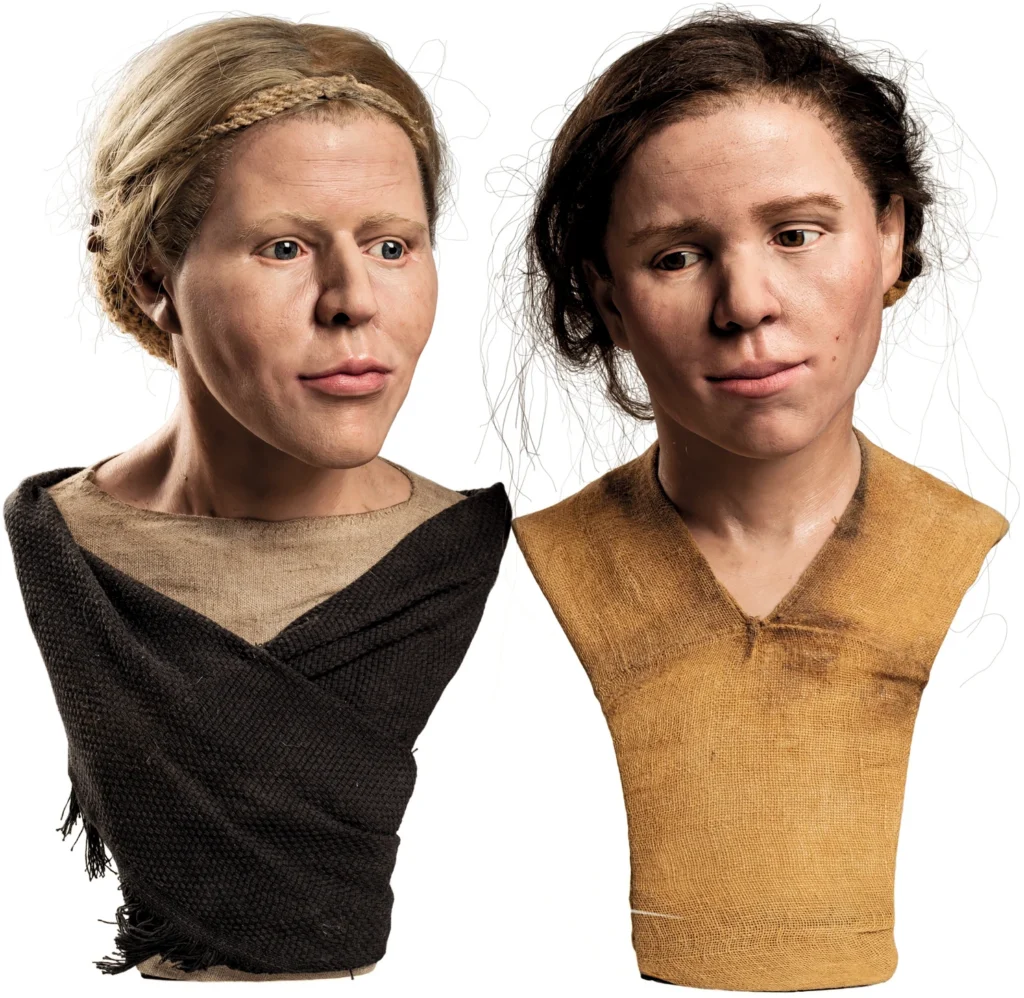
Ancient DNA analysis revealed a genetic relationship between the two women—possibly sisters—while the newborn was not biologically related to either. The DNA results also determined that one woman likely had green or hazel eyes, while the other probably had blue eyes, offering a rare chance for realistic 3D facial reconstructions based on skeletal data.
Isotopic analysis of strontium, carbon, and nitrogen confirmed the women were locals and consumed a protein-rich diet uncommon in the region’s Neolithic populations. According to isotope ratios, meat made up a significantly higher percentage of their diet compared to neighboring communities—perhaps a necessity for sustaining heavy labor.
Technological Firsts: Hyper-Realistic Facial Reconstructions
Utilizing hyper-realistic 3D modelling techniques, the researchers reconstructed the faces of the two women. These silicone-based busts now form part of an exhibit in the Anthropos Pavilion of the Moravian Museum in Brno. The reconstructions are not just artistic interpretations—they are based on precise cranial measurements, genetic phenotyping, and archaeological textile evidence.
“These lifelike models humanize history,” said Eva Vaníčková, lead reconstructive artist. “They allow us to look into the eyes of two individuals who lived, suffered, and worked thousands of years ago.”
A Sacred Landscape of Labor and Death
The Krumlov Forest has long been known as a major site of prehistoric chert mining, used primarily for stone tools. But the increasing evidence of ritualized activity—including burials in deep shafts—has led researchers to reinterpret the forest as a sacred landscape, possibly a symbolic gateway to the underworld.
According to archaeologist Martin Oliva, “This site was not merely industrial; it was spiritual. These burials may represent reconciliation rituals—returning the dead, or even the miners themselves, back to the earth.”
Conclusion: A Compelling Archaeological Mystery
Despite nearly three decades of excavation in the Krumlov Forest, discoveries like these continue to challenge and enrich our understanding of prehistoric Europe. Were these women revered workers, enslaved laborers, or sacrificial offerings? The answer may lie buried in the earth—but thanks to modern science and interdisciplinary collaboration, the past is slowly speaking again.
As researchers gear up for further DNA and proteomic analysis using next-generation sequencing (NGS), the story of the Krumlov women is far from over.
Vaníčková, E., Vymazalová, K., Vargová, L. et al. Ritual Burials in a Prehistoric Mining Shaft in the Krumlov Forest (Czechia). Archaeol Anthropol Sci 17, 146 (2025). https://doi.org/10.1007/s12520-025-02251-1
Cover Image Credit: Vaníčková et al., 2025, Archaeological and Anthropological Sciences, Vol. 17, Article 146. DOI: 10.1007/s12520-025-02251-1
