
12 November 2025 The Future is the Product of the Past

Intricate Design Revealed on 1100-Year-Old Gold-Inlaid Ritual Spear from Japan’s Island of the Gods

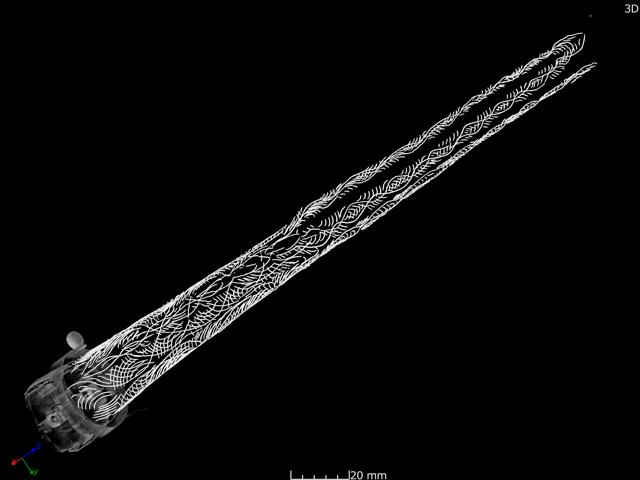
A recent archaeological breakthrough on Japan’s sacred Okinoshima Island has unveiled an ornately decorated iron spear from the late Kofun period, offering a rare glimpse into the spiritual and political rituals of the ancient Yamato Dynasty. Hidden beneath rust and time for over a millennium, the spear has now been confirmed to contain intricate phoenix and vine motifs, inlaid with what is likely pure gold—using an advanced metalworking technique known as kinzogan.

A Sacred Relic from a Sacred Island

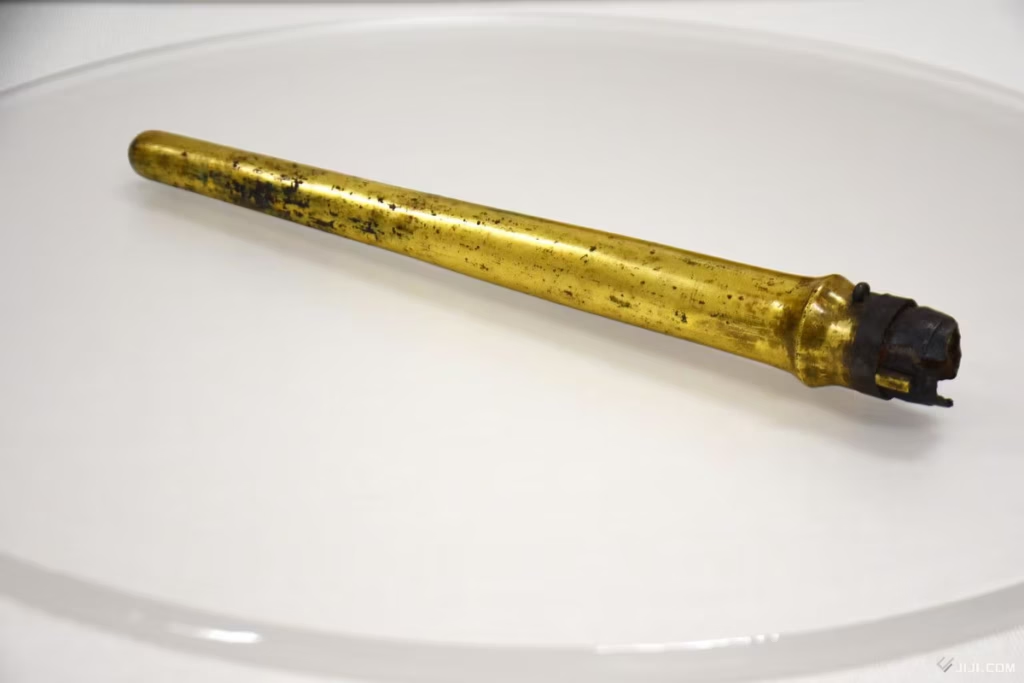
Discovered in 1954 but only recently scanned with high-resolution X-ray CT and X-ray fluorescence technology, the 30.5 cm-long spear had been sealed inside a gilt bronze sheath and found under a boulder on Okinoshima—an island long revered as a sacred space dedicated to marine rituals. The spear is now recognized as one of the finest examples of ritual weaponry from East Asia, with experts calling it “unparalleled in beauty and symbolic craftsmanship.”

According to Toshinori Mizuno, head of materials at the Archaeological Institute of Kashihara, “This spear demonstrates the Yamato state’s extraordinary dedication to the spiritual rites held on Okinoshima. Its complexity reflects both technical mastery and religious reverence.”

Okinoshima: Japan’s Island of the Gods

Located in the Genkai Sea, Okinoshima Island has been considered off-limits to the general public for centuries, and is still maintained under strict ritual purity by the Munakata Taisha Shrine, which manages the sacred island. Even today, women are not allowed to enter the island, and male visitors must undergo purification rituals before setting foot on its shores.

From the 4th to the 9th century, Okinoshima served as a central ritual site for the Yamato polity, Japan’s early imperial state, which performed elaborate ceremonies to pray for safe maritime voyages, particularly those involving diplomatic and trade missions to the Korean Peninsula. Offerings, known as hōnōhin, were dedicated to the sea deities believed to protect these journeys.


📣 Our WhatsApp channel is now LIVE! Stay up-to-date with the latest news and updates, just click here to follow us on WhatsApp and never miss a thing!!


A 3-D image of the spear through the X-ray of a CT scan. Credit: Preservation and Utilization Council of “Sacred Island of Okinoshima and Associated Sites in the Munakata Region"
A 3-D image of the spear through the X-ray of a CT scan. Credit: Preservation and Utilization Council of “Sacred Island of Okinoshima and Associated Sites in the Munakata Region”

These rituals left behind a vast legacy: over 80,000 artifacts, including bronze mirrors, swords, glass beads, and now this ornate spear—all designated National Treasures of Japan.

Rediscovering Ancient Innovation

What makes this spear unique is not just its historical context, but the artistry itself. The embedded patterns, featuring phoenixes (hōō)—mythical creatures symbolizing peace and divine protection—are believed to represent an appeal for celestial favor. Experts suggest that the combination of gold inlay and arabesque patterns may indicate influences from continental Asia, possibly via the Korean Peninsula, while the construction remains distinctly Japanese.

The kinzogan technique seen in the spear involves carving intricate designs into metal and embedding gold wire or foil into the grooves—a process requiring extreme precision and often reserved for royal or sacred items.

According to Tadashi Nishitani, professor emeritus of archaeology at Kyushu University, “This discovery is without precedent in Japan. It confirms the scale and sophistication of state-level ritualism during the Kofun period, centered on Okinoshima’s sanctity.”

Continuing Efforts to Preserve Japan’s Spiritual Heritage

The Cultural Affairs Agency of Japan has allocated significant funding to scan and analyze over 4,200 metal artifacts from Okinoshima, as part of a long-term preservation project coordinated by the “Sacred Island of Okinoshima and Associated Sites in the Munakata Region” Preservation and Utilization Council.
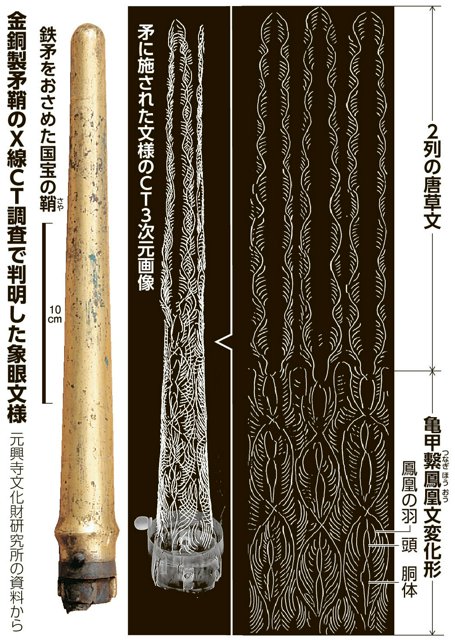
Credit: Preservation and Utilization Council of “Sacred Island of Okinoshima and Associated Sites in the Munakata Region”

This council includes Munakata Taisha, local government authorities, and cultural researchers, all working to protect and promote Okinoshima’s global cultural significance, recognized by UNESCO in 2017 as a World Heritage Site.

A Living Connection to the Past

Okinoshima continues to represent a rare, living connection to ancient Japan’s religious and political history. This latest discovery not only enhances our understanding of Kofun-period craftsmanship but also reaffirms the sacred island’s role as a spiritual epicenter of early Japanese statehood.

As the spear rests once again in protective storage, it stands as a shining symbol—both literally and historically—of a time when gods, rulers, and artisans converged on an island where the sea met the divine.

Okinoshima Heritage

Cover Image Credit: The gilt bronze sheath containing the ancient spear tip was preserved at Munakata Taisha Shrine in Munakata, Fukuoka Prefecture, as of June 10. Photo: Kengo Hiyoshi

Related Articles

A Neolithic Ornate Necklace with Over 2,500 Stones found in a Child’s Grave

3 August 2023

3 August 2023

An ornate necklace found in a child’s grave in ancient Jordan about 9,000 years ago provides new insights into the...

200 Feet to the Past: The Millennium-Old Mystery of the Himalayan Towers

8 May 2025

8 May 2025

In the remote and rugged landscapes of the Himalayas, a series of enigmatic structures known as the Himalayan Towers, or...

“If this site (Sharda temple)is restored and conserved, it will attract thousands of Hindus and Buddhists from Kashmir and the rest of the world”

7 August 2021

7 August 2021

Sharda Peeth, a historic learning institution located 200 kilometers (124 miles) from Muzaffarabad, the capital and largest city of Pakistan-administered...

Researchers Examine 4,000 Bricks to Solve the Secrets of an Ancient Roman Metropolis of Trier

12 April 2025

12 April 2025

Trier, once a significant economic and political center in the northern provinces of the Roman Empire, is set to be...

4,000-year-old settlement found during Balasore town India

9 July 2021

9 July 2021

A 4,000-year-old settlement and ancient artifacts have been discovered in the Balasore district, India. The Odisha Institute for Maritime and...

3,000-Year-Old Eyeliner Innovative Formula Discovered in Iran: A Unique Iron Age Kohl Without Lead

17 July 2025

17 July 2025

Ancient black eyeliner found in Iron Age graves reveals a previously unknown cosmetic recipe using graphite and manganese oxide, predating...

A Polish diplomat in Turkey has unravels the enigma of a long-lost ancient city

31 January 2022

31 January 2022

Robert D. Rokicki, a diplomat in the Polish embassy in Ankara used a unique method of “histracking” to find the...

The first settlement of the Cimmerians in Anatolia may be Büklükale

7 June 2022

7 June 2022

Archaeologists estimated that the first settlement in Anatolia of the Cimmerians, who left Southern Ukraine before Christ (about 8th century...

Four 1,900-year-old Roman swords found in Judean Desert

6 September 2023

6 September 2023

The Israel Antiquities Authority (IAA) announced the discovery of four extremely well-preserved Roman swords hidden in a cave in the...

2,000-year-old bamboo slips discovered in Yunnan

31 March 2023

31 March 2023

Thousands of bamboo slips (rectangles tied together to form books) have been discovered at the Hebosuo archaeological site in southwestern...

Surprisingly High-Altitude Silk Road Cities Discovered in Uzbek Mountains

25 October 2024

25 October 2024

Archaeologists have discovered two lost medieval cities in the eastern mountains of Uzbekistan that were important hubs on the ancient...

Archaeologists Found Evidence of a Lost Temple in Chorazin Linked to Jesus’ Healing Miracles

12 August 2024

12 August 2024

Recent archaeological excavations in Israel may have unearthed the remains of a long-lost temple, believed to be the very site...

A Mysterious 1,800-year-old Roman Statue Unearthed During Car Park Construction Work in UK

13 March 2024

13 March 2024

A 1,800-year-old Roman marble statue of a woman’s head was discovered during construction in the parking lot of Burghley House...

Human history in one click: Database with 2,400 prehistoric sites

10 August 2023

10 August 2023

The role of culture in human spread: Digital data collection contains 150 years of research. Human history in one click:...

Discovery of Celtic Coins in the Czech Republic Unveils an Unknown Celtic Settlement

8 October 2025

8 October 2025

A remarkable archaeological discovery in northern Plzeň has unveiled hundreds of gold and silver Celtic coins, bronze ornaments, and even...