
6 December 2025 The Future is the Product of the Past

New rune discovery in Oslo

For the third time in a month and a half, archaeologists have found a new rune in Oslo. The artifact was unearthed during excavations by the Norwegian Institute for Cultural Heritage Research (NIKU) for the medieval park in Oslo’s Old Town.

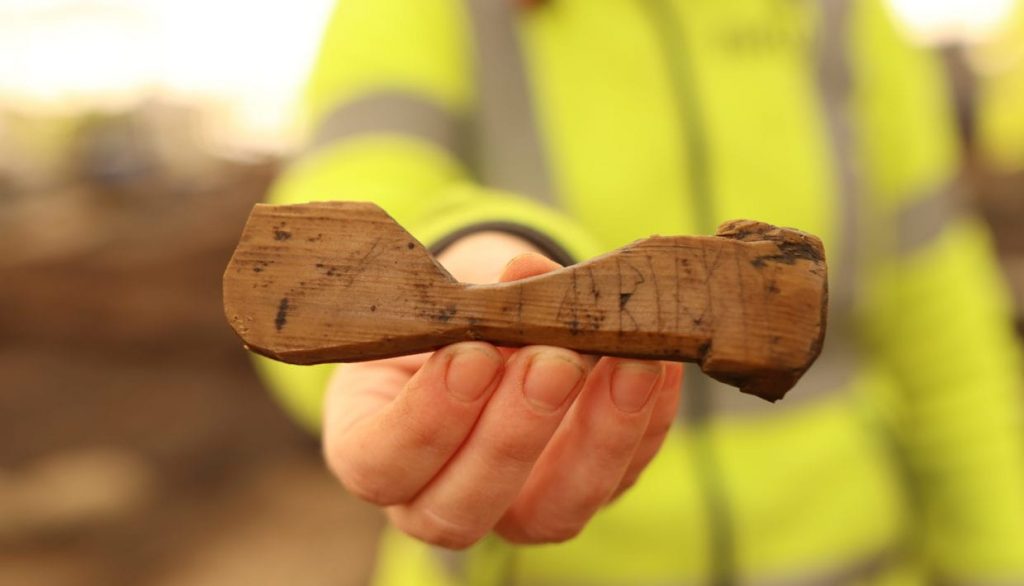
The latest discovery is a roughly cut wooden object that measures 11.4 centimeters in length, carved with eight runes.

Archaeologists found the wooden object in the same waste layer as the falcon figure found in December.

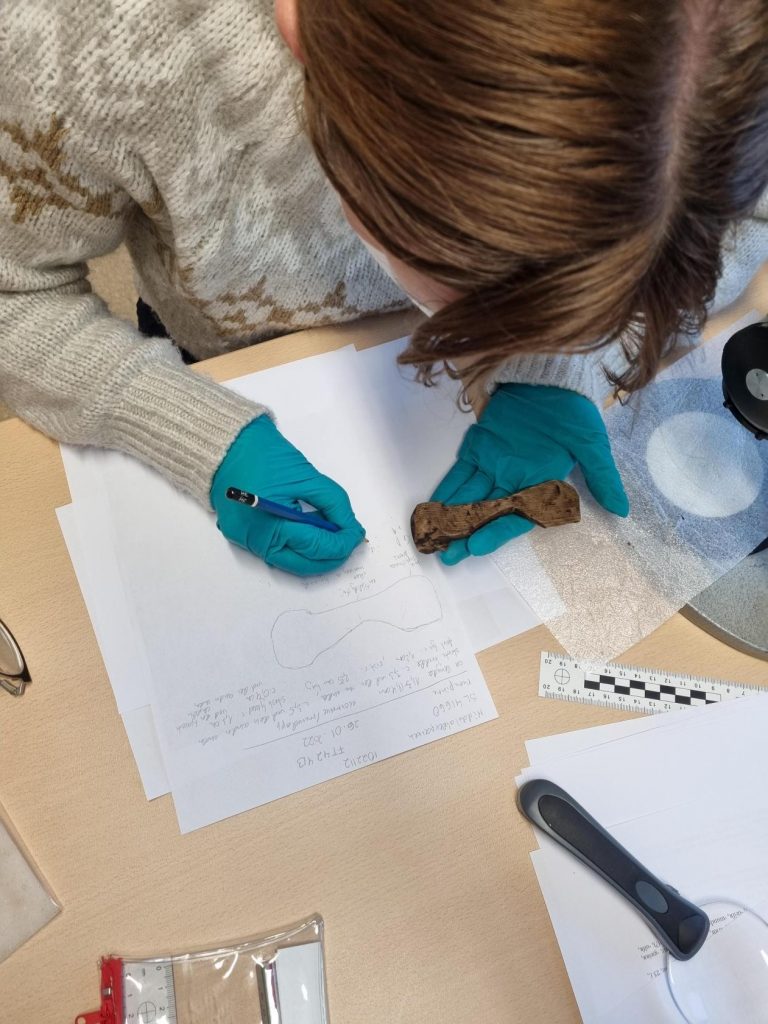
The discovered rune was deciphered by Kristel Zilmer, professor of runology at Universitetet Oslo.

Zilmer suggested that the text is an owner’s inscription, with the name spelled as ‘asbin’ and likely stands for ‘Ásbjǫrn’, a common Old Norse male name that can be found in medieval writings often written in Latin script. The rest of the text in Norse is ‘á mik’ which means ‘owns me’.


📣 Our WhatsApp channel is now LIVE! Stay up-to-date with the latest news and updates, just click here to follow us on WhatsApp and never miss a thing!!


Professor Kristel Zilmer works with the reading of the third runic inscription from excavations in the Medieval Park. Photo:  Jorid Martinsen, NIKU.
Professor Kristel Zilmer works with the reading of the third runic inscription from excavations in the Medieval Park. Photo: Jorid Martinsen, NIKU.

The shape of the object suggests that it was used as a label or marker, possibly attached to something to indicate that ‘Asbjørn owns me’ to mark his property, such as goods or personal items.

“We can’t say anything about what Asbjørn has marked as himself,” says Trond Engen, field manager at Medieval Park.

Although we do not know what Asbjørn actually owned, the marker gives us the name of a real person who lived in Oslo in the 13th century, giving an insight into the city’s trading activity during the 13th century.

Common goods traded in medieval Oslo were imported grain, honey and other foods, salt, beer and wine, basic metal, ceramics and glass, clay pots, baking slabs, millstones and whetstones, imported textiles, etc. was.

Asbjørn was probably a trader that operated in the Klemetsallmenningen area of Olso around the harbour.

NIKU

Photo by Linda Åsheim.

Related Articles

Stone Age Architectural Marvel Unveiled Deep in the Baltic Sea: It may be one of the largest known Stone Age structures in Europe

13 February 2024

13 February 2024

Hiding deep beneath the Baltic Sea, an architectural wonder of the Stone Age has been discovered by researchers. This megastructure,...

Roman-era chambers and clay offering vessels found in Antiocheia Ancient City, in southern Turkey

24 October 2022

24 October 2022

During excavations in southern Turkey’s ancient city of Antiocheia, archaeologists discovered late Roman-era chambers and clay offering vessels. Antakya, better...

5,000-Year-Old Matrilineal Society Discovered in China: DNA Unveils Ancient Female-Led Clans

30 July 2025

30 July 2025

In a remarkable study, scientists have uncovered genetic evidence of a rare matrilineal society in Neolithic China, where women determined...

New discoveries show that Claros continued to serve as an oracle center after Christianity

14 September 2022

14 September 2022

Game boards and forked cross motifs dating to the fifth and seventh centuries AD were discovered at the ancient Greek...

Mysterious 1,600-Year-Old Roman-Era Burial Unearthed in Delbrück-Bentfeld, Germany

15 June 2025

15 June 2025

Archaeologists have uncovered a rare and mysterious Roman-era burial in Delbrück-Bentfeld, Germany, revealing a unique glimpse into the region’s ancient...

In Pontefract, archaeologists have discovered Neolithic remains

18 June 2021

18 June 2021

Archaeologists working on the site of the former Carleton Furniture factory at Mill Dam Lane in Pontefract, West Yorkshire, England,...

New mosaics unearthed in “Zeugma of the Black Sea”

3 October 2022

3 October 2022

New mosaics with various figures were unearthed during the ongoing excavations in the ancient city of Hadrianopolis, which is called...

Britain’s Largest Iron Age Gold Coin Hoard: A Possible Tribute to Julius Caesar?

16 May 2025

16 May 2025

In a stunning revelation, British authorities have recently announced the discovery of an unparalleled Iron Age coin hoard, a singular...

Archaeologists Uncover the Second-Largest Roman Olive Oil Mill in the Empire During Major Tunisian Excavation

19 November 2025

19 November 2025

A groundbreaking archaeological mission in Tunisia has revealed one of the most significant Roman industrial sites ever uncovered: the second-largest...

4,900-year-old Copper Age Fortress with a Violent Past and Odd Roman Burial Found in Spain

13 February 2025

13 February 2025

A remarkable 4,900-year-old Copper Age fortress, featuring a pentagon shape, three concentric walls, 25 bastions, and three ditches, has been...

The 2,200-year-old Agora of Aigai ancient city comes to light

19 August 2024

19 August 2024

Archaeologists have uncovered an agora (city square) during excavations in the ancient city of Aigai, west of Manisa. Aigai, located...

Hittite Royal Seal Warns ‘Whoever Breaks This Will Die’

7 July 2024

7 July 2024

During the excavations in Kırıkkale, a cuneiform seal used by the royal family during the Hittite Empire was unearthed. The...

5000-year-old stoneware workshop found in Iran

24 January 2023

24 January 2023

Iranian archaeologists found the ruins of a stoneware workshop estimated to date back to the 3rd millennium BC, during their...

46 Ice Age Animals Found in a Northern Norway Cave: “Extremely Rare” Discovery Reveals a Frozen Past

22 October 2025

22 October 2025

A remarkable discovery in northern Norway has uncovered the remains of 46 species from the last Ice Age — from...

Khufu Boat moved to its New Museum by Smart Vehicle

8 August 2021

8 August 2021

A 4,600-year-old intact wooden boat bearing the name of an Egyptian pharaoh, Khufu, was transported to a new museum about...