
5 June 2026 The Future is the Product of the Past

Archaeologists discover 1,300-year-old ski trapped in Norwegian ice

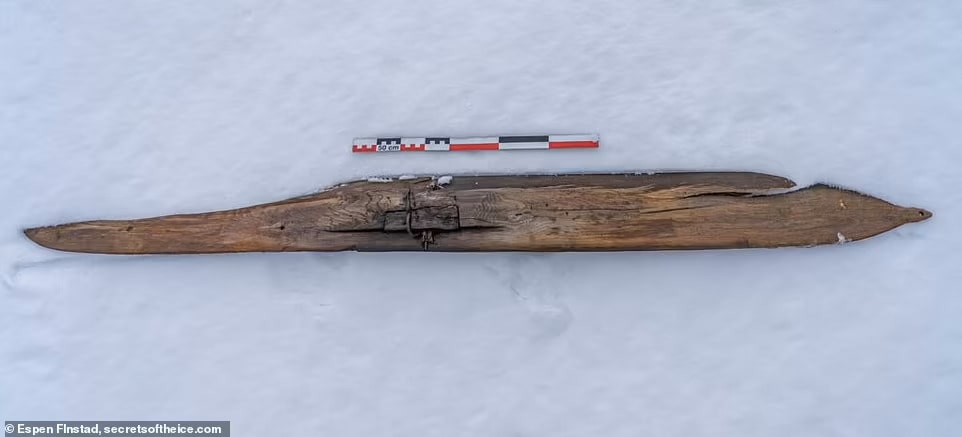
The melting of an ice sheet in Norway has uncovered a pair of remarkably well-preserved skis that had been undisturbed for almost 1,300 years.

The first of the skis was discovered seven years ago at the Digervarden ice patch Norwegian county of Innlandet. Seven years later, the Digervarden ice patch melted enough to reveal its wooden counterpart – together they make the oldest pair of skis ever to be found.

On September 26, a group of Norwegian archaeologists headed by the Secrets of Ice program hiked three hours up Mount Digervarden to the site of the first ski. Using GPS coordinates and pictures from the first visit, the researchers discovered the second ski beneath the ice, which they cut away with an ax and melted with boiling water to liberate the item.

Archaeologist Lars Holger Pilø, who was part of the excavation, wrote in a blog post that the preservation of the new ski is much better, which may be due to it being deeper in the ice.

The new ski shows signs of repairs and a piece of the back end is missing that could still be frozen in the ice. Photo: Andreas Cristopher Nilsson. Secretoftheice.com

The wooden ski was 187 centimeters (74 inches) long and 17 centimeters (6.5 inches) broad, approximately 17 centimeters (6.5 inches) longer and somewhat wider than the first found ski. The identical footing, composed of three twisted birch bindings, a leather strap, and a wooden plug, indicates that each was part of a pair. The foothold also shows signs of repairs, indicating the ski was well used, and the back is missing, likely caused by damage over the centuries.


📣 Our WhatsApp channel is now LIVE! Stay up-to-date with the latest news and updates, just click here to follow us on WhatsApp and never miss a thing!!


While evidence of Iron Age skis like this is uncommon, it is known that skiing has been practiced in Scanadvadia for at least 4,000 years. It is more likely that it originated as a practical model of transportation over snow-capped plains and hills than as a leisure activity for fun-loving hunter-gatherers.

“The skis are not identical, but we should not expect them to be. The skis are handmade, not mass-produced,” Pilø shared in the post

‘They have a long and individual history of wear and repair before an Iron Age skier used them together and they ended up in the ice 1300 years ago.’

Related Articles

Elite Hungarian Conquest-Era Horseman’s Grave with Rich Grave Goods Unearthed at Csongrád-Bokros

31 May 2026

31 May 2026

An elite horseman’s grave from the Hungarian Conquest period has been uncovered at Csongrád-Bokros in southern Hungary, offering archaeologists a...

Polish researchers reveal what ancient Egyptian faience has to do with gold

31 December 2022

31 December 2022

Powdered quartz used to make faience vessels discovered by Polish archaeologists during excavations in the ancient city of Athribis in...

Egyptian archaeologists discovered 16 meters long ancient papyrus with spells from the Book of the Dead

19 January 2023

19 January 2023

Archaeologists working in Egypt’s Saqqara region have unearthed a 16-meter-long ancient papyrus for the first time in a century. Saqqara...

A 7,800-Year-Old Massive Stone Wall Discovered Beneath the Sea off the Coast of France

13 December 2025

13 December 2025

Several meters beneath the restless waters off western France, archaeologists have uncovered the remains of a monumental stone construction that...

What Lies Beneath Bor Ovoo? Turkish and Mongolian Researchers Set to Unearth Ancient Nomadic Traditions

20 July 2025

20 July 2025

Renowned historian Prof. Dr. Kürşad Yıldırım, a leading expert in Central Asian nomadic cultures from Istanbul University, is spearheading a...

1.5-Million-year-old Footprints have Revealed the Co-Existence of two Ancient Human Species in Kenya

30 November 2024

30 November 2024

Thanks to a set of preserved footprints on the ancient shores of Lake Turkana in Kenya, researchers have uncovered the...

3,000-Year-Old Rare British-Style Sickle Unearthed in France

9 August 2025

9 August 2025

On August 6, 2025, France’s Inrap (Institut national de recherches archéologiques préventives) announced a remarkable archaeological find at Val-de-Reuil, in...

Unveiling a Roman Settlement Beyond the Empire: New Discoveries in Delbrück-Bentfeld, Germany

6 April 2025

6 April 2025

Recent archaeological excavations in Delbrück-Bentfeld, located in northwestern Germany, have revealed significant evidence of a Roman settlement that existed beyond...

Copious Copper Supplies Made Cyprus a Trading Center in the Bronze Age

23 March 2023

23 March 2023

Cyprus was a surprisingly busy trading hub during the early period of international trade in the Mediterranean region. Its awe-inspiring...

Remains of Norman Stone Tower Defending Chichester Castle Discovered

5 June 2025

5 June 2025

A remarkable archaeological excavation in Chichester’s historic Priory Park has uncovered the remains of a Norman-era stone tower, known as...

Particle physics and archeology collaboration uncovers secret Hellenistic underground chamber in Naples

13 May 2023

13 May 2023

The ruins of the ancient necropolis of Neapolis, built by the Greeks between the end of the fourth and the...

A small temple discovered in the ancient city of Selinunte, one of the largest and most important ancient Greek cities in southern Italy

9 August 2024

9 August 2024

Recent excavations in the ancient Magna Graecia city of Selinunte in southwestern Sicily have revealed the presence of a new...

Archaeologists Discover Monumental Uruk-Period Building in Kani Shaie, Northern Iraq

29 October 2025

29 October 2025

A research team from the University of Coimbra’s Center for Studies in Archaeology, Arts and Heritage Sciences (CEAACP) has announced...

7,000-year-old discovery in Umm Jirsan Cave

28 June 2021

28 June 2021

Archaeologists have made new discoveries in the Umm Jirsan cave in the Harrat Khaybar lava field in northern Saudi Arabia....

A 1,300-year-old necklace is the ‘richest of its type ever uncovered in Britain’

6 December 2022

6 December 2022

Museum of London Archaeology (MOLA) archaeologists have found a “once-in-a-lifetime” 1,300-year-old gold and gemstone necklace dating back to 630-670 AD...