
23 June 2026 The Future is the Product of the Past

Polish Archaeologists uncover a ancient residence and mysterious mask in Libya’s ancient city Ptolemais

In Libya’s ancient city of Ptolemais on the Mediterranean coast, Polish archaeologists have uncovered a dwelling equipped with an advanced drinking water collection system, and a mysterious mask.

In 2023, archaeologists from Poland’s University of Warsaw made their way back to Ptolemais following a thirteen-year break due to the Libyan civil war. This city, founded by the Ptolemaic dynasty, played a significant role from the 4th century BC until the Arab conquest in the 7th century AD. The study of urban structures was the main focus of this research season, and the results were unexpected.

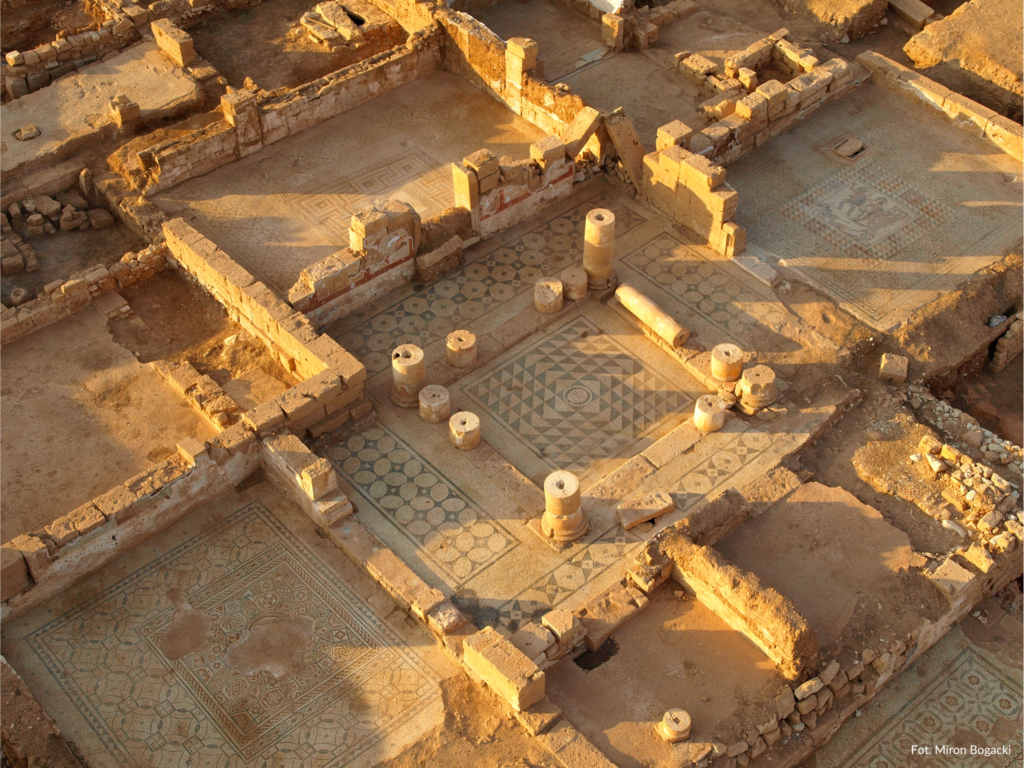
During excavations in June 2024, archaeologists from the University of Warsaw revealed part of a residential complex in the ancient city of Ptolemais. The residence, dating to the late 2nd or early 3rd century CE, featured a sophisticated rainwater collection system including an impluvium that channeled water into underground cisterns.

Piotr Jaworski, head of the Polish Archaeological Mission to Ptolemais, explained that the heart of the eastern area of the house was a small peristyle, surrounded by a kitchen, a staircase, and a room with a mosaic.
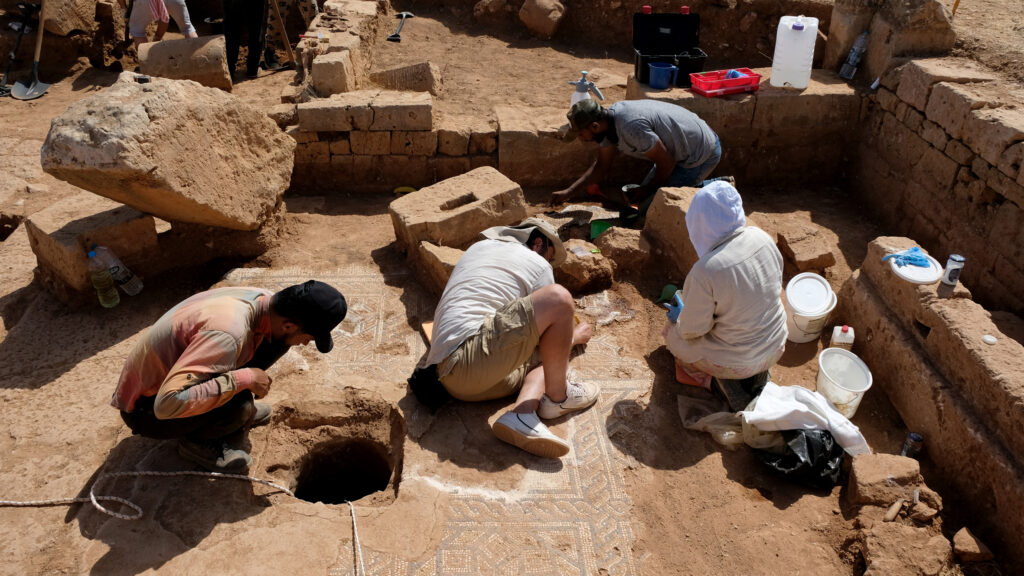
Exploration and conservation of the ruins of the 1st half of the 3rd century house at Ptolemais, June 2024. photo by Piotr Jaworski

A peristyle pool that collected rainwater and routed it to two subterranean cisterns was the centerpiece of the home’s sophisticated water collection system. The house was rebuilt in the late Roman era after being damaged by earthquakes in the third century. Three stone containers at the entrance serve as proof of this and may have been used for offerings or taxes, according to researchers.


📣 Our WhatsApp channel is now LIVE! Stay up-to-date with the latest news and updates, just click here to follow us on WhatsApp and never miss a thing!!


A human face carved in hydraulic mortar inside a cistern was among the most fascinating discoveries. The mask’s origins are unclear due to its lack of distinguishable features, leading to a variety of interpretations. Similarities to carvings found in Libyan sanctuaries are noted by archaeologists, indicating potential local connections or influences. It is possible that the owner of the house or those involved in its creation were of Libyan origin, but this remains speculative.
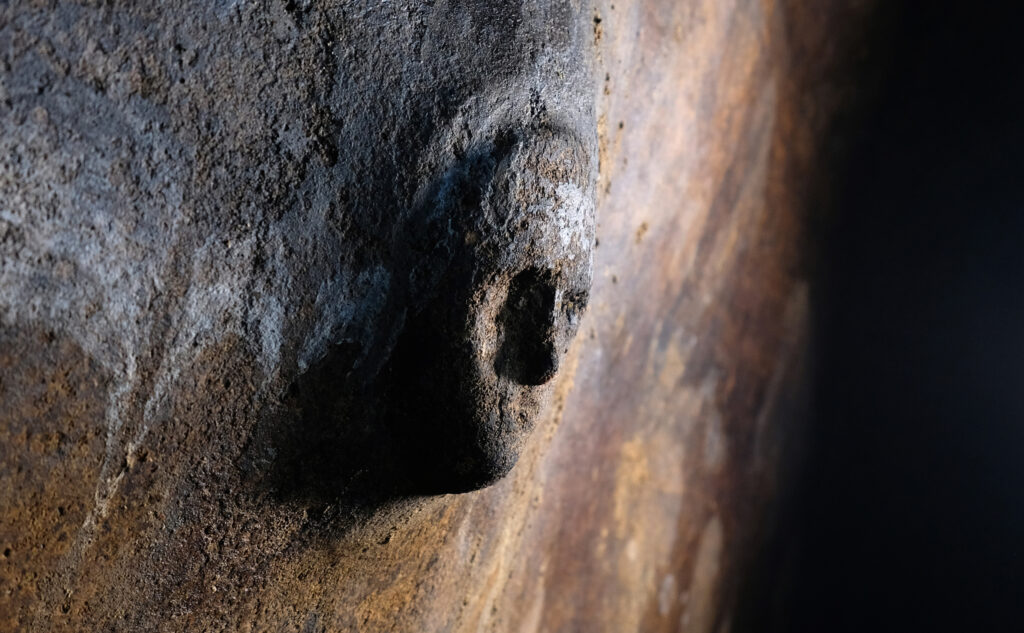
Mask in a cistern. Credit: Anna Tomkowska

Ptolemais, founded in the 3rd century BC, was an important cultural and religious center in Cyrenaica. This place attracts researchers, among others, because of its historical complexity. It most likely still holds many secrets.

With ongoing archaeological efforts, researchers aim to better understand the function of structures on the acropolis and uncover insights into life in ancient Ptolemais.

PAP

Cover Image Credit: Ruins of the House of Leukaktios in Ptolemais discovered by a University of Warsaw expedition between 2001 and 2010. Website of the Republic of Poland

Related Articles

Ancient City Cistern Found Near Croatia’s Iconic Fountain

15 February 2024

15 February 2024

An island-speckled coastline and ancient walled towns place Croatia among the world’s best-beauty cities. But there’s even more to this...

The 5,000-Year-Old Beaded Burials that Reveal Women’s Power in Copper Age Iberia: Over 270,000 Beads

6 February 2025

6 February 2025

Archaeologists investigating the Montelirio tholos burial site in southwestern Spain, dating back approximately 5,000 years, have uncovered that the women...

Winter Solstice Solar Alignment in Kastas Monument: Alexander the Great’s Tribute to Hephaestion

27 May 2025

27 May 2025

A revolutionary study combining archaeology and solar modeling has revealed that the Kastas Monument—the largest funerary structure of ancient Greece—was...

A 2,300-Year-Old Thracian Inscription Reveals the Man King Seuthes III Could Not Lose

24 January 2026

24 January 2026

New research sheds light on a long-standing ancient mystery, suggesting that a previously unknown figure named Epimenes may have served...

Scientists discover traces of paint on the Parthenon Sculptures that reveal their true colours

12 October 2023

12 October 2023

Recent research on the Parthenon Sculptures has found traces of the original paint used to decorate the Parthenon Sculptures, revealing...

Archaeologists discover a “Seleucid satrap tomb” in the ancient Greek (Seleucids) city of Nahavand in Iran

16 May 2022

16 May 2022

Archaeologists announced on Saturday that they discovered a tomb believed to be the tomb of a Seleucid satrap or general...

Britain’s Largest Iron Age Gold Coin Hoard: A Possible Tribute to Julius Caesar?

16 May 2025

16 May 2025

In a stunning revelation, British authorities have recently announced the discovery of an unparalleled Iron Age coin hoard, a singular...

Neolithic village discovered in northeastern France after 150 years of research

29 August 2023

29 August 2023

Archaeologists have uncovered traces of a permanent settlement in the vast Neolithic site of the Marais de Saint-Gond in northeastern...

3,500-Year-Old Hittite Linen Fabric Exhibited for the First Time

10 March 2025

10 March 2025

A remarkable artifact, a piece of Hittite linen fabric dating back 3,500 years, has been publicly exhibited for the first...

The Worst Torture Device in History “Brazen Bull”

2 February 2021

2 February 2021

Agrigentum Tyranny today is in the provincial borders of Agrigento in the Sicily Autonomous Region in the southwest of Sicily....

A Large Copper Age Necropolis Discovered in Italian Town

16 February 2024

16 February 2024

In the town of San Giorgio Bigarello, near the northern Italia city of Mantua, a large Copper Age necropolis dating...

Exciting Discovery of oldest English coin in Canada

16 November 2022

16 November 2022

A gold coin found on the south coast of Newfoundland, Canada’s easternmost province, may be the oldest known English coin...

The place of Puduhepa’s hometown Lawazantiya will be illuminated with Tatarlı Höyük

9 November 2021

9 November 2021

Excavations at Tatarlı Höyük (mound) are trying to reach findings that will enable the determination of the location of Lawazantiya,...

From Destruction to Discovery: Ancient Greek Tombstone Discovered in Libya After Storm ‘Daniel’

2 March 2025

2 March 2025

The Libyan Antiquities Authority has officially confirmed that an ancient artifact uncovered in the torrents caused by Storm “Daniel” in...

The impressive Statue of young Hercules unearthed in Philippi, Northern Greece

24 September 2022

24 September 2022

A larger-than-life youthful Hercules statue dating to the 2nd century A.D. have been found in the ancient city of Philippi...