
8 November 2025 The Future is the Product of the Past

From Türkiye to Iraq: Returning 6,000-Year-Old Cuneiform Tablets That Unlock Ancient Mesopotamia

Türkiye has made a significant contribution to cultural diplomacy and historical justice by returning six ancient cuneiform clay tablets to Iraq. These invaluable artifacts, dating back over 6,000 years and originating from the Ur III, Old Akkadian, and Old Babylonian periods, offer unique insights into the economic, administrative, and religious life of ancient Mesopotamia.

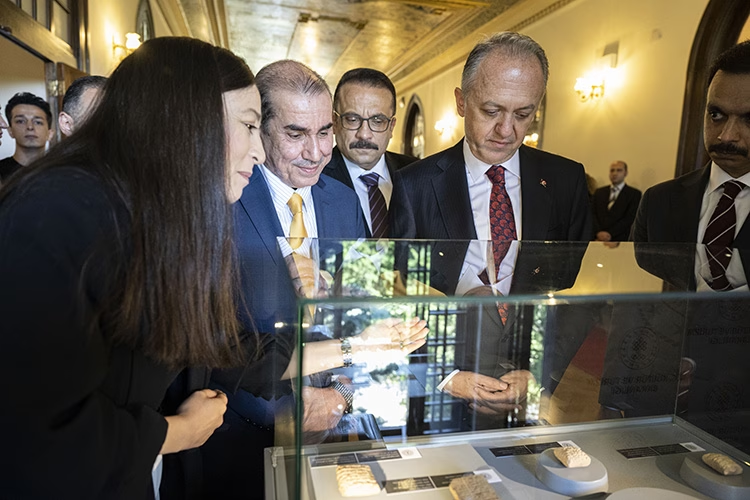
The official handover ceremony took place at the Republic Museum in Ankara, attended by Türkiye’s Deputy Minister of Culture and Tourism, Gökhan Yazgı, and Iraq’s Ambassador to Türkiye, Majid Abdulreda Hassan Al-Lachmawi, symbolizing the deepening cooperation between the two neighboring nations.

Preserving the Heritage of Ancient Civilizations

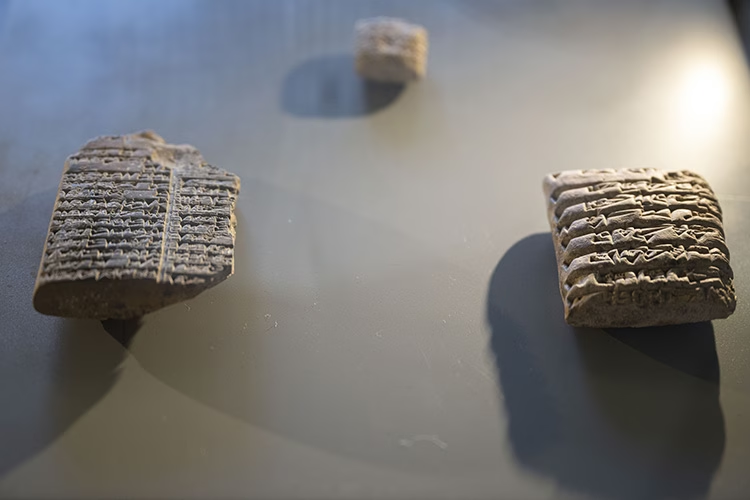
Scientific analysis conducted by experts at the Istanbul Archaeology Museum confirmed the tablets’ Iraqi provenance. These artifacts, made of baked clay inscribed with early writing, contain a variety of records, including lists of priests from the Ur III period, livestock payment accounts from the Old Akkadian era, and administrative documents from the reign of King Ibbi-Sin.

“These tablets are not just relics of the past,” emphasized Deputy Minister Yazgı, “but invaluable cultural and scientific resources that shed light on humanity’s earliest civilizations. Turkey remains committed to safeguarding the cultural heritage of all nations.”

Prof. Dr. Selim Ferruh Adalı led the historical and linguistic analysis, confirming the tablets’ authenticity and cultural significance.


📣 Our WhatsApp channel is now LIVE! Stay up-to-date with the latest news and updates, just click here to follow us on WhatsApp and never miss a thing!!


 The 6,000-year-old cuneiform clay tablets returned to Iraq by Turkey, offering a glimpse into the economic and religious life of ancient Mesopotamia. Credit: AA
The 6,000-year-old cuneiform clay tablets returned to Iraq by Turkey, offering a glimpse into the economic and religious life of ancient Mesopotamia. Credit: AA

A Growing Legacy of Cultural Repatriation

Since 2010, Turkey has repatriated 97 cultural artifacts to Iraq, acting in full compliance with international agreements such as UNESCO’s 1970 Convention on the Means of Prohibiting and Preventing the Illicit Import, Export and Transfer of Ownership of Cultural Property, as well as United Nations Security Council resolutions addressing cultural heritage protection.

“Today’s repatriation reflects Türkiye’s dedication to international law and cultural responsibility,” Yazgı noted, highlighting that the tablets were voluntarily returned by a private citizen—a testament to rising public awareness regarding cultural preservation.

Strengthening Iraq-Turkey Relations through Cultural Cooperation

Ambassador Al-Lachmawi expressed profound gratitude for Türkiye’s cooperation, stating, “The return of these precious artifacts enriches Iraq’s historical legacy and stands as a powerful symbol of friendship and mutual respect between our countries.”
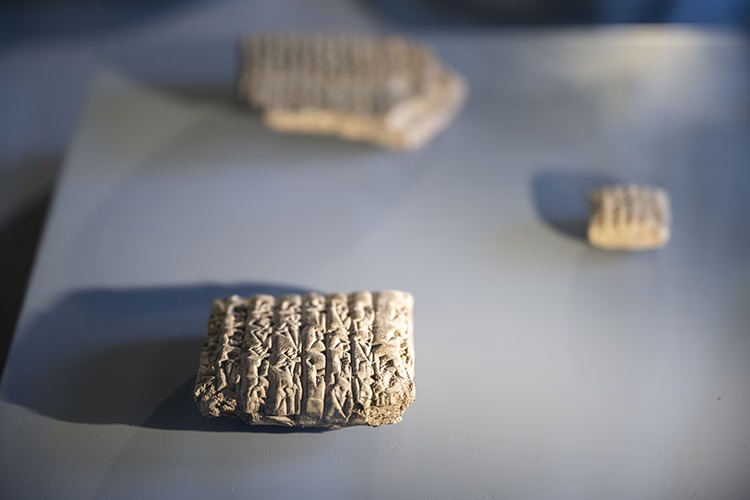

Cuneiform tablet from the Ur III period, part of a collection repatriated from Türkiye to Iraq—etched with early records of temple duties and livestock payments. Credit: AA

Turkey’s Leading Role in Protecting Cultural Heritage

Under the leadership of cultural authorities and institutions like the Istanbul Archaeology Museum, Türkiye continues to combat illegal trafficking and foster international partnerships aimed at preserving humanity’s shared history. The repatriation of these 6,000-year-old tablets represents a concrete achievement in cultural diplomacy and the pursuit of historical justice.

Cover Image Credit: Deputy Minister Gökhan Yazgı and Iraqi Ambassador Al-Lachmawi at the handover ceremony in Ankara’s Republic Museum. AA

Related Articles

25 Qing Dynasty tombs found in China’s Hunan

25 May 2022

25 May 2022

25 graves dating from the Qing Dynasty (A.D. 1644–1912) have been uncovered in the Houbeishan tomb complex in southern China,...

Europe’s Oldest Blue Pigment Found in Stone Age Paint Box

30 September 2025

30 September 2025

Archaeologists in Germany have uncovered the earliest evidence of blue pigment ever used in Europe, rewriting our understanding of Stone...

4 Aztec child burials unearthed in Mexico and dated to the Early Colonial period may be indicators of Aztec resistance

6 July 2022

6 July 2022

During an archaeological rescue effort in Mexico City’s historic central district of La Lagunilla, the remains of an Aztec house...

New fortification walls discovered in the ancient city of Pergamon

14 February 2022

14 February 2022

2,500-year-old fortification walls were found in the Ancient City of Pergamon (Bergama), which was included in the World Heritage List...

Manot Cave yielded evidence for ritualistic gathering 35,000 years ago, the earliest on the Asian continent

13 January 2025

13 January 2025

Archaeological research at the Manot Cave in what is now the Galilee in northern Israel has uncovered evidence of ritualistic...

Archaeologists have unearthed part of Hadrian’s Aqueduct, one of the Largest Hydraulic Works of the 2nd century AD, and Extremely Rare Greek Coins

11 January 2024

11 January 2024

Archaeologists have unearthed part of Hadrian’s aqueduct, one of the largest hydraulic works of the 2nd century AD, and a...

‘Astonishingly Preserved’ Ancient Roman Well Found in Cambridgeshire was An Engineering Failure

22 August 2024

22 August 2024

In an excavation at the site of future highway improvements in Cambridgeshire, the team from MOLA (Museum of London Archaeology)...

One of its kind, 1,500-year-old Roman ‘Lorica Squamata’ legion armor restored

19 June 2024

19 June 2024

The 1,500-year-old Roman ‘Lorica Squamata’ legion armor, the only known example in the world, found in the ancient city of...

3,500-Year-Old Cuneiform Tablets and Seal of Unknown Hittite Prince Unearthed in Türkiye

19 October 2025

19 October 2025

In the ancient heart of southern Türkiye, history has once again spoken through the clay. Archaeologists excavating the site of...

The ‘extraordinary’ Roman mosaic depicting scenes from Homer’s Iliad unearthed in a Rutland farmer’s field is the first of its kind in England

25 November 2021

25 November 2021

The 1,500-year-old mosaic discovered by a farmer was considered Britain’s “most exciting” Roman find. The artwork was discovered on private...

Archaeologists Find the Missing Link of the Alphabet

15 April 2021

15 April 2021

Researchers believe that Tel Lachish pottery is the oldest of its kind found in the region, and could explain how...

Rare a Serbian Stefan Uros II Milutin Silver Grosso discovered in Bulgaria’s Medieval Rusocastro Fortress

8 September 2023

8 September 2023

Archaeologists have discovered a silver grosso minted by the Serbian king Stefan Uros II Milutin in the medieval Rusocastro fortress,...

Unique finds unearthed in the ancient city of Olba in southern Türkiye

16 August 2023

16 August 2023

In the excavations carried out in the ancient city of Olba, located in the Silifke district of Mersin, in the...

The migration movement that started from Siberia 30,000 years ago may have shaped Göbeklitepe

24 June 2022

24 June 2022

Professor Semih Güneri, retired faculty member from Dokuz Eylul University (DEU) Caucasus Central Asia Archeology Research Center, stated that they...

Roman-era chambers and clay offering vessels found in Antiocheia Ancient City, in southern Turkey

24 October 2022

24 October 2022

During excavations in southern Turkey’s ancient city of Antiocheia, archaeologists discovered late Roman-era chambers and clay offering vessels. Antakya, better...