
8 December 2025 The Future is the Product of the Past

Extraordinary discovery in France: An unlooted 1800-year-old Roman Sarcophagus discovered

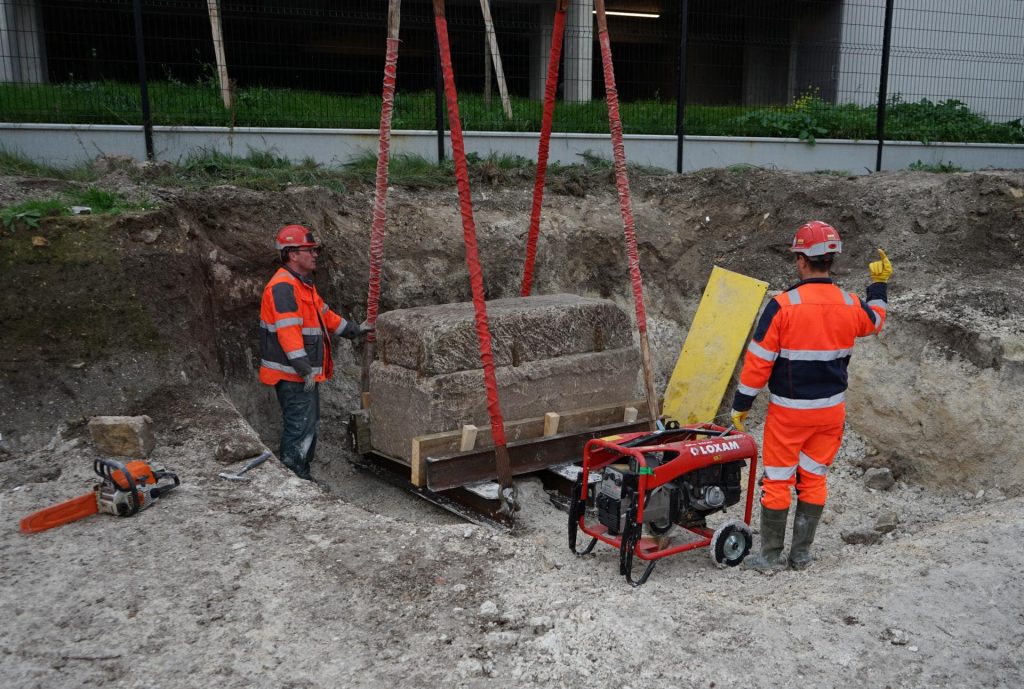
Archaeologists from France’s National Institute of Preventive Archeology (INRAP) have unearthed an unlooted ancient stone sarcophagus in the vast ancient necropolis on Rue Soussillon in northeastern France.

It’s not often that archaeologists find an unlooted Roman sarcophagus, so when it does happen, it becomes the perfect opportunity to learn more about the past.

The ancient Durocortorum was the capital of the province of Gaul Belgium and was one of the largest cities in the Roman Empire. The city extended over 600 hectares and was delimited by a powerful wall. It was in the second half of the 19th century, during extension work in Reims, that the contours of this so-called “Augustan” enclosure were highlighted as well as the extra muros necropolises, located around the seven main access routes. (towards Boulogne, Soissons, Paris, Lyon, Trier, Cologne and Bavay). In 22 years of research, 5,000 tombs have been explored and added to the museum’s collections.

The First World War destroyed the museum as well as a large part of its collections and documentation. Apart from knowledge of the topography of the funerary spaces, very little remains from the excavations of these ancient necropolises. The layout of the “great enclosure” has been little explored by archeology and presents areas of uncertainty that each discovery completes. In this context, the discovery of a portion of the intact necropolis on Rue Soussillon constitutes an exceptional discovery for Reims archaeologists.
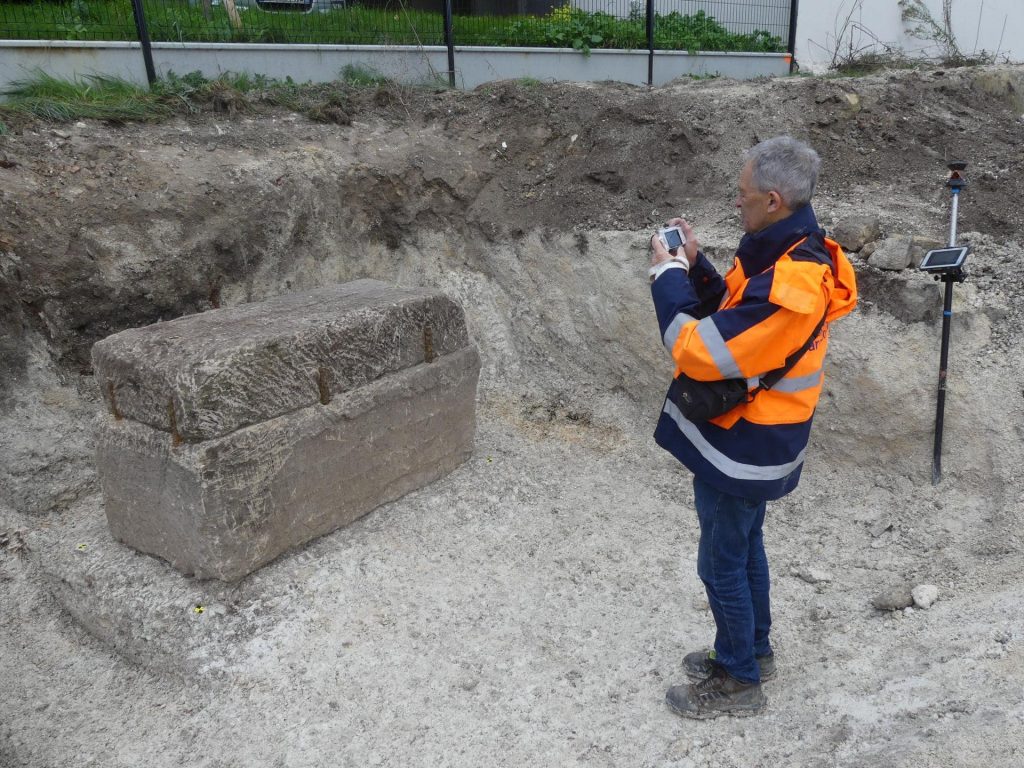
Photo: France's National Institute of Preventive Archeology (INRAP)
Photo: France’s National Institute of Preventive Archeology (INRAP)

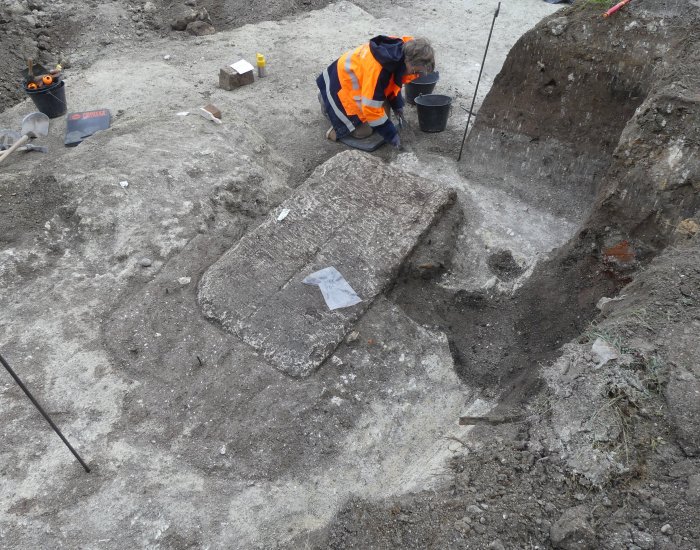
On Rue Soussillon, researchers have uncovered 1,200 m2, which is just a portion of a sizable ancient necropolis. The high concentration of tombs in this area of the city is especially intriguing because it has long been thought of as a swampy area unfit for any kind of settlement.


📣 Our WhatsApp channel is now LIVE! Stay up-to-date with the latest news and updates, just click here to follow us on WhatsApp and never miss a thing!!


During the recent excavation, scientists discovered a lime sarcophagus limestone that measures 3.3 feet high, 5.4 feet long, and 2.6 feet wide, with a 1,700-pound lid held in place by iron pegs sealed with lead. The archaeologists first did X-rays on the sarcophagus then used an endoscopic camera. They found a skeleton of a woman inside, alongside a number of other objects, including a mirror.
Archaeologists have discovered an intact Roman sarcophagus in Reims. Photo: © Émilie Jouhet, Inrap
Photo: © Émilie Jouhet, Inrap

“It’s quite exceptional, it’s the first time that we have found a tomb intact and which has not been looted. It was sealed by eight iron staples, and we were the first to explore it,” Agnès Balmelle, deputy scientific and technical director at Inrap Grand Est, told local news Le Parisien.

“The skeleton occupied the entire space of the [5-foot] tank, the individual must have been around 40 years old and had a special status. Four oil lamps were found near her legs and shoulders, as well as a small mirror, an amber ring and a comb,” Balmelle added.

Inside the sarcophagus were also two glass containers possibly containing perfumed oils.

The unearthed items indicate that the burial occurred in the 2nd century A.D. Samples of the sediment on the bones and on the bottom of the tank will make it possible to determine if there are plant remains or products linked to the treatment of bodies.

INRAP

Cover Photo: France’s National Institute of Preventive Archeology (INRAP)

Related Articles

Africa May not be Where the First Pre-Human First Appeared

22 March 2021

22 March 2021

According to one opinion: About 2 million years ago, our first ancestors moved north from their hometown and left Africa....

Severed right hands reveal Trophy-Taking practices in Ancient Egypt

2 April 2023

2 April 2023

Twelve severed hands were found in Egypt as part of a horrifying “trophy-taking” practice that was just made revealed by...

3,500-year-old perfectly preserved ancient frozen bear found in Siberian

28 February 2023

28 February 2023

As the permafrost on Bolshoy Lyakhovsky Island in eastern Siberia melted, a mummified brown bear that lived more than three...

The ability to produce ceramic vessels came to Europe via Siberia and the Caspian Sea region

6 January 2023

6 January 2023

A new study suggests that the knowledge for making ceramic vessels came to Europe from the Middle East and the...

Hidden Royal Trove of rulers of Poland and Lithuania discovered in the underground vaults of Vilnius Cathedral in Lithuania

17 January 2025

17 January 2025

A unique find was made in the dungeons of the Vilnius Cathedral: The royal funerals of the Polish and Lithuanian...

1800 Years Old Roman Milestone Used as Seat at Turkish Mosque

7 November 2024

7 November 2024

A milestone from the Roman Emperor Gordianus III period, which dates to 239 AD, was discovered in the Fatsa district...

The three-headed statue of Goddess Hecate discovered in Turkey’s Mersin

18 August 2023

18 August 2023

In the ancient city of Kelenderis in Mersin, located in the south of Turkey, the statue of the 3-headed goddess...

Unique and very well-preserved prehistoric engravings found in southwestern Catalonia

23 March 2023

23 March 2023

Significant prehistoric rock art has been discovered in La Febro, in southwestern Catalonia. The team that discovered the art inside...

Vikings arrived in Newfoundland 1,000 years ago: Scientists

20 October 2021

20 October 2021

Vikings’ first permanent settlement in North America – the coastal outpost in Newfoundland known as L’Anse aux Meadows now has...

Do Byzantine coins Record the Supernova of 1054?

25 June 2022

25 June 2022

SN 1054 was one of the most spectacular astronomical events of all time. The supernova explosion eventually formed what is...

Archaeologists discovered 7,000-years-old Neolithic Settlement in the Czech Republic

31 July 2024

31 July 2024

Archaeologists have discovered a Neolithic settlement of about 7,000 years old near Kutná Hora, east of Prague in the Czech...

A first in 35 years! Child grave with bracelets and gifts found in ancient city of Kelenderis

25 June 2022

25 June 2022

During this year’s excavations in the ancient city of Kelenderis, founded on the Mediterranean coast in the southern province of...

Oldest Aboriginal pottery discovered in Far North Queensland

10 April 2024

10 April 2024

More than 2000 years ago, Aboriginal Australians were producing ceramics on a secluded island about 35 kilometers off the coast...

Researchers have found in miniature ceramic bottles evidence of the oldest known use of cosmetics in the Balkans

14 July 2021

14 July 2021

In miniature ceramic bottles from excavations ascribed to the Lasinja Culture in the Southeast Prealps and the Vinča Culture in...

Archaeologists unearth the long-lost homestead of King Pompey in Lynn

3 July 2024

3 July 2024

Archaeologists from the University of New Hampshire (UNH) and a historian from Northeastern University believe they might have found the...