
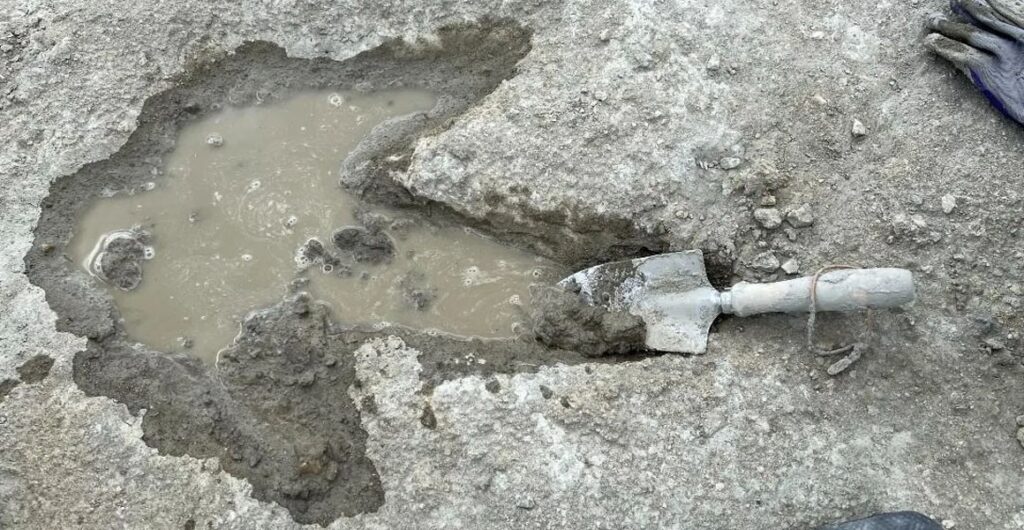
Archaeologists have uncovered one of the world’s longest and most extraordinary sets of dinosaur footprints in a British quarry, shedding new light on the lives of colossal Jurassic giants that once roamed what is now southern England.
The groundbreaking discovery was made at Dewars Farm Quarry in Oxfordshire by teams from the University of Oxford Museum of Natural History (OUMNH) and the University of Birmingham. The site, dubbed part of Britain’s “dinosaur highway”, has revealed hundreds of immaculately preserved footprints dating back 166 million years to the Middle Jurassic Period.
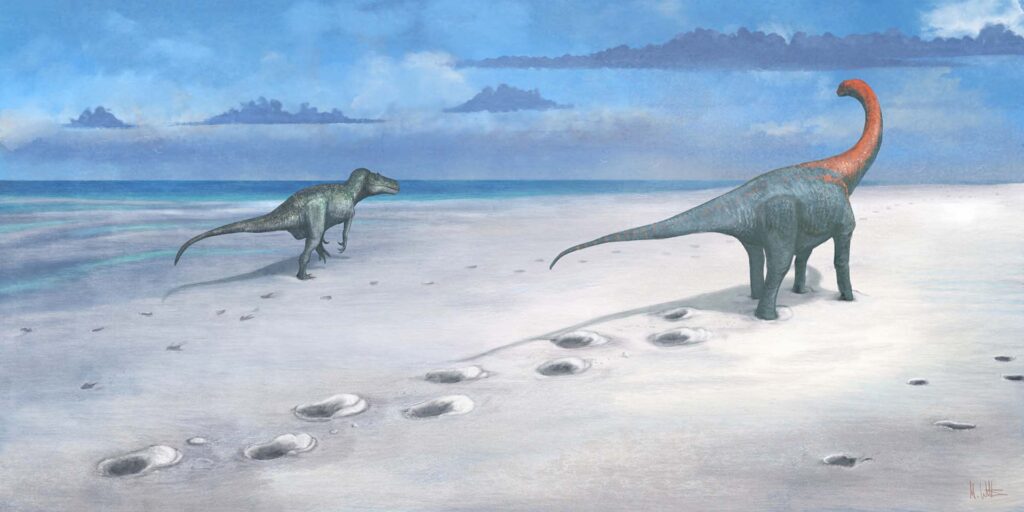
The trackways — one of which stretches over 220 meters, making it the longest continuous dinosaur trail in Europe — were likely made by a single Cetiosaurus, a plant-eating sauropod that grew up to 18 meters long. Nearby prints from the fearsome Megalosaurus, the first dinosaur ever named by scientists (in 1824), were also identified.
Footprints from Britain’s Jurassic Past
Dr Duncan Murdock, Earth Scientist at OUMNH, described the site as “a breathtaking snapshot of life during the Jurassic period.” He explained,
“The preservation is so detailed that we can see how the mud was deformed as the dinosaur’s feet squelched in and out. Along with other fossils like burrows, shells and plants, we can bring to life the muddy lagoon environment these dinosaurs walked through.”
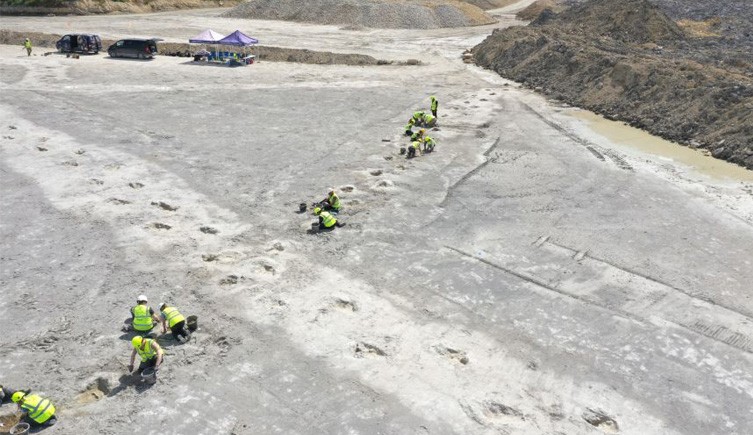
The discovery began when quarry worker Gary Johnson noticed “unusual bumps” while clearing clay from the quarry floor. What followed was a massive collaborative excavation involving more than 100 scientists, students, and local volunteers. Over 200 footprints were unearthed, digitally recorded with drone imaging, and transformed into 3D models to preserve every detail.
A Window into Ancient Behavior
By analyzing the tracks, researchers were able to reconstruct how these dinosaurs moved — even capturing moments when they may have shifted weight or changed direction.
Professor Peter Falkingham from Liverpool John Moores University created a full 3D animation of the Cetiosaurus walking, offering a mesmerizing glimpse into its prehistoric gait.
One particularly intriguing footprint appears to have “pulled to the side,” suggesting the dinosaur paused mid-stride, perhaps leaning on one leg — a rare insight into animal behavior from deep time.
Megalosaurus: Britain’s First Dinosaur
The Oxfordshire site is especially significant because it preserves footprints from Megalosaurus, the world’s first scientifically named dinosaur.
Dr Emma Nicholls, Vertebrate Paleontologist at OUMNH, noted,
“Scientists have known about Megalosaurus for longer than any other dinosaur on Earth, yet these discoveries prove there is still new evidence out there, waiting to be found.”
The carnivorous Megalosaurus — about nine meters long with clawed, three-toed feet — likely shared its territory with the massive herbivorous Cetiosaurus. Remarkably, some of their tracks even cross over, raising questions about possible interactions between predator and prey.
A Legacy of Discovery and Innovation
Professor Kirsty Edgar of the University of Birmingham emphasized the broader importance of the site:
“These footprints offer an extraordinary window into the lives of dinosaurs, revealing details about their movements, interactions, and the tropical environment they inhabited.”
The site builds upon earlier discoveries in the same quarry from the 1990s, where more than 40 trackways were documented. Modern technology, however, has allowed this new excavation to capture details never before possible. Over 20,000 drone images were taken to create a permanent digital record of the site for research and public education.
Professor Richard Butler, Palaeobiologist at the University of Birmingham, said,
“There is much more that we can learn from this site, which is an important part of our national Earth heritage. Our 3D models will allow researchers to study and make accessible this fascinating piece of our past for generations to come.”
From Quarry to Exhibition
The discovery will be featured on BBC Two’s “Digging for Britain” (January 8, 2025) and showcased in the new “Breaking Ground” exhibition at Oxford University Museum of Natural History. Visitors will see the original Megalosaurus fossils used in its first description, alongside images, videos, and interactive 3D models from the dig.
Despite challenges posed by scorching weather and rock-hard sediment, researchers say the find has exceeded all expectations. The footprints, once hardened in Jurassic mudflats near the equator, were perfectly preserved beneath layers of limestone for millions of years — until a controlled quarry explosion finally exposed them.
A Journey 166 Million Years in the Making
As modern scientists piece together the movements of these ancient giants, the Dewars Farm discovery stands as a powerful reminder that Britain’s prehistoric past still has secrets buried beneath its soil.
In the words of Professor Butler:
“This site is not just a scientific treasure — it’s a story of discovery, collaboration, and our enduring fascination with the giants that once walked our land.”
Oxford University Museum of Natural History
Cover Image Credit: More than 200 footprints that were made around 166 million years ago were uncovered in an Oxfordshire quarry. Oxford University Museum of Natural History
