
16 January 2026 The Future is the Product of the Past

4,500-Year-Old Harappan Settlement Unearthed in Rajasthan’s Thar Desert

Archaeologists uncover the first-ever Harappan site in Rajasthan’s Thar Desert near the Pakistan border, expanding the known geographical reach of the Indus Valley Civilization.

In a groundbreaking archaeological discovery, researchers have uncovered the first confirmed Harappan settlement in the Thar Desert of Rajasthan, offering unprecedented insight into the Indus Valley Civilization’s expansion into India’s arid western frontier.

The site, known as Ratadia Ri Deri, lies roughly 60 km from Ramgarh tehsil in Jaisalmer district and only 17 km from the India-Pakistan border. This marks the first recorded evidence of a Harappan presence in this remote desert region, historically thought to be outside the civilization’s known boundaries.

A Collaborative Scientific Effort

The excavation was led by a team of experts including Dilip Kumar Saini from Rajasthan University, Professor Jeevan Singh Kharkwal of Rajasthan Vidyapeeth, and historian Parth Jagani, with crucial support from Dr. Tamegh Panwar, Dr. Ravindra Devda, and local contributors Pradeep Kumar Garg and Chatar Singh ‘Jam’.

Initial clues emerged when Pradeep Kumar Garg, a local schoolteacher, reported unusual pottery shards to the Save Our Heritage Foundation, prompting formal archaeological investigation.


📣 Our WhatsApp channel is now LIVE! Stay up-to-date with the latest news and updates, just click here to follow us on WhatsApp and never miss a thing!!


Artefacts Reveal Sophisticated Urban Life

Among the artefacts unearthed were: Red and wheat-colored pottery, including bowls, pitchers, and perforated jars

Handmade pottery adorned with geometric patterns

Chert stone blades (8–10 cm), likely sourced from Rohri, Pakistan

Bangles made of clay and conch shells

Terracotta cakes in triangular, circular, and idli-like forms

Stone mills, wedge-shaped and standard rectangular Harappan bricks

A furnace with a central column, resembling structures in Kanmer (Gujarat) and Mohenjo-daro (Pakistan)

The findings indicate a planned settlement with socio-economic complexity, mirroring features of urban Harappan centers.
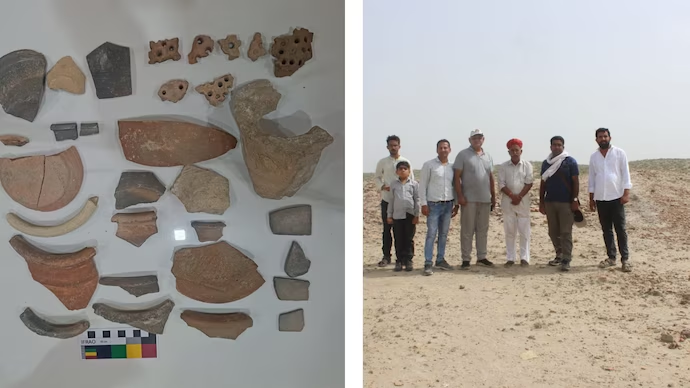
Harappan civilisation artefacts discovered in Jaisalmer and the team involved in the discovery.
Harappan civilisation artefacts discovered in Jaisalmer and the team involved in the discovery. Credit: Harshita Das – Indıa Today

Historic Implications for Harappan Geography

Experts believe the site, likely dating between 2600 BCE and 1900 BCE, serves as a vital link between northern Rajasthan and Gujarat, reshaping assumptions about the geographical scope of the Indus Valley Civilization. The presence of sophisticated construction in such a harsh, arid zone suggests the Harappans were capable of adapting to desert environments, possibly leveraging trade routes and natural resources along the now-extinct Saraswati River.

“This is a historic breakthrough in Rajasthan’s desert archaeology,” said researcher Dilip Kumar Saini. “The discovery of a Harappan settlement in this barren landscape underscores the civilization’s adaptive resilience and reach.”

Historian Parth Jagani added, “This is the first urban Harappan settlement found in the desert belt between North Rajasthan and Gujarat. Its proximity to the Pakistan border adds another layer of strategic and cultural significance.”

Global Impact and Ongoing Research

The research team has submitted their findings to both the Indian Journal of Science and a prominent international peer-reviewed journal. If accepted, the site is expected to gain global attention as a key node in the broader Harappan cultural and economic network.

According to Dr. Jeevan Singh Kharkwal, “This discovery bridges a major archaeological gap, demonstrating how rural Harappan sites supported broader trade and production networks across diverse environments.”

As excavations continue, this remarkable site offers a new lens into the Harappan civilization’s rural-urban dynamics, environmental adaptation strategies, and cross-regional connectivity. More settlements may yet lie buried beneath the shifting sands of Rajasthan, awaiting rediscovery.

Cover Image Credit: – WikipediaCC BY 2.0

Related Articles

2800-year-old two Swords found in Germany from the start of the Iron Age

8 June 2022

8 June 2022

During archaeological excavations in preparation for the construction of the fire station in the Frieding district of Andechs in southern...

Ancient Mythical Castle “Sörby Borg” Discovered on Swedish Island Creates Archaeological Sensation

4 August 2021

4 August 2021

A text from the early 18th century mentions the castle, which has become a bit of a legend. It has...

Archaeologists Find One of the Long-Lost Holy Cities in Jordan

13 July 2025

13 July 2025

A remarkable archaeological discovery in Jordan has brought one of the Holy Land’s long-lost cities back to light. Researchers now...

Egypt unearths 2,300-year-old remains of Greco-Roman town in Alexandria

28 August 2021

28 August 2021

An Egyptian archeological team discovered the ruins of a Greco-Roman residential and commercial town in the north coast city of...

Silver Necklace with Eight-Pointed Star and Ishtar Symbol Discovered at Amos Ancient City in Türkiye

31 December 2025

31 December 2025

A striking archaeological discovery has been made in Türkiye’s southwestern Muğla province, where excavations at the Amos Ancient City in...

4 Aztec child burials unearthed in Mexico and dated to the Early Colonial period may be indicators of Aztec resistance

6 July 2022

6 July 2022

During an archaeological rescue effort in Mexico City’s historic central district of La Lagunilla, the remains of an Aztec house...

Ancient Bone Flute Discovered in Iran Offers Rare Glimpse into 8,000-Year-Old Musical Traditions

29 June 2025

29 June 2025

The National Museum of Iran has launched an exciting initiative in collaboration with the Public Relations Department of the Ministry...

The World’s Earliest Ground Stone Needles Found in Western Tibetan Plateau

26 June 2024

26 June 2024

In western Tibet, six peculiar stone artifacts were discovered in 2020 by archaeologists excavating close to the shore of Lake...

Gürcütepe’s 9,000-Year-Old Figurines Offer Rare Clues to Life After Taş Tepeler’s Monumental Age

11 December 2025

11 December 2025

Just southeast of Şanlıurfa, on the northwestern edge of the vast Harran Plain, a small but exceptionally informative archaeological site...

1,500-Year-Old Roman Mosaic Unearthed in Mardin: Hidden Masterpiece Rescued from Smugglers

24 October 2025

24 October 2025

A 1,500-year-old mosaic depicting vivid animal figures has been recovered during an anti-smuggling operation in southeastern Türkiye’s Mardin province. Buried...

New Neolithic structure unearthed at Tas-Silġ in Malta

8 October 2021

8 October 2021

Archaeologists excavating at Tas-Silġ in Marsaxlokk have discovered the remains of another Neolithic structure, Heritage Malta said. The discovery substantially...

Ancient Celtic Bone Pen Found in Southern Germany

14 December 2024

14 December 2024

From August to October this year, the State Office for the Preservation of Monuments (LAD) in the Stuttgart Regional Council...

“Exceptionally rare” gold sword pommel given to Scottish national museums

24 October 2022

24 October 2022

An “exceptionally rare” solid gold sword pommel found by a metal detectorist near Blair Drummond, Stirling, has been acquired by...

Comb and gold hair-ring dating back more than 3,000 years unearthed in south Wales

14 July 2023

14 July 2023

Archeologists in south Wales, have unearthed a golden hair ring and the oldest wooden comb ever found in the U.K....

Hagia Sophia May Collapse: Experts Sound Alarm Over 1,500-Year-Old World Heritage Monument

30 June 2025

30 June 2025

Beneath the grandeur of Hagia Sophia’s golden domes and sacred mosaics lies a ticking time bomb. With over 1,500 years...