
12 November 2025 The Future is the Product of the Past

Archaeologists may have Found a Viking Age Marketplace in Norway

Archaeologists from the University of Stavanger have identified the possible remains of a marketplace from the Viking Age on a Norwegian farm.

The farm is located at Utstein on the island of Klosterøy, which lies off the southwestern coast of the nestled off the southwestern coast of Norway. The 1.7-square-kilometer island lies on the south side of the Boknafjorden in the Rennesøy island group.

A picturesque island Klosterøy is known for its rich cultural heritage and is home to Norway’s best-preserved medieval monastery, among other attractions.

In September 2023, the team conducted surveys using state-of-the-art ground-penetrating radar technology, and they found strong evidence of human activity beneath the surface of the island. The scan results revealed the presence of several man-made structures, including pit houses and the foundations of three piers or boathouses, suggesting a bustling hub of commerce and trade during the Viking Age.

The radar surveys, conducted as part of the “Power’s Harbor” research project, were spearheaded by Professor Håkon Reiersen and his team from the Museum of Archaeology.


📣 Our WhatsApp channel is now LIVE! Stay up-to-date with the latest news and updates, just click here to follow us on WhatsApp and never miss a thing!!


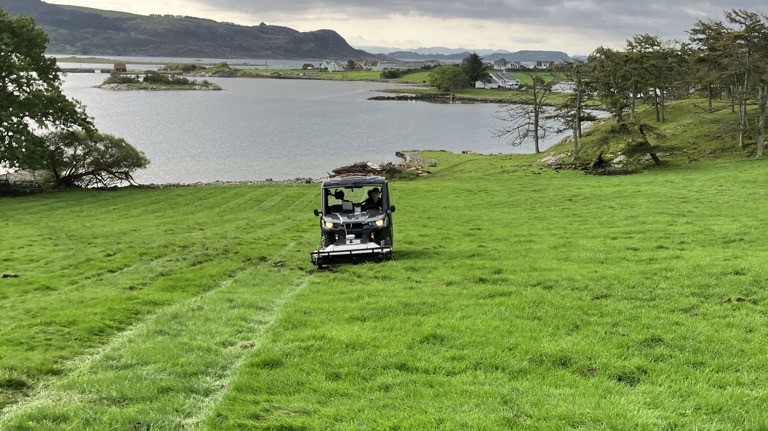
The archaeologists drive over a possible pit house. Photo: Grethe M. Pedersen, AM, UiS

Metal detector sweeps revealed additional evidence, including artifacts such as coins and weights commonly used in trade. This discovery would be a unique archaeological breakthrough for the region if confirmed.

Kristoffer Hillesland from the University of Stavanger’s Museum of Archaeology, highlighted the prevalence of pit houses across Scandinavia during the Viking Age, often serving as workshops for craftsmanship.

 Pit houses, with floors excavated below ground level, were common throughout Europe, especially in Scandinavia and Iceland. Experts believe these structures, equipped with chimney vents, served as artisanal workshops, providing relief from the summer heat and winter cold.

The case for a long-standing marketplace at Utstein became stronger when it was combined with evidence from metal detectors and other cultural sites.

These results, which were examined by archaeologists and specialists from the Norwegian Institute for Cultural Heritage Research, emphasized the necessity of more investigation.

Grethe Moéll Pedersen, an archaeologist involved in the project, said: “While many indicators suggest that this may be a marketplace, we cannot be 100 percent certain until further investigations are conducted in the area to verify the findings.”

University of Stavanger

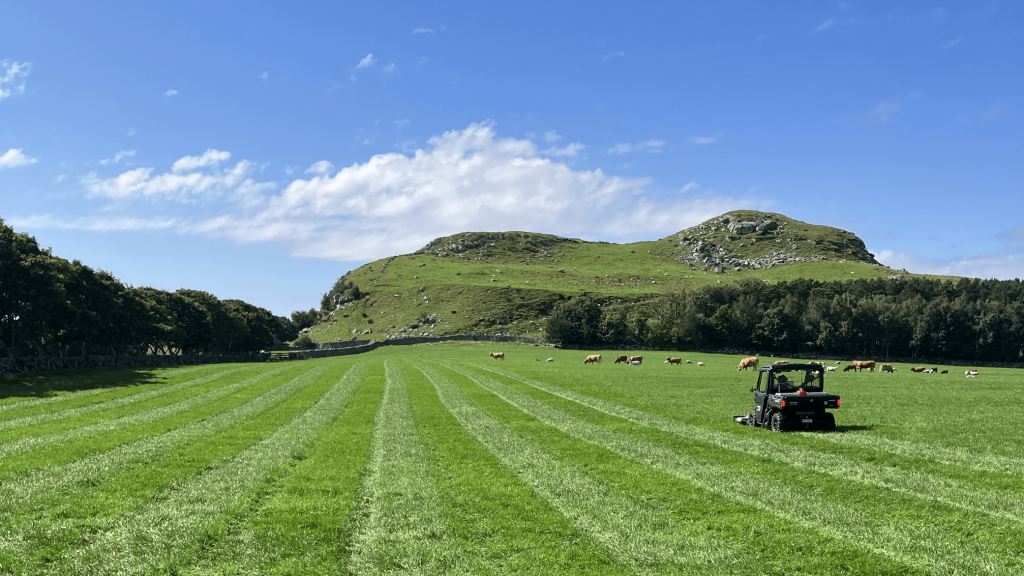
Cover Photo: The Georadar car passes over the Utstein Gard field in Klosterøy. Photo: Grethe M. Pedersen, AM, UiS

Related Articles

New study: Human brains preserve in diverse environments for at least 12 000 years

21 March 2024

21 March 2024

A study by forensic anthropologist Alexandra Morton-Hayward and her team from the University of Oxford has shown that the human...

A submerged stone bridge constructed 5600 years ago shed light on the human colonization of the western Mediterranean

31 August 2024

31 August 2024

An interdisciplinary research team, led by University of South Florida (USF) geology Professor Bogdan Onac, has examined an ancient submerged...

Archeologists in Peru find a 1,000-year-old adolescent mummy wrapped in bundle

25 April 2023

25 April 2023

Archaeologists have unearthed a more than 1,000-year-old mummy on the outskirts of Peru’s capital, Lima. The mummified adolescent was wrapped...

At Göbeklitepe, believed to be the earliest known Mesolithic temple complex, grinding stones were discovered

26 October 2022

26 October 2022

A recent discovery at Göbeklitepe, the oldest known Mesolithic temple complex, has revealed grinding stones, new finds expected to shed...

Manot Cave yielded evidence for ritualistic gathering 35,000 years ago, the earliest on the Asian continent

13 January 2025

13 January 2025

Archaeological research at the Manot Cave in what is now the Galilee in northern Israel has uncovered evidence of ritualistic...

Archaeologists in northern Spanish have discovered what they believe to be the oldest Basque language text

15 November 2022

15 November 2022

Archaeologists have discovered what they believe to be the oldest Basque language text, on  Irulegi archaeological site, near the Aranguren...

A Big, Round, 4,000-Year-Old Stone Building Discovered on a Cretan Hilltop

12 June 2024

12 June 2024

During excavations for an airport on Greece’s largest island of Crete, a large circular monument dating back 4000 years was...

The ancient city of Karkamış “House of the Seal” brings a different perspective to the Hittite-Assyrian relations with its important finds

6 May 2022

6 May 2022

Historical artifacts discovered during excavations by Turkish and Italian teams in the ancient city of Karkamış (Carchemish) in southern Gaziantep...

Woodhenge Found in Denmark: A Link Between Denmark and Britain’s Neolithic Past

1 March 2025

1 March 2025

In a stunning revelation, archaeologists have unearthed a remarkable structure dubbed “woodhenge” in Denmark, a discovery that not only illuminates...

Neanderthals too may have Developed a System of Numerical Notation

2 June 2021

2 June 2021

People developed numbers tens of thousands of years ago, according to archeological findings. Scholars are now investigating the first comprehensive...

Ancient Humans Used Indigo Plant 34,000 Years Ago: First Evidence of Non-Food Plant Processing Found in Georgia

3 September 2025

3 September 2025

34,000-year-old indigo plant residues found in Georgia’s Dzudzuana Cave reveal that prehistoric humans processed plants for more than just food....

Where We Saw Sin, There Was Care: A Baby Buried in a Medieval Belgian Brothel

23 May 2025

23 May 2025

A medieval brothel in Belgium yields a discovery that forces historians to confront forgotten tenderness in places long seen only...

Archaeologists, First-ever Roman-era Tombs Dug Directly into the Rock Uncovered in Al Bahnasa, Egypt

8 January 2024

8 January 2024

Spanish archaeologists made a ground-breaking discovery of rock-hewn Ptolemaic and Roman tombs, mummies, coffins, golden masks, and terracotta statues in...

Artificial Intelligence Project That Will Revolutionize Archaeology

5 April 2021

5 April 2021

Polish Scientists to opening a new era in archeology They plan to use artificial intelligence to detect prehistoric cemeteries, castles,...

2,300 Years Old First Complete Ancient Celtic Village and Roman Settlement Discovered in Munich

22 October 2023

22 October 2023

Archaeologists have discovered an ancient Celtic village and evidence of a smaller Roman settlement in Munich, Germany. The 2,300-year-old Celtic...