
26 June 2026 The Future is the Product of the Past

Bronze Age Treasure Found in Swedish Forests

A man who studied the forest to make a map for the orienteering club in western Sweden made an incredible discovery.

Cartographer Thomas Karlsson first learned that the treasure he thought was a fake was 2500 years old and belonged to the bronze age.

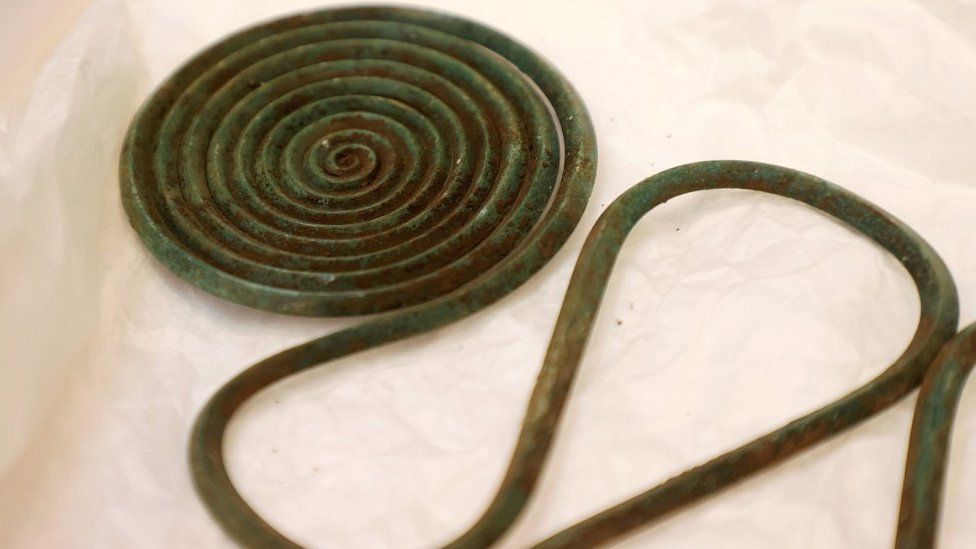
Found treasure, It includes about 50 items, such as necklaces, bracelets and clothing pins.

The cartographer, Thomas Karlsson, said “I first thought it might be a lamp, but when I looked closer I saw that it was old jewelry”.

According to Swedish archaeologists, it is very rare to find such a hoard in a forest. Such gifts were typically left in rivers or wetlands by ancient tribes. The hoard was on the forest floor, next to rocks.

They have been dated between 750 and 500 BC.
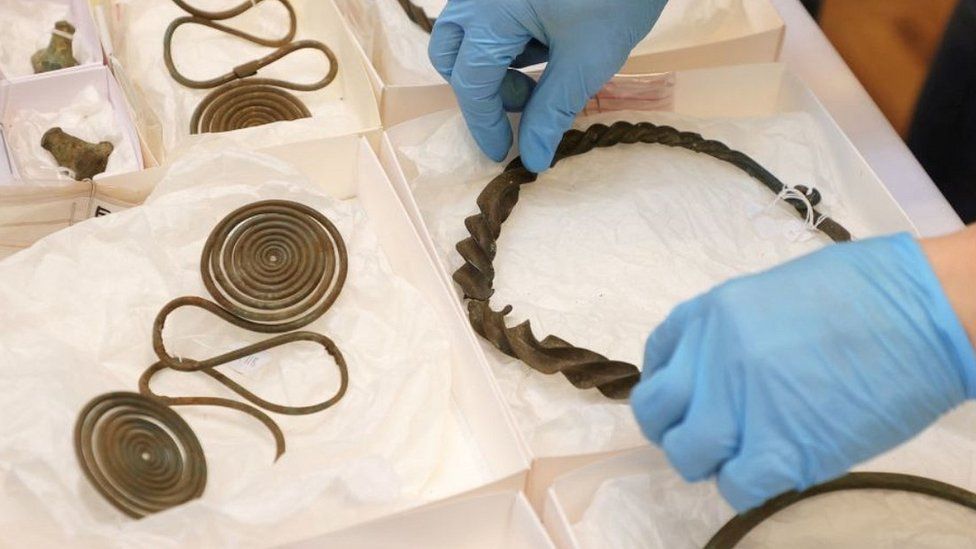
It is one of Sweden's most spectacular Bronze Age finds
It is one of Sweden’s most spectacular Bronze Age finds.AFP

When staring down at a map he was working on, Mr. Karlsson noticed the metallic glint. Since the ornaments were in such fine repair, he first assumed they were copies. Then, while drinking coffee in the park, he emailed a local archaeologist, according to the regional newspaper Goteborgs-Posten.

The forest is located near the town of Alingsas, about 48 kilometers (30 miles) northeast of Gothenburg.

Archaeologists refer to it as a “depot” discovery, which means it was intentionally left as a sacrifice to a deity or gods, or to invest in life after death.

The jewelry “is extremely well preserved”, said Prof Johan Ling, lecturer in archaeology at Gothenburg University.

“Most of the items can be linked to a woman, or women, of high status,” he said, quoted by Goteborgs-Posten.
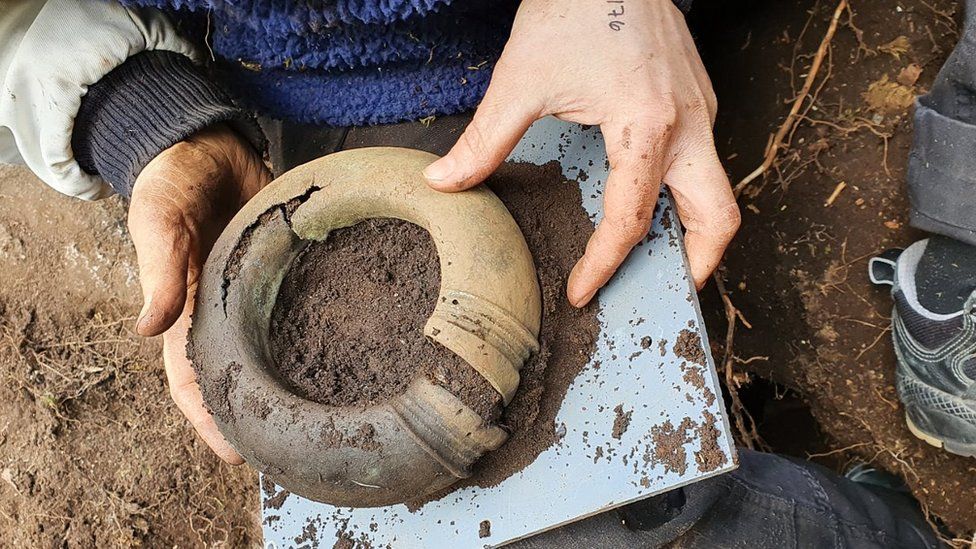
Celtic torcs
This is believed to be an ankle ring, similar to Celtic torcs. Photo: MATS HELLGREN/VGREGION

The treasure includes a type of rod used to spur on horses, previously found in neighbouring Denmark, but not in Sweden.

Since such antiquities are considered state property in Sweden, anyone who discovers them is required by statute to contact the police or municipal authority. The Swedish National Heritage Board then agrees on a monetary award, if any, for the finder.

Mr. Karlsson said a reward “would be a nice bonus, but it’s not very important to me.

“It’s fun to be a part of exploring history. We know so little about that era because there are no written sources.”

The Bronze Age lasted in Scandinavia from about 1700BC to 500BC, until it gave way to the Iron Age. The Iron Age lasted until about the year 800 when the Viking Age began.

Pernilla Morner, an antiquities expert for the Vastra Gotaland region, said that “not since the bronze shields from Froslunda were excavated from a field in Skaraborg in the mid-1980s has such an exciting find from the Bronze Age been made in Sweden”.

VGRfokus, a news site for Vastra Gotaland, says a team of Gothenburg archaeologists is now investigating the site in detail.

Source: BBC

Related Articles

New Samnite Necropolis Sector Discovered in Pontecagnano: 34 Tombs and Unusual Child Burials with Bronze Warrior Belts

11 March 2026

11 March 2026

Archaeologists working in southern Italy have uncovered 34 Samnite-period tombs in the municipality of Pontecagnano Faiano, offering new insights into...

Remains of 14th-century Synagogue thought to be one of largest in region discovered in Poland

14 August 2023

14 August 2023

The remains of what is thought to be a sizeable 14th-century synagogue complex, including a mikvah, have been discovered during...

Vampires Were Born Here: The Forgotten Serbian Village Behind the World’s Oldest Vampire Legend

18 July 2025

18 July 2025

Picture a quiet Balkan village at dusk: the sun dips behind dense forests, mist curls around forgotten gravestones, and the...

Rare Arabic inscription discovered during Malta housing project works

3 May 2023

3 May 2023

A rare Arabic inscription, possibly dating back to medieval times, was discovered at the site of a social housing project...

Obsidian Research in Alberta Uncovers Evidence of Extensive Long-Distance Trade Among Indigenous Peoples Before European Contact

31 March 2025

31 March 2025

Recent research into obsidian artifacts in Alberta, a province located in western Canada, has unveiled significant evidence of long-distance trade...

Excavations at a 4th millennium BC settlement uncover evidence for the emergence and rejection of the earliest state institutions in Iraq

6 December 2024

6 December 2024

New excavations of the 4th-millennium B.C settlement at the archaeological site of Shakhi Kora, located in the Iraqi Kurdistan region...

Standing Swords, Beads, and Magnificent Horse Gear: Viking Treasures Unearthed Along Sweden’s E18

5 November 2025

5 November 2025

Two upright swords thrust into Viking graves, strings of glittering beads, and richly decorated horse equipment have emerged from the...

500-year-old board game discovered carved into a stone slab in a Polish castle

12 September 2023

12 September 2023

A board game carved into stone was discovered by archaeologists investigating the castle at Ćmielów in the Świętokrzyskie Voivodeship in...

Rare Mithras Sanctuary in Croatia Challenges Long-Held Views of Roman Mystery Cult Worship

5 June 2026

5 June 2026

A Mithras sanctuary in Croatia may force scholars to rethink one of the Roman Empire’s most distinctive mystery cults, after...

Roman Soldiers at Vindolanda Secretly Made Their Own Ink — Using Techniques Forgotten in the Mediterranean

5 March 2026

5 March 2026

At the northern edge of the Roman Empire, where winds swept across Britain’s frontier and soldiers guarded the boundary of...

New Elymaean Rock Carving in Iran Shows Possible Parallels with the Hercules–Hydra Motif Known from 325 BC Greek Coinage

21 December 2025

21 December 2025

A newly discovered Elymaean rock carving in southwest Iran is drawing significant scholarly attention for its unusual iconography and its...

The Famous Cueva de Ardales cave in Spain was used by ancient humans for over 50,000 years

8 June 2022

8 June 2022

Cueva de Ardales cave in Málaga, Spain,  famed for the extensive prehistoric art on its walls was excavated for the...

A 2,000-Year-Old Roman Inkwell Found in Portugal Contains a Technological Recipe That Shouldn’t Exist

17 November 2025

17 November 2025

A 2,000-year-old Roman inkwell found in Conimbriga reveals an advanced mixed-ink formula, challenging what we know about ancient writing technology...

Anglo-Saxon monasteries were more resilient to Viking attacks than thought

31 January 2023

31 January 2023

Researchers from the University of Reading’s Department of Archaeology have found new evidence that Anglo-Saxon monastic communities were more resistant...

Otto the Great’s Tomb Marble Did Not Come from Italy or Greece, New Research Reveals

19 December 2025

19 December 2025

A major archaeological discovery in Germany is reshaping long-held assumptions about one of Europe’s most iconic imperial monuments. The tomb...