
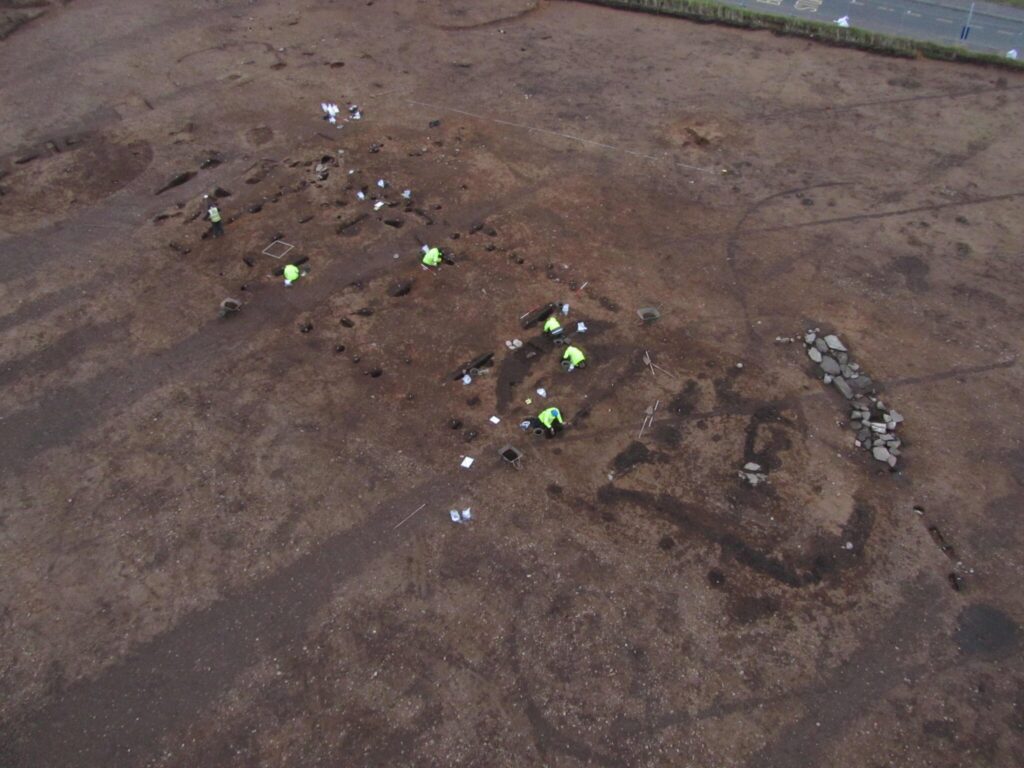
Archaeologists uncover one of the largest Neolithic timber halls in Scotland, revealing a long-lost site of prehistoric gatherings, rituals, and Bronze Age wealth.
In a discovery hailed as one of the most significant in recent Scottish archaeology, researchers from GUARD Archaeology have unearthed a vast Neolithic timber hall near Carnoustie, Angus, believed to have served as a ceremonial and communal gathering place for some of Scotland’s earliest farming communities around 4000 BC—over a thousand years before Stonehenge was constructed.
The excavation, carried out in advance of a football pitch development near Carnoustie High School and funded by Angus Council, revealed the remains of a 35-metre-long and 9-metre-wide timber hall—the largest of its kind ever found in Scotland. The monumental structure, built using massive oak timbers with complex internal divisions and thick daubed walls, points to a highly sophisticated and organized Neolithic society.
“This monumental timber hall was fully formed, architecturally advanced, and entirely alien to the Mesolithic traditions that preceded it,” explained Beverley Ballin Smith, co-author of the newly published excavation report.
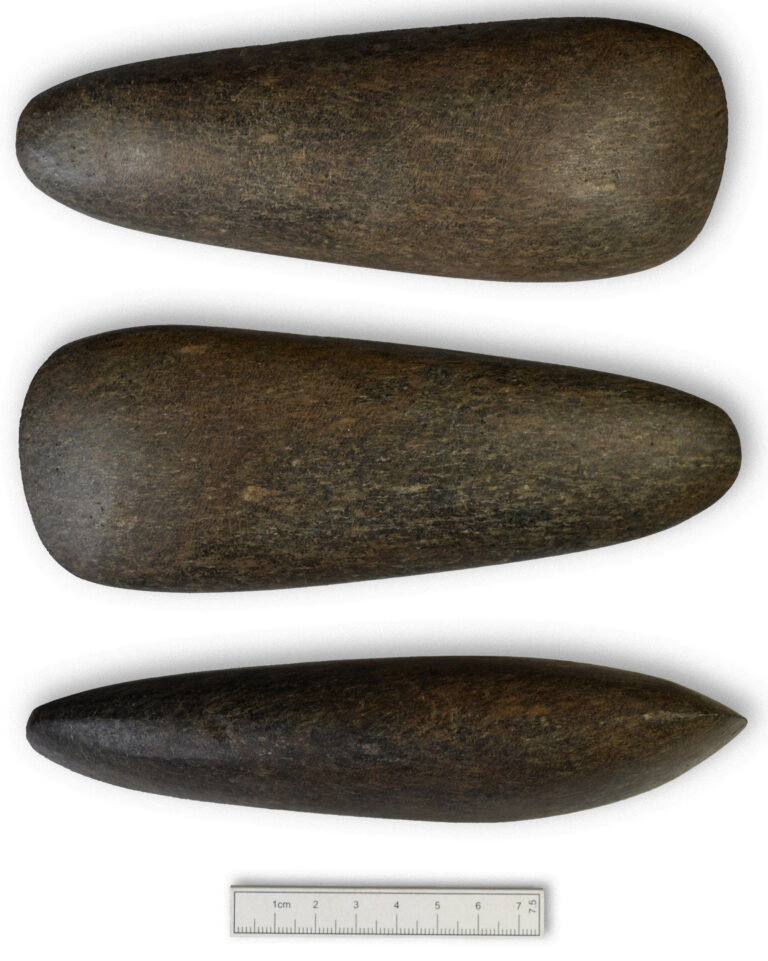
Unlike other isolated Neolithic halls found across Scotland, the Carnoustie site features a smaller adjacent hall, measuring nearly 20 metres in length, likely used for domestic purposes. Charred cereal grains and hazelnut shells found in its large hearth suggest daily living activities. However, the larger hall was more symbolic: archaeologists uncovered deliberately buried stone tools and rare artifacts, indicating ceremonial or ritualistic functions.
The elevated location of the timber halls near natural routeways suggests they were seasonal gathering spots—possibly the center of autumn feasts when hazelnuts were plentiful. Artifacts recovered from as far afield as the Highlands and Isle of Arran—including pitchstone, smoky quartz, and a rare garnet-albite-schist axe—highlight the wide-reaching cultural and trade connections of the community.
The site saw continued activity for centuries. Around 3800–3700 BC, a smaller hall was constructed within the original structure’s footprint and continued to receive ritual deposits until approximately 3600 BC. Seasonal visits and gatherings persisted at the location until about 2500 BC.
Bronze Age Legacy: A Hidden Hoard of Weapons and Wealth
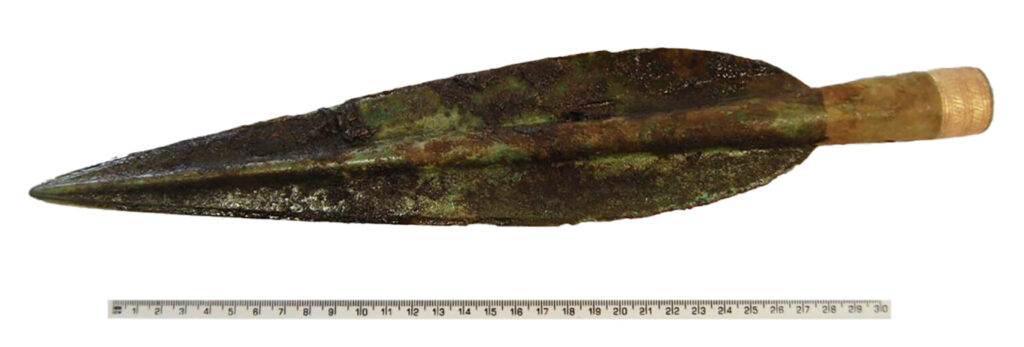
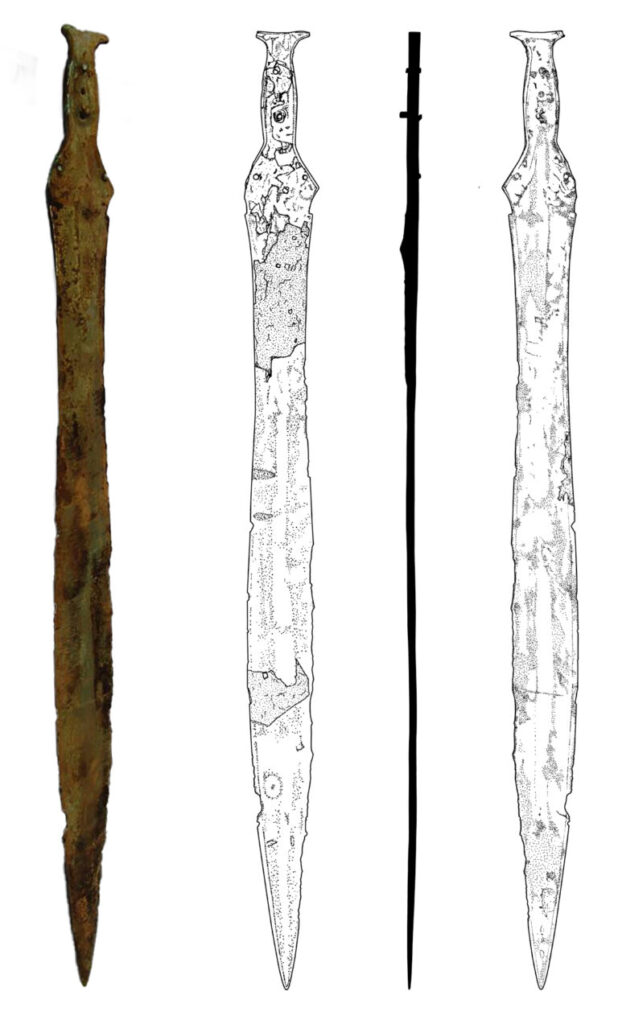
Even more remarkably, archaeologists uncovered a Late Bronze Age metalwork hoard, buried centuries later—between 1118 and 924 BC—within the footprint of a much later roundhouse. The hoard included a bronze sword in its original wooden scabbard, a gold-banded spearhead, and a sunflower-headed swan-neck pin, all carefully wrapped in woollen cloth and sheepskin. This preservation is credited to copper’s antimicrobial properties.
“The bronze objects were likely crafted in Scotland using materials imported from eastern England and possibly the Irish Sea area,” said Warren Bailie, co-author of the excavation report.
The sword bears combat damage, while the spearhead shows structural weaknesses—indicating both ceremonial and practical use. A shale bangle found nearby, along with the hoard, suggests the settlement’s occupants were of high status, even though the roundhouse itself appeared modest.
Such hoards are extremely rare, and a similar discovery from the 1960s north of Dundee points to a regional tradition of burying wealth for safekeeping—perhaps during uncertain times.
In a whimsical twist, the final “inhabitant” of the site was a field mouse, discovered through traces of grass and copper staining inside the spearhead socket.
Modern Development, Ancient Past
This world-class archaeological site was uncovered thanks to standard pre-construction assessments. Angus Council required an archaeological survey before the development of sports pitches—a move that unexpectedly revealed over 6,000 years of history beneath the turf.
“No one imagined the construction of football pitches would lead to the discovery of one of Scotland’s most important archaeological finds,” said Kathryn Lindsay, Chief Executive of Angus Council. “This has given us a rare and valuable insight into life in Angus during the Neolithic and Bronze Ages.”
The full report, ARO60: Neolithic timber halls and a Bronze Age settlement with hoard at Carnoustie, Angus, by Beverley Ballin Smith, Alan Hunter Blair, and Warren Bailie, is now available through Archaeology Reports Online.
Cover Image Credit: GUARD Archaeologists excavating the long Neolithic Hall at Carnoustie. Credit: GUARD Archaeology
