
8 November 2025 The Future is the Product of the Past

Amarna’s Hidden Chapter: From Abandoned Pharaoh’s City to Christian Monastic Hub

New archaeological findings have reshaped our understanding of Amarna, the once-glorious capital of ancient Egypt founded by Pharaoh Akhenaten in the 14th century BCE. Known in antiquity as Akhetaten, this city was designed as a revolutionary capital devoted exclusively to the Sun god Aten, symbolizing a dramatic departure from traditional Egyptian polytheism. For about fifteen years, Amarna thrived as a political and religious center, home to impressive temples, palaces, and administrative complexes.

Following Akhenaten’s death, however, his successor Tutankhamun abandoned Amarna and returned the royal seat to Thebes. For generations, historians believed the city was permanently deserted. But recent studies, published in the Minia Journal of Tourism and Hospitality Research, now reveal a forgotten chapter in Amarna’s history—its transformation into a hub of Christian monasticism during the Roman and Byzantine periods.

Archaeological excavations in the Amarna tombs, particularly in the northern cliff region, uncovered evidence of monastic settlements dating from the 5th and 6th centuries CE. Unlike the grandeur of the pharaonic temples, early Christian monks chose to inhabit rock-cut tombs, adapting them into austere monastic dwellings, churches, and workshops. The Tomb of Panehsy, also known as Tomb 6, revealed a small church complete with an apse decorated with red crosses, birds, and an eagle—symbols deeply rooted in early Christianity in Egypt.
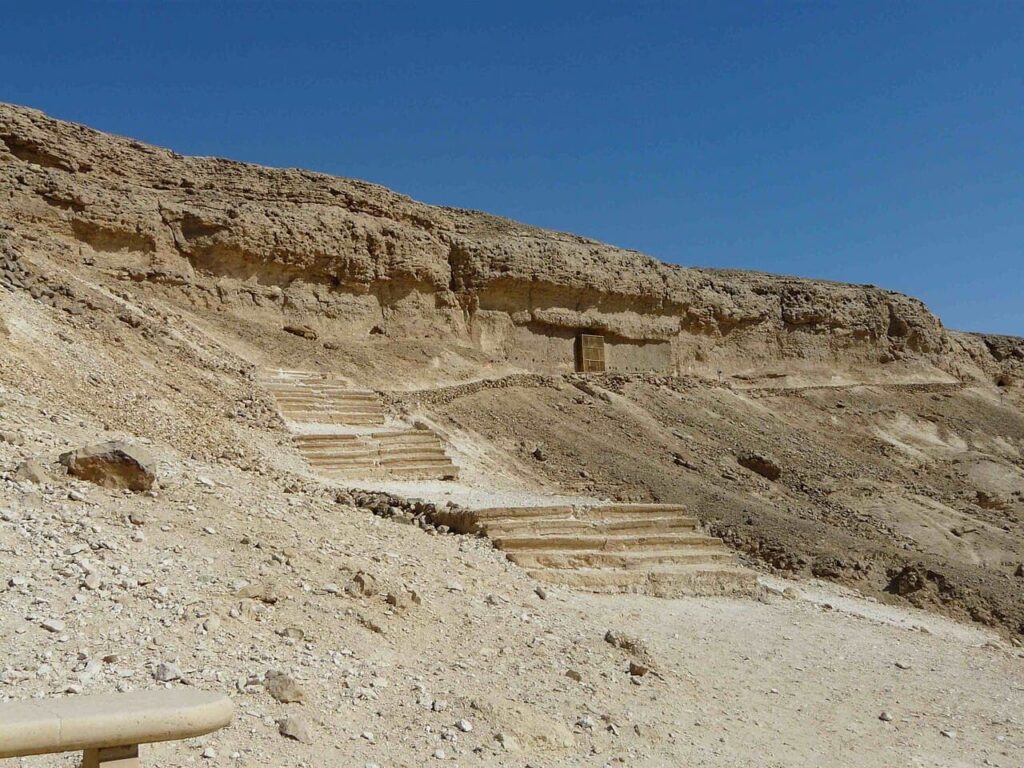

Christian monks established monastic communities within the tombs of Amarna’s necropolis during the Byzantine period. Credit: Wikimedia Commons

Material evidence, including imported amphorae from Tunisia, Syria, and Alexandria, points to active trade during this period. Items such as cooking vessels, looms, and carved storage niches suggest a highly organized and self-sufficient monastic lifestyle. This material culture offers a window into the daily routines of monks who transformed Amarna’s sacred desert into a new spiritual landscape.

According to the study, the monks’ presence in Amarna was not the result of political exile or persecution. Rather, it was the desert monasticism ideal—seeking solitude and spiritual purification—that drew them to this isolated location. The tombs and cliffs, elevated above the Nile Valley, likely held symbolic significance as a barrier between the sacred and the profane. In doing so, the monks reimagined Amarna not only as a place of retreat but also as a site of spiritual resistance and rebirth.


📣 Our WhatsApp channel is now LIVE! Stay up-to-date with the latest news and updates, just click here to follow us on WhatsApp and never miss a thing!!


This new interpretation of Amarna expands its historical significance—from a fleeting pharaonic experiment in religious innovation to a long-lasting center of Christian archaeology in Egypt. It stands as a rare example of a site where two distinct religious revolutions—Atenism and Christianity—left their mark on the same landscape across centuries.
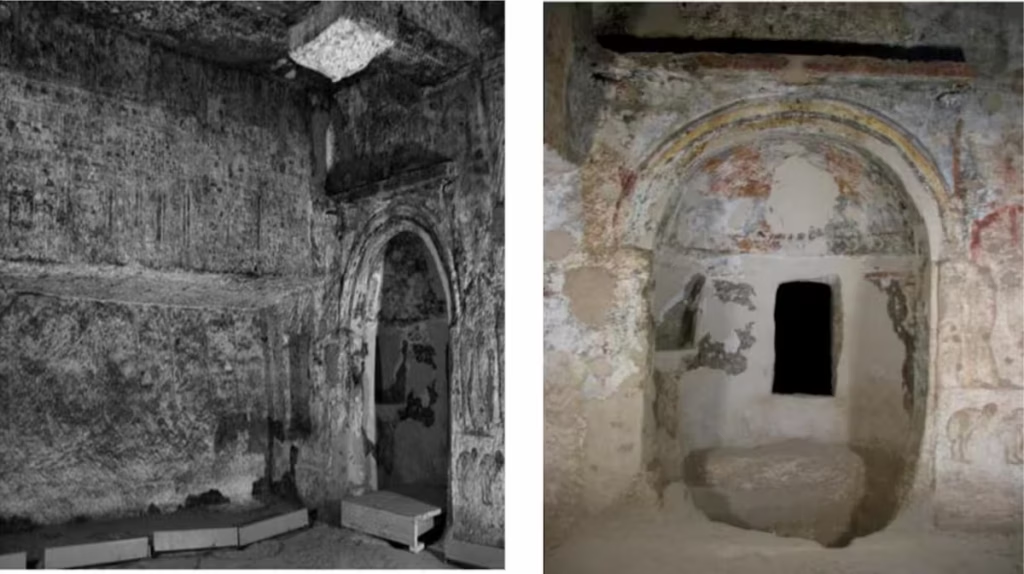
The apse features the cornice of the original false door above, a later-added window in the rear wall, and a cistern carved into the floor—evidence of adaptive reuse by Christian monastic communities. Credit: Pyke 2008, EA 32,8

Ahmed Fathy Saddik, Samar Mostafa Kamal, Walaa Mohamed Abdekhakim (2025), Life at Amarna during the late Roman Period. Minia Journal of Tourism and Hospitality Research, vol.19, no.2. DOI:10.21608/mjthr.2025.383481.1199

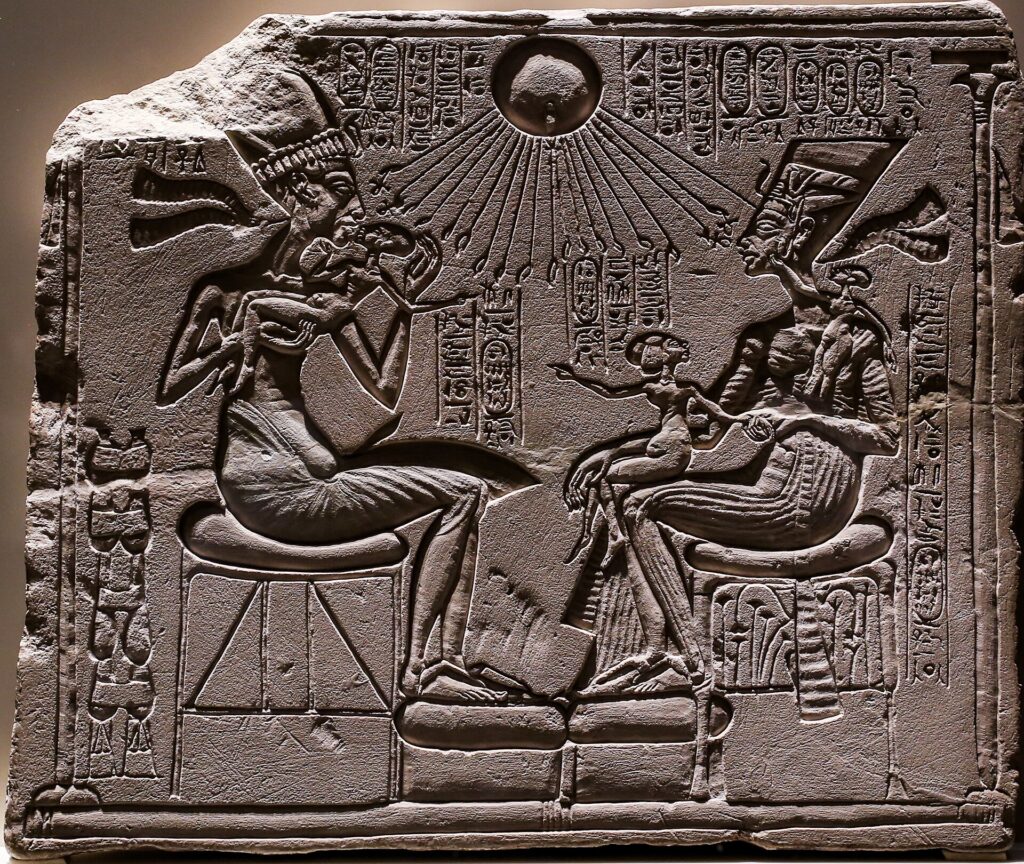
Cover Image Credit: Akhenaten, Nefertiti and their children. Public Domain

Related Articles

Seven Roman altars multicolored in the Great Northern Museum

12 November 2021

12 November 2021

We know that the ancient world is now very colorful. But these colors weren’t just limited to robes and other...

A Ribat Mosque shares space with the Roman sanctuary dedicated to Sun and Ocean was discovered in Portugal

2 November 2023

2 November 2023

The ruins of a second Islamic ‘ribat’ mosque dating back to the 11th and 12th centuries have been discovered at...

Ancient Agora Discovered in Hyllarima: Shops to Be Excavated in the Heart of the City

29 June 2025

29 June 2025

A major archaeological discovery has been made in the ancient city of Hyllarima in southwestern Türkiye—the city’s central agora has...

Wildfire Uncovers Lost Biblical Village of Bethsaida on the Sea of Galilee

16 August 2025

16 August 2025

In a surprising twist of fate, a wildfire that swept through Israel’s Betiha Nature Reserve in late July has unveiled...

World’s first deepwater archaeological park inaugurated off Xlendi, Malta

10 August 2023

10 August 2023

The world’s first deepwater archaeological park has been inaugurated for divers off the coast of Xlendi in Gozo. This unique...

Assyriologist solves archaeological mystery from 700 BC in Khorsabad, Iraq

7 May 2024

7 May 2024

A new interpretation of a set of temple symbols that have puzzled scholars for more than a century has been...

Glacier archaeologists find a 1300-year-old arrow in melting ice

20 August 2022

20 August 2022

The Glacier archaeologists found a 1300-year-old arrow from the Norwegian Iron Age during a research project on the Langfonne ice...

Researchers found similar descriptions in the Book of Revelation and ancient curse tablets

10 February 2023

10 February 2023

A research project headed by Dr. Michael Hölscher of Johannes Gutenberg University Mainz (JGU), has uncovered that the book of...

Tombs rich in artifacts discovered by Swedish archaeologists in Cyprus

7 July 2023

7 July 2023

A Swedish archaeological expedition made the extraordinary discovery of tombs outside the Bronze Age trading metropolis of Hala Sultan Tekke...

The 4,500-year-old Wisconsin canoe was built around the same time that Stonehenge was being constructed

31 May 2024

31 May 2024

Historians from Wisconsin have reported the amazing finding of at least eleven prehistoric canoes in Lake Mendota, which is close...

The tomb of the “Bird Oracle Markos” was found in the ancient city of Pergamon

31 August 2022

31 August 2022

During the excavations carried out in the Ancient City of Bergama, which is on the UNESCO World Heritage List, the...

New Study Reveals Ancient Secrets of the 3,600-year-old Nebra Sky Disc

2 December 2024

2 December 2024

Discovered in 1999 in Germany, the Nebra Sky Disc is the oldest known depiction of the cosmos. A recent examination...

Remarkable discovery of Iron Age and Roman treasures found near a boggy area on Anglesey

29 February 2024

29 February 2024

Metal detectorist Ian Porter unearthed sixteen historical artifacts in a boggy field on Anglesey. Among the items found were Iron...

Remains of 240 people found beneath Ocky White department store in Wales

13 October 2022

13 October 2022

Archaeologists found skeletal remains of over more than 240 people, from beneath a former department store in Pembrokeshire in Wales,...

Extraordinary discovery in France: An unlooted 1800-year-old Roman Sarcophagus discovered

27 September 2023

27 September 2023

Archaeologists from France’s National Institute of Preventive Archeology (INRAP) have unearthed an unlooted ancient stone sarcophagus in the vast ancient...