
22 June 2026 The Future is the Product of the Past

A spectacular rare ancient Roman bronze coin depicting the moon goddess was discovered off the coast of Israel

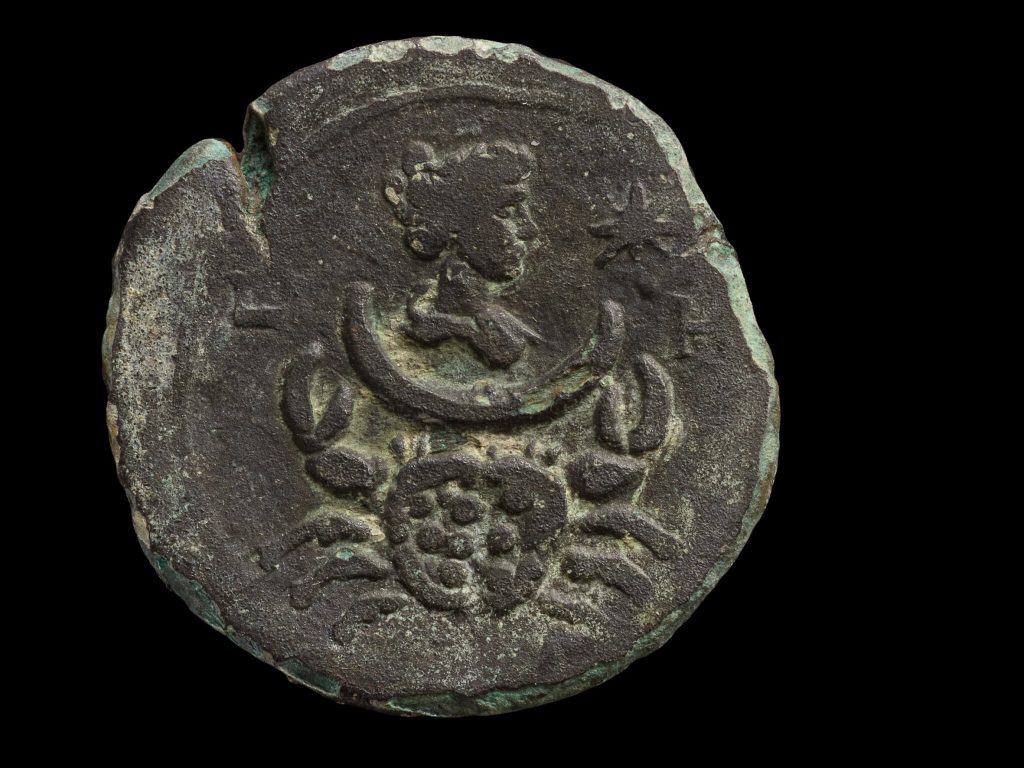
A rare 1850-year-old exceptionally well-preserved bronze coin depicting the Roman moon goddess Luna has been found off the coast of Carmel in Haifa, the Israel Antiquities Authority said on Monday.

The coin was struck at Alexandria, Egypt, during the reign of Emperor Antoninus Pius (138-161 CE). The reverse depicts Luna over a representation of the zodiacal sign Cancer. The coin carries the date ‘Year eight,’ which corresponds to the eighth year of Antoninus Pius’ reign, approximately 144/145 CE.

While the IAA did not say exactly when the coin was recovered, the Marine Archeology Unit of the Israel Antiquities Authority found the coin on the seafloor during a search to protect the artifacts from coastal development.
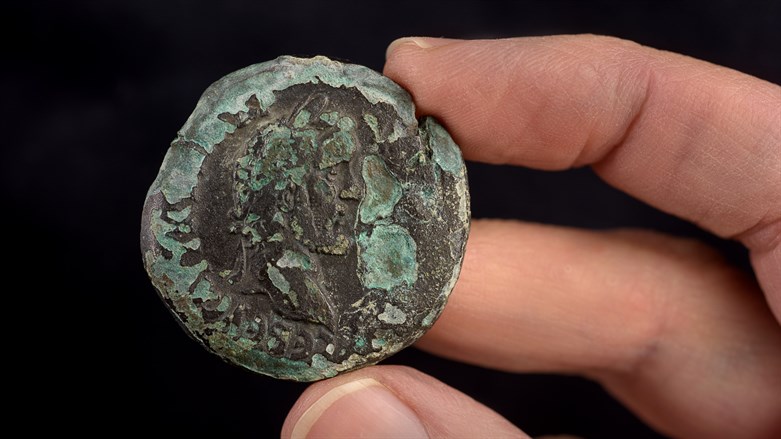
Portrait of the Roman Emperor Antoninus Pius. Photo: Dafna Gazit, Israel Antiquities Authority

Find belongs to a series of thirteen coins, twelve depicting the different signs of the zodiac and another the complete zodiac wheel.

Israel Antiquities Authority Maritime Archaeology Unit director Jacob Sharvit said it was the first time such a coin has been found off Israel’s coast.


📣 Our WhatsApp channel is now LIVE! Stay up-to-date with the latest news and updates, just click here to follow us on WhatsApp and never miss a thing!!


Sharvit said that “it is a rare addition to the National Treasures collection”.

“Israel’s Mediterranean shores and waters have yielded many archaeological sites and finds that attest to connections in antiquity between Mediterranean ports and the countries along it. These finds, which were lost at sea and disappeared from sight for hundreds and thousands of years, have been remarkably well preserved; some are extremely rare and their discovery completes parts of the historical puzzle of the country’s past,” he said.
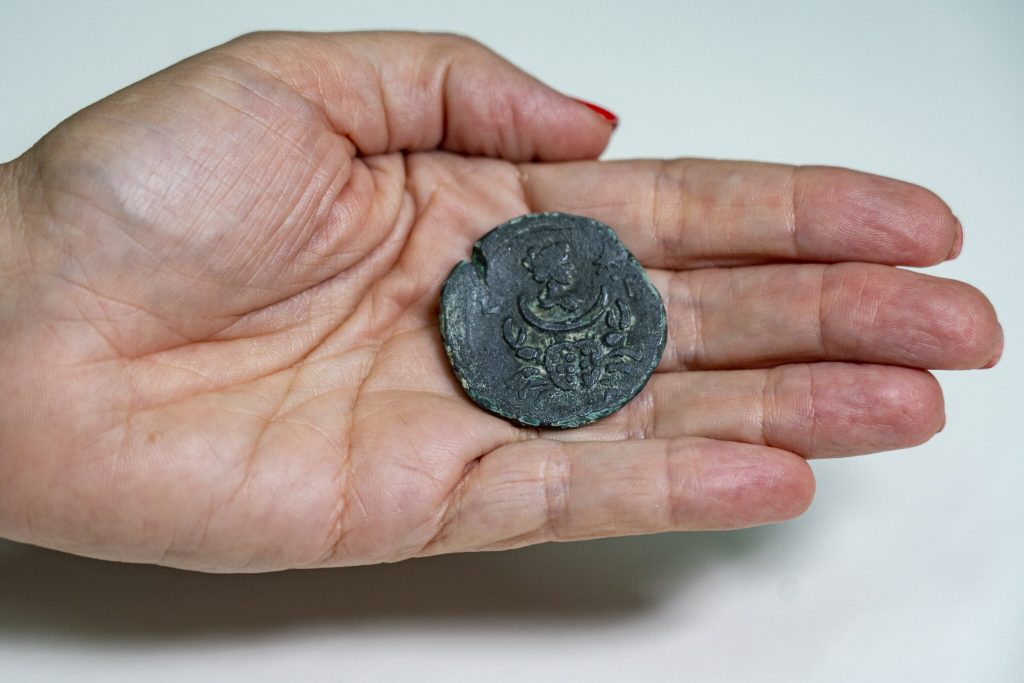
A 1,850-year-old coin bearing the image of Luna, the goddess of the moon. found off the Carmel Coast. Photo: Dafna Gazit, Israel Antiquities Authority

According to the IAA, Antoninus’ reign was the quietest of the Roman Empire, occurring at the height of the Pax Romana, or Roman calm, and Antoninus himself was not from the military, was never in a war, and never even left Rome.

“During his rule, the empire’s relations with the Jews were greatly improved, the decrees of Hadrian were revoked, and Jews were allowed to practice circumcision, the IAA said.

IAA

Cover Photo: Israel Antiquities Authority

Related Articles

4000-year-old boat salvaged near the ancient city of Uruk one of the most important cities in ancient Mesopotamia

6 April 2022

6 April 2022

A team of archaeologists from the Iraqi German Mission of the State Board of Antiquities and the Orient Department of...

Sacred Sanctuary of Phrygian Mother Goddess Matar Unearthed in Attouda Ancient City

2 October 2025

2 October 2025

A groundbreaking archaeological discovery has been made in Attouda Ancient City, located in the Sarayköy district of Denizli, Turkey. Excavations...

Analysis of Ancient Scythian Leather Samples Shows Ancient Scythians Made Leather from Human Skin

20 December 2023

20 December 2023

The ancient Scythians’ history as fearsome warriors dates back more than 2,000 years, and now research from a multi-institutional team...

Iconic Double Arch collapsed after an ancient pyramid in America, Tribes Link Fall With ‘Bad Omen’

10 August 2024

10 August 2024

Two ancient North American structures collapsed within just nine days of one another. The iconic Double Arch, also known as...

Bronze Age women’s jewelry set discovered in Güttingen carrot field, Swiss

17 October 2023

17 October 2023

A set of Bronze Age women’s jewelry was discovered by archaeologists in Güttingen, Thurgau canton, northeastern Switzerland, in a freshly...

Two Deep Ritual Wells Sealed with 3100-year-old Calcium Carbonate Discovered on Greek Island

6 August 2024

6 August 2024

Aerial photographs of the “Kotroni” Lakithra region, strategically located on the island of Cephalonia, west of the Greek mainland, revealed...

Famous Egyptologist Zahi Hawass Wants to See Hieroglyphs as an İntegral Part of The Curriculum

23 February 2021

23 February 2021

The Egyptian council of ministers is discussing the introduction of archaeological and tourist materials in the education curriculum to help...

2,000‑Year‑Old “Jesus Cup” Unearthed in Alexandria: Could It Be the Earliest Material Reference to Christ?

23 September 2025

23 September 2025

A ceramic bowl discovered in Alexandria, dubbed the “Jesus Cup” and inscribed “DIA CHRSTOU O GOISTAIS”, has sparked debate: might...

Large Roman Complex found in Swiss Gravel Quarry

30 August 2023

30 August 2023

Archaeologists have discovered the remains of walls of a Roman building complex built nearly 2,000 years ago in the Äbnetwald...

Archaeologists unearth mosaic floors in the ruins of a building they believe is the lost Church of the Apostles

23 October 2021

23 October 2021

In the historical village of Bethsaida on the edge of the Sea of Galilee, archaeologists discovered mosaic floors in the...

China’s Great Wall Restoration Reveals a Ming Cannon, Watchtower Life, and Hidden Artifacts

19 May 2026

19 May 2026

Archaeologists working along the Jiankou section of the Great Wall near Beijing have uncovered a rare collection of Ming Dynasty...

2,700-year-old Children’s Cemetery unearthed in Turkey’s Tenedos

2 March 2024

2 March 2024

A 2700-year-old children’s cemetery was discovered during ongoing excavations in the ancient city of Tenedos in Bozcaada,  southeast of the...

In the backstage of Smyrna Ancient Theater Latrina found

3 November 2021

3 November 2021

Interesting finds unearthed during the excavations of the 2400-year-old Ancient City of Smyrna in the Aegean region of Turkey continue...

The Gobi Wall: Ancient Statecraft Hidden in Mongolia’s Sands

17 June 2025

17 June 2025

Stretching 321 kilometers across the arid highlands of southern Mongolia, the Gobi Wall has long stood as a silent enigma...

Archaeologists unearthed the earliest known evidence of body perforation in skeletons dating back 11,000 years at the Boncuklu Tarla in Türkiye

11 March 2024

11 March 2024

Archaeologists have unearthed the earliest known evidence of body perforation in skeletons dating back 11,000 years at the Boncuklu Tarla...