
10 December 2025 The Future is the Product of the Past

A 2,000-year-old Roman grave belonging to soldier Flaccus unearthed in Netherlands

Archaeologists have uncovered a 2,000-year-old grave from the Roman settlement in Heerlen, Netherlands. The latest analysis has shown that it belonged to a Roman soldier named ‘Flaccus’.

The discovery is being touted as the “most unique evidence of Roman habitation at this location,” as this is the first time a Roman grave has been found from 0 AD with a name pointing to its occupant.

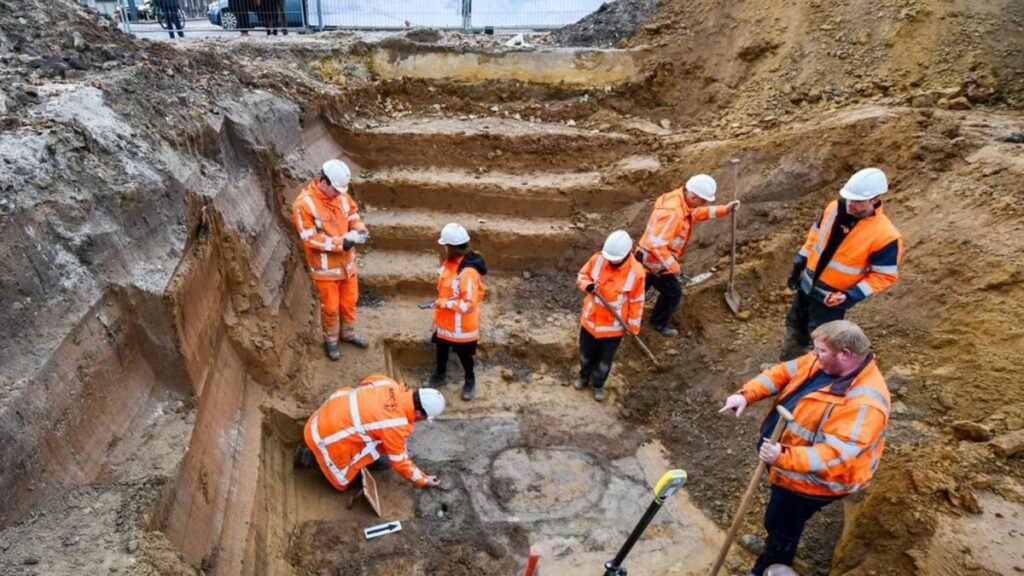
The discovery, which was discovered during ongoing excavations at the Raadhuisplein (Town Hall Square), provides fresh information about Heerlen’s past as Coriovallum, a Roman settlement that was ideally situated at the intersection of important Roman roads.

During a renovation project at the Raadhuisplein in late November 2024, archaeologists from ADC ArcheoProjecten discovered the grave. Because of its rectangular shape and discolored soil, the pit was first thought to be a cellar pit. However, the discovery of cremation remains clarified the pit’s function.

The grave also contained a fragment of a La Tène bracelet, pottery, shards, and three complete Roman plates of Terra Sigillata, according to a statement released by the municipality. One of these plates bore the abbreviation “FLAC,” a nickname for Flaccus, carved into its surface.


📣 Our WhatsApp channel is now LIVE! Stay up-to-date with the latest news and updates, just click here to follow us on WhatsApp and never miss a thing!!


Artifacts, including the personalized bowl, discovered at the site. Source: Municipality of Heerlen. Credit: Municipality of Heerlen/Facebook

Experts deduced the name ‘Flaccus’ from the abbreviation FLAC, which was carved into a bowl discovered in the grave, as per the media statement. “In addition to the bowl, the researchers also found a bronze skin scraper and four different plates. The pottery, which comes from Italy, confirms that Flaccus was a Roman soldier. It is a unique find because it is not only the oldest Roman grave in Heerlen but also because no name was known there before,” the statement noted.

The Raadhuisplein, located near the historical roads Via Belgica and Via Traiana, was an important location in the middle of the Roman settlement Coriovallum, the Heerlen of that time. The square is a unique place where 2000 years of history come together and the complete story of Heerlen is revealed bit by bit.

 These special discoveries contribute to a deeper understanding of Heerlen’s rich past and its Roman origins.

Municipality of Heerlen

Cover Image Credit: Municipality of Heerlen/Facebook

Related Articles

1st Century BCE Medusa Mask Mold Discovered in Ancient Finziade, Sicily

24 January 2025

24 January 2025

At the Finziade archaeological site in the Sicilian town of Licata, archaeologists have discovered a mask mold that could represent...

Egypt dig unearths 41 mln-year-old Whale in desert -Tutcetus rayanensis-

12 August 2023

12 August 2023

Paleontologists in Egypt announced the discovery of a new species of extinct whale that inhabited the sea covering present-day Egypt...

The oldest evidence of human use of tobacco was discovered in Utah

11 October 2021

11 October 2021

According to recent research, burnt seeds discovered in the Utah desert suggest that humans used tobacco initially and that some...

Archaeologists Uncover Exceptional Roman Mausoleum Near Lyon, Modeled After Augustus’ Tomb

23 August 2025

23 August 2025

Archaeologists in France have unearthed a remarkably well-preserved Roman mausoleum in Saint-Romain-en-Gal, near Lyon, that was modeled on the famous...

Scientists may have discovered pieces of the Asteroid that caused the extinction of the Dinosaurs

14 May 2022

14 May 2022

Scientists are piecing together remnants of the day the extinction of the dinosaurs began. A tiny fragment of the asteroid...

Rare Prehistoric Animal Carvings Discovered For The First Time In Scotland

31 May 2021

31 May 2021

Animal carvings thousands of years old have been found for the first time in Scotland. The carvings, estimated to be...

The Stolen Frescoes were Returned to the Pompeii Archaeological Park

20 May 2021

20 May 2021

Six frescoes ripped from the remains of ancient Roman villas years ago have been returned to the Pompeii archaeological site,...

Archaeologists may have Found a Viking Age Marketplace in Norway

21 February 2024

21 February 2024

Archaeologists from the University of Stavanger have identified the possible remains of a marketplace from the Viking Age on a...

Earliest Known Stone Mold for Coin Production in Roman Hispania Unearthed

27 March 2025

27 March 2025

Researchers from the University of Jaén have made a groundbreaking discovery at the archaeological site of Obulco, modern-day Porcuna, revealing...

The Tomb of Prince with a Monumental Pink Granite False Door Unearthed in Saqqara

23 April 2025

23 April 2025

In a remarkable archaeological discovery, an Egyptian team has unveiled the tomb of Prince Waser-If-Re, son of Pharaoh Userkaf, the...

Archaeologists discover a 4,000-year-old ancient city in the Iraqi Dhi Qar region

20 July 2021

20 July 2021

An astonishing find was made by archaeologists in Iraq‘s Dhi Qar province, where an ancient settlement estimated to be 4,000...

6,000 Years of Human History Unearthed in Brittany: From Stone Age Villages to Roman Farms

25 October 2025

25 October 2025

A large-scale archaeological excavation in the heart of Brittany has unveiled more than six thousand years of continuous human occupation,...

Fingerprints Found on Orkney Pottery Belong to Young Men

14 June 2021

14 June 2021

Details of the two young guys whose fingerprints were discovered on a fragment of a clay pot dating back over...

Well-Preserved Hittite “Bird Omen Text” Discovered at Kayalıpınar–Samuha, a Key Religious Hub of the Ancient Empire

24 July 2025

24 July 2025

Archaeologists working at the ancient Hittite settlement of Kayalıpınar, located in Türkiye’s Sivas province, have uncovered a remarkably well-preserved clay...

Archaeologists Uncover ‘Holy Water Effect’ Children’s Graves Beneath a 12th-Century Chapel

15 October 2025

15 October 2025

Archaeologists in Saxony-Anhalt in Germany have uncovered around 1,000 medieval artifacts and more than 50 graves, including those of children...