1 January 2026 The Future is the Product of the Past

Earliest Multiplication Formulas Discovered in a 2,300-Year-Old Chinese Tomb

Archaeologists excavating a tomb in the Qinjiazui archaeological site of Jingzhou City, Hubei Province, China, have found the earliest multiplication formulas on record.

The earliest multiplication formulas on record have been discovered on bamboo slips from the Warring States period (475BC-221BC), pushing the history of these formulas back by nearly a century, China’s National Cultural Heritage Administration (NCHA) announced at a press conference.

The formula, which dates back to the 4th century BC during the Warring State Period (475-221 BC), precedes another piece discovered in central Hunan Province by approximately a century, said Yang Kaiyong, a research fellow at the Jingzhou Museum. The burial – known simply as M1093 – probably dates back to the reign of either King Chu Xuan or King Chu Wei, from 369 to 329 BCE.

Bamboo slips were the most popular writing material in the period before paper became widespread. These slips, which are typically a centimeter or two wide and a few inches long, have been discovered in large numbers at the Qinjiazui site. Of all the tombs identified so far, M1093 contains the highest number of these slips.

Thousands of bamboo slips holding over 30,000 characters ranging from mathematics, literature, and animal husbandry to medicines have been discovered in the tomb.


📣 Our WhatsApp channel is now LIVE! Stay up-to-date with the latest news and updates, just click here to follow us on WhatsApp and never miss a thing!!


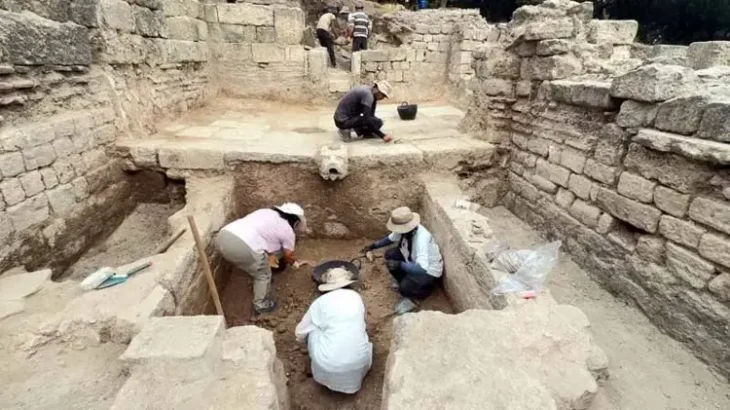
An archaeologist sorts out bamboo slips at a tomb in the city of Jingzhou, central China’s Hubei Province. Photo: Jingzhou Museum/Handout via Xinhua

Scientists have used infrared scanning to reveal the words on the slip: “Five times seven is thirty plus five, four times seven is twenty plus eight, three times seven is twenty plus one.”

On one of the strips, researchers found multiplication formulas as well as the oldest known example of an algebraic table known as Jiujiushu.

According to the researchers: “This significant discovery offers invaluable new resources for studying the history, culture, and ideologies prevalent during the pre-Qin period.”

The Warring States period lasted from 475 to 221 BCE and ended when the Qin state overcame its six adversaries. This resulted in the unification of the Chinese empire for the first time and the establishment of the Qin dynasty.

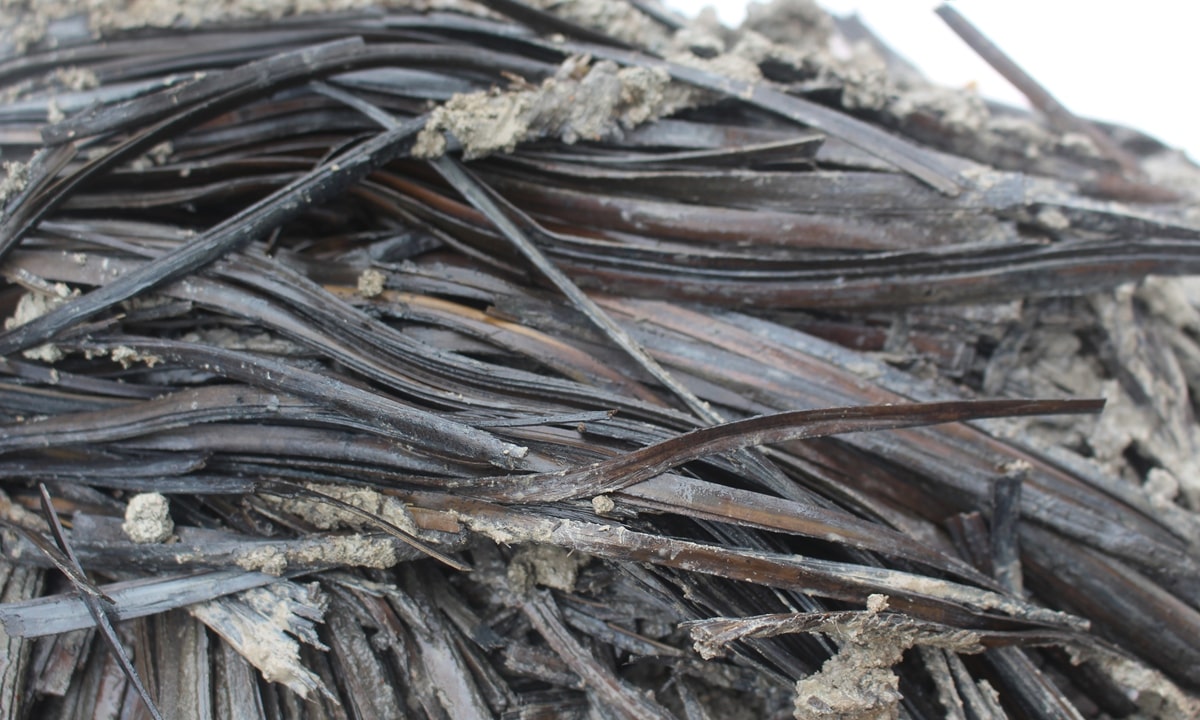
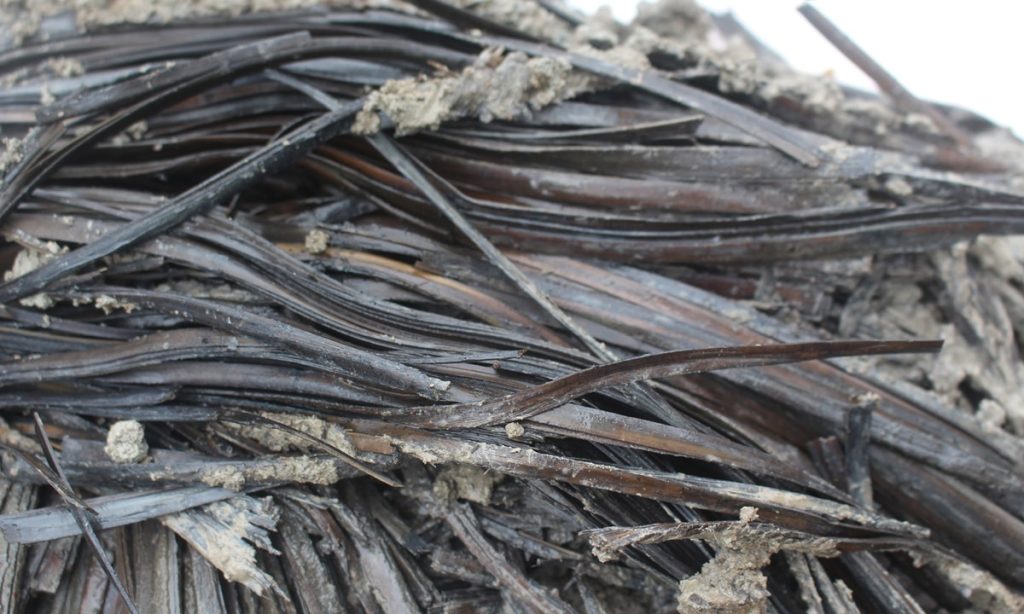
Cover Photo: Bamboo scripts from the Warring States period (475BC-221BC) unearthed from the M1093 tomb at the Qinjiazui site in Jingzhou city, Hubei Province. Photo: China’s National Cultural Heritage Administration
Related Articles

Ancient Graffiti Unearthed at Artezian in Crimea: A Hidden Message on Temple Plaster

6 October 2025

6 October 2025

Archaeologists exploring the ancient settlement of Artezian in Crimea have uncovered a tantalizing piece of antiquity: a fragment of graffiti...

1.5 Million-Year-Old Hand Axes and Seven Paleolithic Sites Discovered in Iraq’s Western Desert

30 January 2025

30 January 2025

Archaeologists from the Free University of Brussels (VUB) uncovered hand axes dating back 1.5 million years and discovered seven Paleolithic...

Oman has recovered an exceptional collection of silver jewelry from a prehistoric grave

7 November 2022

7 November 2022

From a prehistoric grave dating to the 3rd millennium BC in Dahwa, North Batinah, a team of international archaeologists working...

Medieval Hub of Arts & Crafts Center discovered in Nola: The discovery could rewrite the history of early medieval Nola

23 August 2023

23 August 2023

On the outskirts of Nola, a district from the early Middle Ages has been discovered. According to the Soprintendenza Archeologia,...

Analysis of Butchered Bones, Somerset Pit Reveals Bronze Age Cannibalism

17 December 2024

17 December 2024

Archaeologists have uncovered the bloodiest massacre in early Bronze Age Britain and evidence of Bronze Age cannibalism. It is the...

Historic Leeds cemetery discovery unearths an ancient lead coffin belonging to a late Roman aristocratic woman

14 March 2023

14 March 2023

Archaeologists in northern Britain uncovered the skeletal remains of a late-Roman aristocratic woman inside a lead coffin, as well as...

New study reveals unique characteristics and complex origins of late Bronze Age swords discovered in the Balearic Islands

25 November 2024

25 November 2024

A recent study uncovered a wealth of new information regarding the production, material makeup, and cultural significance of Late Bronze...

The Lady of the Inverted Diadem (7th Century BC): A Fallen Aristocrat Unearthed in Boeotia, Greece

29 November 2025

29 November 2025

An archaeological discovery in Boeotia uncovers the 7th-century BC Lady of the Inverted Diadem, revealing elite burials, rare artifacts, and...

3000 Years Old Bronze Age Settlement Unveiled Ahead of New Stadium Construction

27 July 2025

27 July 2025

Archaeologists have uncovered an expansive Late Bronze Age settlement in Wolmirstedt, Saxony-Anhalt, ahead of the construction of a new multimillion-euro...

Britain’s first Roman funerary bed is discovered in central London after 2,000 years

7 February 2024

7 February 2024

Archaeologists excavating a construction site in London have unearthed the first Roman “flat-packed” funerary furniture – a fully intact Roman...

A cobbled ford uncovered near Evesham could be the finest Roman example of its type in Britain

19 October 2022

19 October 2022

A cobbled ford believed to be of Roman construction has been discovered near Evesham in Worcestershire, England. If the path...

A 4000-year-old Fabric Found in a Cave of Skulls in the Judean Desert is the Oldest Dyed with Insect Dye

15 July 2024

15 July 2024

Researchers discovered an ancient textile dyed with kermes (Kermes vermilio) in Israel’s Cave of Skulls that dates back to the...

Vast Lost Maya Ritual Complex Reveals a Civilization Built Without Kings

9 November 2025

9 November 2025

Hidden for more than 3,000 years in the lowlands of Tabasco, the vast lost Maya ritual complex of Aguada Fénix...

Urartian King Argishti’s shield reveals the name of an unknown country

30 January 2023

30 January 2023

The inscription on a bronze shield purchased by the Rezan Has Museum revealed the name of an unknown country. It...

Archaeologists discovered medieval Bury St Edmunds Abbey ‘Bishop Boy’ token in Norfolk

19 December 2023

19 December 2023

Archaeologists have discovered token in Norfolk in the East of England, dating from between 1470 and 1560, given to the...