
14 December 2025 The Future is the Product of the Past

Rare Gold Coin from Reign of Byzantine Emperor Justin II Unearthed at Tuida Fortress in Sliven, Bulgaria

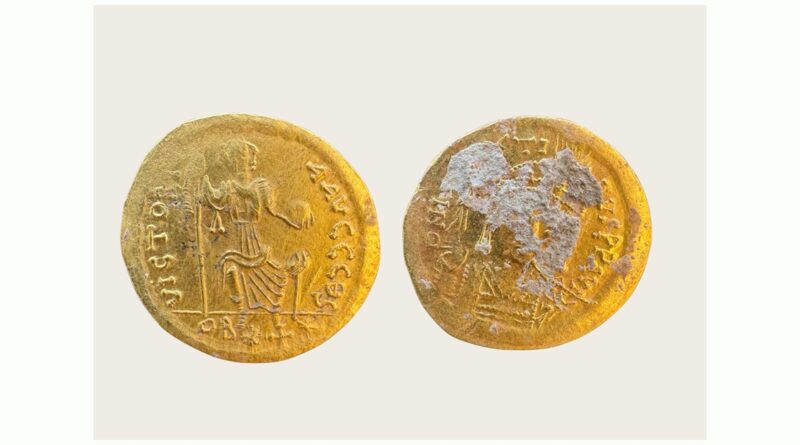
A rare gold coin dating back to the reign of Eastern Roman (Byzantine) Emperor Justin II (r. 565–578 CE) has been discovered at the Tuida Fortress, a strategically important early Byzantine stronghold located in the northeastern part of Sliven, Bulgaria, the Sliven Regional Historical Museum has announced.

This exceptional find marks the fourth gold coin uncovered at the Tuida site and is considered particularly significant due to its rarity and historical context.

Who Was Emperor Justin II?

Justin II was the nephew and successor of Emperor Justinian I, one of the most influential rulers of the Byzantine Empire. Justin II’s reign followed the grandeur of Justinian’s ambitious building projects and territorial expansion, but was instead marked by increasing pressure from the Sassanid Empire in the east and the Lombards in the west. He is also remembered for episodes of mental instability, which led to his wife, Empress Sophia, and his general Tiberius assuming control of the empire during the later years of his rule.

About Tuida Fortress

The Tuida Fortress (also spelled “Tuidda”) stands atop Hisarlaka Hill, a strategic location within the Stara Planina (Balkan Mountains) fortification system. Originally constructed in the late Roman period and rebuilt during the early Byzantine era, Tuida served as a crucial military and administrative center. The fortress played a defensive role throughout Roman, Byzantine, and medieval Bulgarian history, guarding against invasions and controlling key transit routes.

Discovery Details

Initially, the coin was believed to belong to Emperor Justinian I (r. 527–565 CE), but after professional cleaning and analysis, experts from the Sliven museum confirmed it dates to the rule of Justin II. The front (obverse) of the coin features a forward-facing bust of Emperor Justin II, depicted holding a globe surmounted by Victoria, the Roman goddess of victory. The inscription reads:


📣 Our WhatsApp channel is now LIVE! Stay up-to-date with the latest news and updates, just click here to follow us on WhatsApp and never miss a thing!!


D N IVSTINVS P P AVG
(Dominus Noster Justinus Perpetuus Augustus, Latin for “Our Lord Justin, Ever August”)

On the back (reverse), the inscription reads: VICTORIA AVGGG ΘS
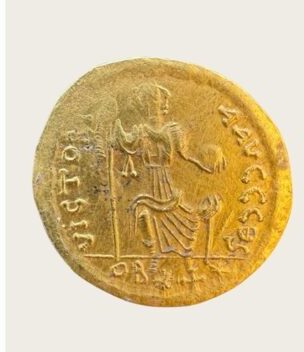
The obverse shows the bust of Emperor Justin facing forward, holding a globe with Victoria. Credit: Sliven Regional Historical Museum

According to researchers, the rare gold coin was likely minted in Theopolis, the historical name for Antioch, one of the most significant cities of the Eastern Roman Empire. Today, this ancient city is known as Antakya, located in southern Türkiye near the Syrian border.

Antioch was a major center of administration, commerce, and religion during Roman and Byzantine times. The presence of the mint mark “ΘS” on the reverse of the coin supports the theory that it originated from the Antioch (Theopolis) mint, further enhancing the historical and geographical value of the find.

An Archaeological Season Rich in Finds

So far in this year’s excavation season at Tuida, archaeologists have uncovered 23 coins spanning from the 2nd–3rd centuries to the 12th–13th centuries, offering a broad glimpse into the site’s continuous occupation and significance through centuries of tumultuous history.

Significance of the Find

The discovery of this rare Justin II solidus contributes valuable information to the study of Byzantine numismatics and the economic history of the region. It also reinforces Tuida’s status as a critical node in the imperial defense network during the early Byzantine period.

For history enthusiasts and scholars alike, this golden artifact sheds new light on the enduring legacy of the Byzantine Empire in Southeastern Europe and the vibrant cultural heritage of Sliven, one of Bulgaria’s oldest continuously inhabited areas.

Cover Image Credit: Sliven Regional Historical Museum

Related Articles

The first and largest astronomical observatory of the 6th century BC discovered in Egypt’s Kafr El-Sheikh

24 August 2024

24 August 2024

Archaeologists in Egypt unveiled the first and largest astronomical observatory from the 6th century BCE in the Buto Temple at...

The three-headed statue of Goddess Hecate discovered in Turkey’s Mersin

18 August 2023

18 August 2023

In the ancient city of Kelenderis in Mersin, located in the south of Turkey, the statue of the 3-headed goddess...

Extraordinary Discovery at Göbeklitepe: 12,000-Year-Old Human Statue Found Inside Wall

19 September 2025

19 September 2025

Türkiye’s Minister of Culture and Tourism Mehmet Nuri Ersoy has announced a groundbreaking archaeological discovery at Göbeklitepe, the world-renowned UNESCO...

1700 years ago the Korean peninsula had more genetic diversity than in our time, “Facial reconstruction possible through DNA analyses”

22 June 2022

22 June 2022

An international team led by The University of Vienna and the Ulsan National Institute of Science and Technology in collaboration...

Ancient Celtic Bone Pen Found in Southern Germany

14 December 2024

14 December 2024

From August to October this year, the State Office for the Preservation of Monuments (LAD) in the Stuttgart Regional Council...

Two monumental sculpted Roman heads unearthed in Carlisle, northern England

25 May 2023

25 May 2023

Two monumental statue heads believed to be dated to the early 3rd century have been unearthed during excavations at a...

Çatalhöyük Unearths New Secrets: Social Change and the “House of the Dead” in One of the World’s Oldest Cities

30 August 2025

30 August 2025

Nestled in the Konya Plain of central Türkiye, Çatalhöyük, a 9,000-year-old Neolithic settlement and UNESCO World Heritage Site, continues to...

Are There Stone Age Megastructures on the Baltic Sea Floor?

11 June 2025

11 June 2025

The western Baltic Sea may conceal far more prehistoric cultural heritage than previously believed — including monumental underwater structures created...

Remains of first Islamic madrassa found in Turkey’s Harran

1 December 2021

1 December 2021

The remnants of a 12th-century madrassa (Islamic institution of higher instruction) have been discovered in the archaeological site of Harran,...

7,000-Year-Old Animal-Figured Seals Found in Arslantepe, Anatolia’s First City-State

27 August 2024

27 August 2024

Archaeologists working at the Arslantepe Mound (Turkish: Arslantepe Höyük), a UNESCO World Heritage Site in Türkiye’s eastern Malatya province and...

3,000-year-old ‘charioteer belt’ discovered in Siberia

21 July 2023

21 July 2023

Russian archaeologists uncovered the grave of a Late Bronze Age man buried wearing a “charioteer’s belt”, a flat bronze plate...

From Destruction to Discovery: Ancient Greek Tombstone Discovered in Libya After Storm ‘Daniel’

2 March 2025

2 March 2025

The Libyan Antiquities Authority has officially confirmed that an ancient artifact uncovered in the torrents caused by Storm “Daniel” in...

Lion-Head Stone Spout Channels Wine in New Bathonea Wine & Olive Oil Workshop Discovery

16 October 2025

16 October 2025

A finely carved lion-head stone spout has emerged from the soil of Bathonea, the ancient harbor city lying along Istanbul’s...

A burial complex and an Ancient Dog Statue have been unearthed during excavations in Appio Latino quarter the Rome

8 January 2022

8 January 2022

Workers laying pipes for utility company Acea at Via Luigi Tosti in Rome’s Appio Latino quarter have unearthed an ancient...

Neolithic Twin of Knossos: First 8,800-Year-Old Architectural Remains Unearthed on Gökçeada

28 August 2025

28 August 2025

Archaeologists excavating the Uğurlu-Zeytinlik Mound on Türkiye’s westernmost island in the Aegean Sea, Gökçeada (Imbros), have uncovered something never before...