
9 February 2026 The Future is the Product of the Past

Bone workshop and oil lamp shop unearthed in Aizanoi ancient city in western Turkey

Archaeologists have unearthed a bone workshop and an oil lamp shop in an Aizanoi ancient city in the Çavdarhisar district of Kütahya in western Turkey.

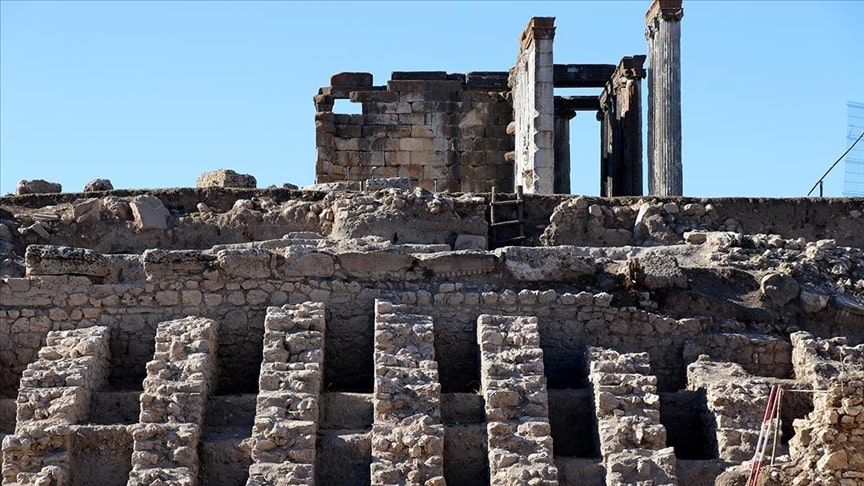
The Kütahya Museum Directorate is conducting excavations in Aizanoi, often known as the “Second Ephesus” and home to Anatolia’s best-preserved Zeus Temple.

Excavation coordinator Kütahya Dumlupınar University (DPU) Faculty of Arts and Sciences, Head of Archeology Department Prof. Dr. Gökhan Coşkun told Anadolu Agency (AA) that they are working in areas that have never been excavated before.

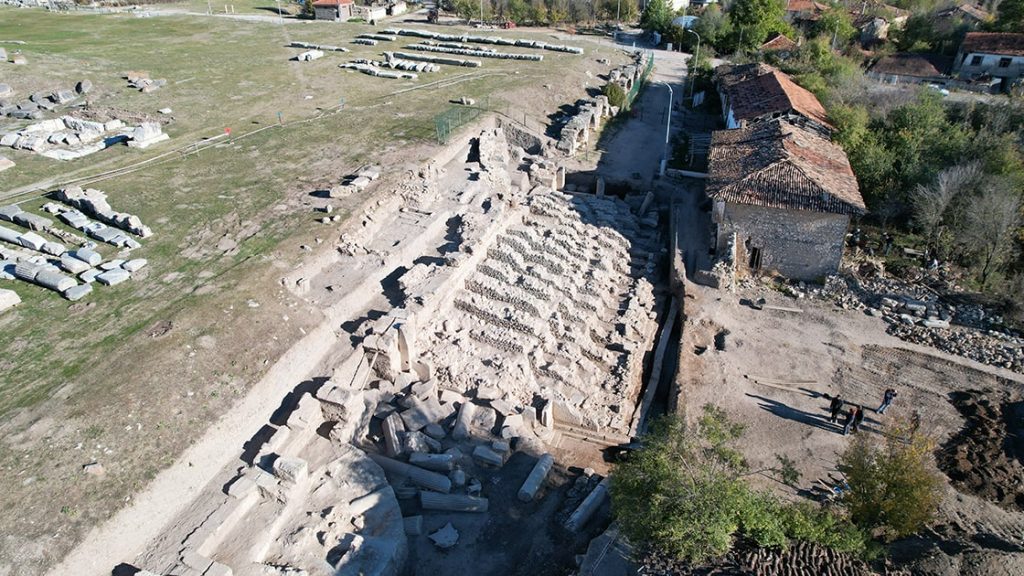
Professor Gökhan Coşkun stated that they worked in two distinct wings of the agora (a public open space used for assembly and marketplaces in ancient Greece) and uncovered significant discoveries that would shed light on the ancient city’s economic and social life.

Underlining that they were able to identify two of the uncovered shops, he said thousands of bone fragments were found inside one of the stores. Some were unprocessed and it seems they were used as raw materials, he added.


📣 Our WhatsApp channel is now LIVE! Stay up-to-date with the latest news and updates, just click here to follow us on WhatsApp and never miss a thing!!


The excavations at the Aizanoi site, known as the "Second Ephesus" and home to the best-preserved Zeus Temple in Anatolia. (AA Photo)
The excavations at the Aizanoi site, known as the “Second Ephesus” and home to the best-preserved Zeus Temple in Anatolia. (AA Photo)

“As far as we understand from this, there was a local bone workshop in Aizanoi during the Roman period and located in the agora. It served as both a workshop and a sales place. Among the processed bone artifacts were mostly women’s hairpins and spoons,” Coşkun said.

“During the excavation of the other shop, we encountered many intact and broken oil lamps, which are the lighting tools of the ancient period.  Findings from both shops show local production in Aizanoi. It is an important finding for us that we determined that important production activities were carried out in Aizanoi during the Roman period.”

Prof. Dr. Gökhan Coşkun added that they aim to bring the unearthed areas to tourism.

This city is located in the municipality of Çavdarhisar, 57 kilometers from the city center of Kütahya. The city experienced its golden age in the second and third centuries AD and became the center of episcopacy in the Byzantine era.

 The city features a temple dedicated to Zeus that is the best preserved in Anatolia. There is also a large theatre and a stadium adjacent to the theatre. There are two Turkish-style baths, one of which is mosaic-decorated, as well as a gymnasium, five bridges on Kocaçay that are being used today, an old dam, a trade house, and avenues with columns on both sides, necropolis regions, and Metre Steune sacred cave.

Related Articles

Archaeologists Discovered 8,200-year-old Eyeliner in Türkiye’s Yeşilova Höyük

16 September 2024

16 September 2024

During the archaeological excavations in Yeşilova Höyük (Yeşilova Mound) in Bornova district of Izmir, an 8,200-year-old kohl made of stone...

The oldest evidence of human cannibalism as a funerary practice in Europe

7 October 2023

7 October 2023

According to a new study, cannibalism was a common funerary practice in northern Europe around 15,000 years ago, with people...

9 Synagogues in Izmir to Reopen as Museum

26 March 2022

26 March 2022

As part of a Jewish heritage project in Izmir, Turkey, nine historic synagogues will be reopened as museums. Built by...

Medieval Rye: From Humble Weed to Powerful Staple – New Study Reveals Surprising Farming Secrets

27 May 2025

27 May 2025

Discover how medieval rye cultivation was far more advanced than previously believed. New research reveals intensive farming and fertilizing techniques...

Archaeologists may have uncovered a 13th-century castle in Shropshire

7 August 2021

7 August 2021

Archaeologists have been working on a mound of land in Wem, Shropshire, that belongs to Soulton Hall, Elizabethan mansion and...

1,400-year-old coins found in a piggy bank in ancient city of Hadrianopolis

3 January 2024

3 January 2024

Archaeologists unearthed a collection of 10 coins believed to date back nearly 1,400 years, retrieved from what appears to be...

Decapitated skeletons of Roman ‘criminals’ found on HS2 route

5 February 2022

5 February 2022

Archaeologists working with the HS2 project have discovered 425 bodies on the route of the new railway line – around...

The Ephesus Massacre: 80,000 Romans Slaughtered in a Single Night of Blood and Betrayal

29 May 2025

29 May 2025

The Ephesus Massacre saw 80,000 or more Romans killed overnight during the Asiatic Vespers — one of the deadliest uprisings...

Hidden Treasure from the Thirty Years’ War: Rare Silver Coins Found in Copper Cauldron in Brandenburg

21 July 2025

21 July 2025

A rare archaeological discovery in Germany has captivated historians: Silver coins dating back to the early 17th century have been...

Archaeologists Uncover lost Indigenous Settlement of Sarabay, Florida

9 June 2021

9 June 2021

The University of North Florida archaeological team is now quite sure that they have uncovered Sarabay, a lost Indigenous northeast...

Archaeologists unearth the long-lost homestead of King Pompey in Lynn

3 July 2024

3 July 2024

Archaeologists from the University of New Hampshire (UNH) and a historian from Northeastern University believe they might have found the...

Earliest Direct Evidence of Psychoactive Plant Use in Iron Age Arabia Identified in Tomb at Qurayyah

25 May 2025

25 May 2025

In a remarkable archaeological breakthrough, scientists have uncovered the earliest known use of the psychoactive plant Peganum harmala—commonly known as...

Archaeologists Discovered 1,500-Year-Old Maya Palace in Mexico

25 September 2023

25 September 2023

Mexican National Institute of Anthropology and History (INAH) archaeologists have discovered a palace at an ancient Maya city in southeastern...

China exhibits 2,000-year-old artifacts discovered in Guangzhou

12 August 2021

12 August 2021

On August 10, the National Museum of China launched an exhibition featuring archaeological finds from ancient China’s Qin (221–207 BC)...

Tipasa’s Underwater Secrets: Algeria’s Hunt for a Lost Ancient City

1 September 2025

1 September 2025

Algeria has launched a new underwater archaeological campaign off the coast of Tipasa, a UNESCO World Heritage Site celebrated for...