12 March 2026 The Future is the Product of the Past

A Mikveh or Jewish ritual bath discovered in basement of former strip club in Poland

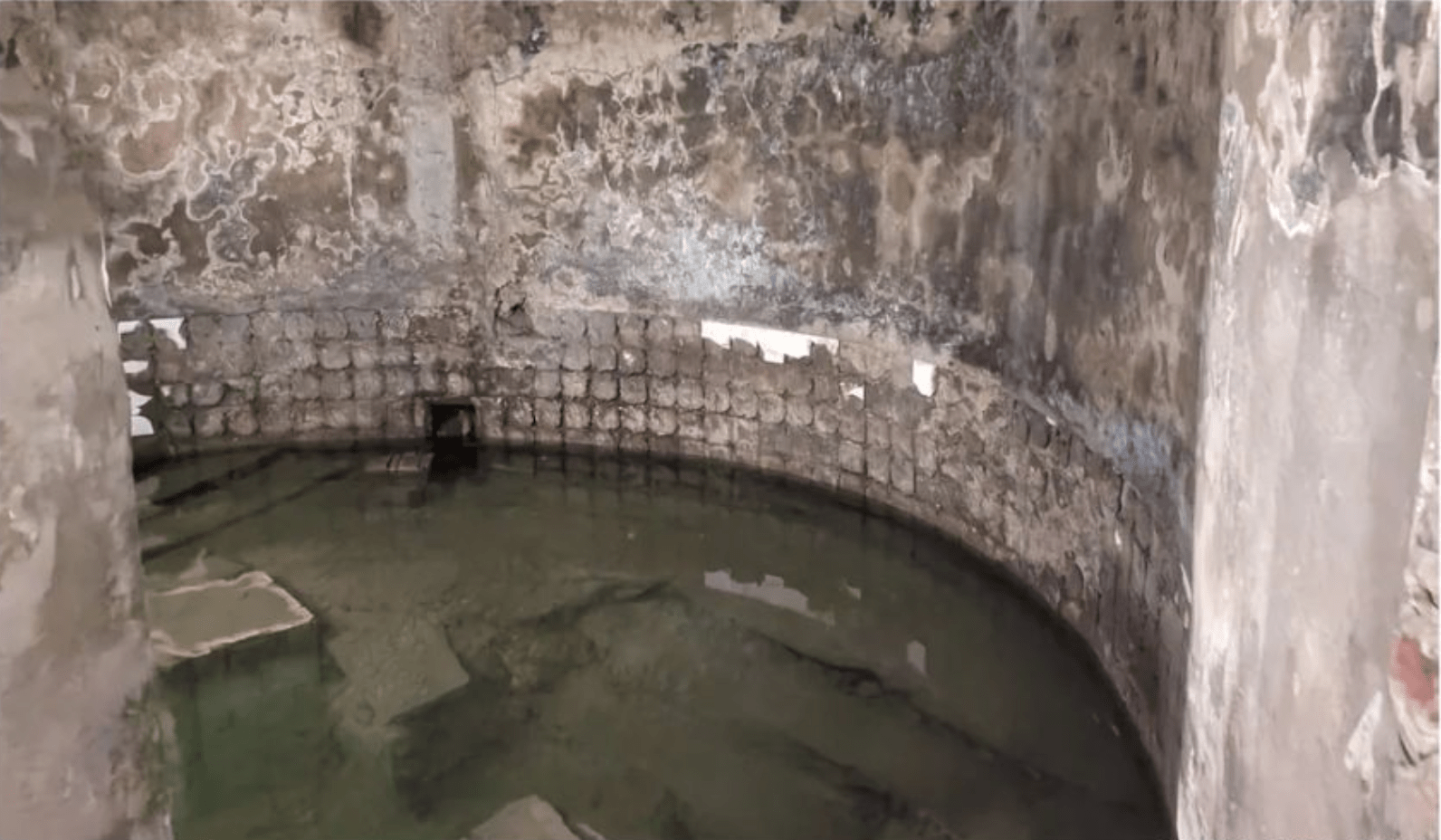
Marian Zwolski, a Chmielnik businessman, bought a former nightclub that had been closed for 15 years a few years ago. When he opened the basement door to his new home, he found something unexpected: a mikveh, or Jewish ritual bath.

Before the Holocaust, the population of the town of Chmielnik, Poland, was around 80% Jewish. Sephardic Jews, having been expelled from Spain during the Inquisition, settled in Chmielnik and eventually built a synagogue in 1638.

After the war, only four Jews remained. Today, the building houses a museum of the town’s Jewish life and history. Now another Jewish heritage site has been discovered, in an unlikely place.

The Sphinx nightclub in the town of Chmielnik, in southern Poland, closed about 15 years ago. The bar in the deserted building is still visible, complete with a Heineken sign on the wall and a sign that states that no one under the age of 18 may be served alcohol. Additionally intact is the pole upon which strippers once performed.

The building was recently purchased by Marian Zwolski, a Chmielnik-native businessman and amateur historian. He was astounded by what he saw when he opened the door to the basement, which is located beneath the dance floor. He learned that he now owned a rare and magnificent Jewish heritage site.


📣 Our WhatsApp channel is now LIVE! Stay up-to-date with the latest news and updates, just click here to follow us on WhatsApp and never miss a thing!!
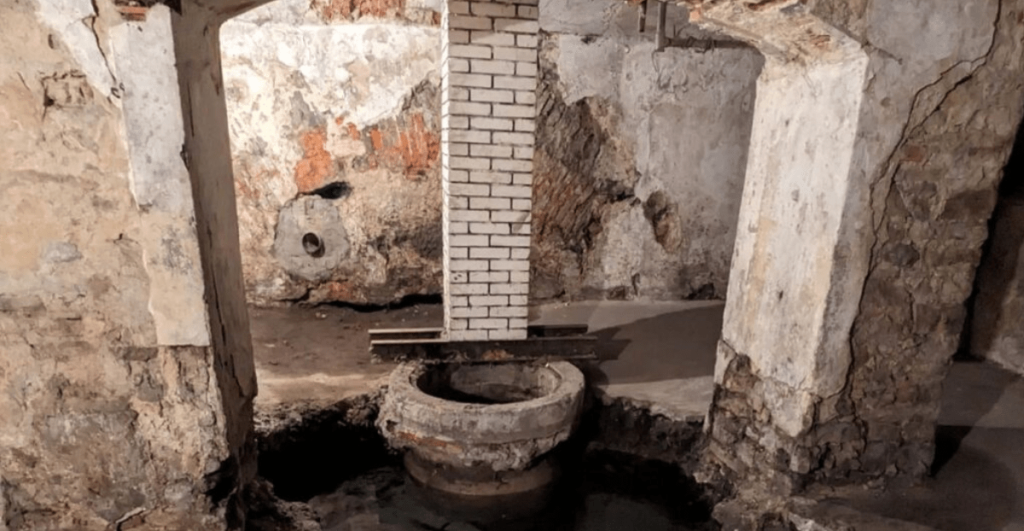


Visitors to the former nightclub are greeted by an unusual site: a large mikveh, or ritual purification bath, full of water. Its blue-and-white floor tiles have held up well. In one corner, there are stars of David on the walls. An adjacent room holds a smaller mikveh that was used by women.

The bath’s blue and white floor tiles are still there, as are Stars of David on the wall. A smaller mikveh, likely used by women, is in a neighboring room.

“It’s astonishing,” said Meir Bulka, who advocates for the preservation of Jewish heritage in Poland, in an interview with Haaretz. “You enter the basement, and you’re in another world. It’s like a time capsule.”

Zwolski, who also operates a funeral home in nearby Kielce — the site of a 1946 pogrom that killed 42 Jews — told Haaretz he is hoping to turn his new mikveh into a tourist attraction, possibly a museum.

“I was born and raised here, so I care about the history of the place. I don’t want it to disappear,” Zwolski says. “I encourage the people to remember the past and I also call on you, the Jews, to preserve it and see to it that it is memorialized.”

Cover Photo: Ofer Adaret
Related Articles

Earthquakes caused slight damage to Hatay Archeology Museum

10 February 2023

10 February 2023

The Republic of Turkey Ministry of Culture and Tourism issued a press release on the latest status of museums and...

Ancient Tamil Nadu’s Metalworking Legacy Traced Back to 3300 BCE

7 February 2025

7 February 2025

Recent archaeological research has uncovered compelling evidence that Tamil Nadu’s metalworking traditions date back to at least 3300 BCE, highlighting...

A Celtiberian city more than 2000 years old found in Spain

16 July 2023

16 July 2023

The Polytechnic University of Madrid announced the discovery of a Roman camp and the Celtiberian city of Titiakos in the...

In Peru, Archaeologists Discovered an Ancient Dance Floor that can Imitate Rumbling of Thunder

21 July 2023

21 July 2023

Archaeologists have discovered an ancient “sounding” dance floor in Peru that was designed to create a drum-like sound when stepped...

42,000-year-old Shell Jewellery Workshop Discovered – The Oldest in Western Europe

27 September 2025

27 September 2025

Archaeologists have made a groundbreaking discovery in Saint-Césaire, Charente-Maritime, uncovering what is now considered the oldest shell jewellery workshop in...

Scientists Use Artificial İntelligence to Study Ancient Australian Rock Art

1 April 2021

1 April 2021

Rock art is the oldest surviving human art form. Throughout Australia, petroglyphs are part of the life and customs of...

Divers Discover 2,500-Year-Old Shipwreck and anchors Off the Coast of Sicily

23 January 2025

23 January 2025

A shipwreck dating back to the 5th and 6th centuries BC was discovered in the waters of Santa Maria del...

4000-year-old boat salvaged near the ancient city of Uruk one of the most important cities in ancient Mesopotamia

6 April 2022

6 April 2022

A team of archaeologists from the Iraqi German Mission of the State Board of Antiquities and the Orient Department of...

Columns in Lagina Hecate Sanctuary Rise Again

19 February 2021

19 February 2021

Lagina Hecate Sanctuary is located in Yatağan district of Muğla. It is an important sacred area belonging to the Carians...

Central Turkey’s largest Byzantine mosaic structure found

28 October 2021

28 October 2021

A 300-square-meter (3,330 square feet) ​floor mosaic belonging to the Late Roman-Early Byzantine period was discovered during excavation work in...

An engraving on an almost 2,000-year-old knife believed to be the oldest runes ever found in Denmark has been discovered by archaeologists

22 January 2024

22 January 2024

Archaeologists have found a small knife with a completely unique runic inscription that can be dated almost 2000 years ago....

Mythical Viking stronghold Jomsborg could be on Hangman’s Hill near Wolin, archaeologist say

14 July 2023

14 July 2023

A new hypothesis about the location of the mythical Viking stronghold on Hangman’s Hill near Wolin (West Pomerania) has been...

Archaeological excavations unearthed the first great Iberian city in Contestania and the oldest one

11 May 2024

11 May 2024

Archaeologists from the University of Alicante and the University of Murcia “Damas y Héroes. In the project “Tras la Ilici...

Pendants and beads reveal nine European Cultures living across the continent 30,000 years ago

1 February 2024

1 February 2024

In a new study, researchers have constructed a continent-wide database of personal ornaments worn by Europeans 34,000-24,000 years ago, a...

The easternmost Roman aqueduct in Armenia was discovered

19 November 2021

19 November 2021

Archaeologists from the University of Münster and the National Academy of Sciences of the Republic of Armenia have discovered remains...