
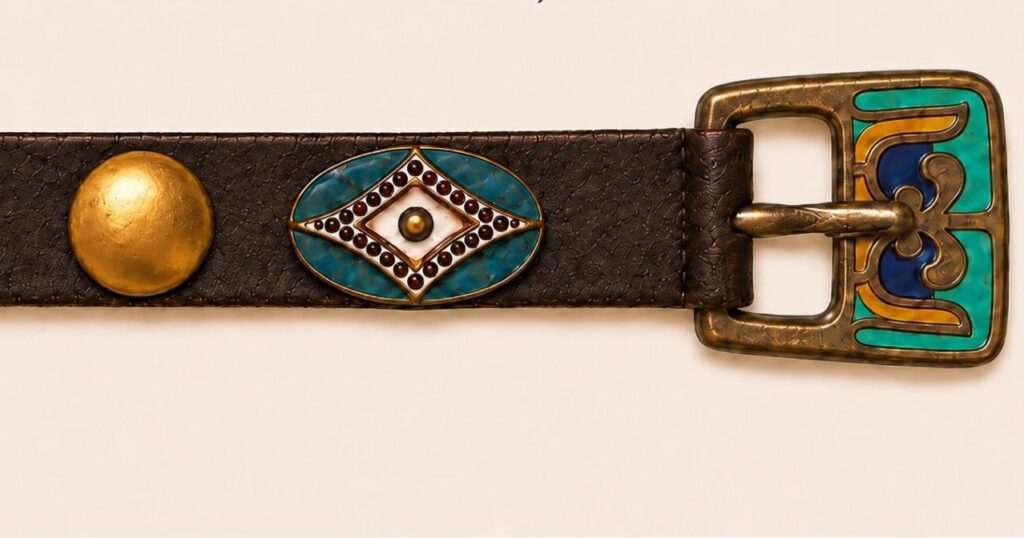
An unusual collection of enamel-decorated metal objects dating to approximately 1,800 years ago has been discovered in a forest near Chernivtsi, Ukraine. The finds include a miniature buckle and decorative belt fittings that may reveal previously undocumented connections between local communities and the Roman world.
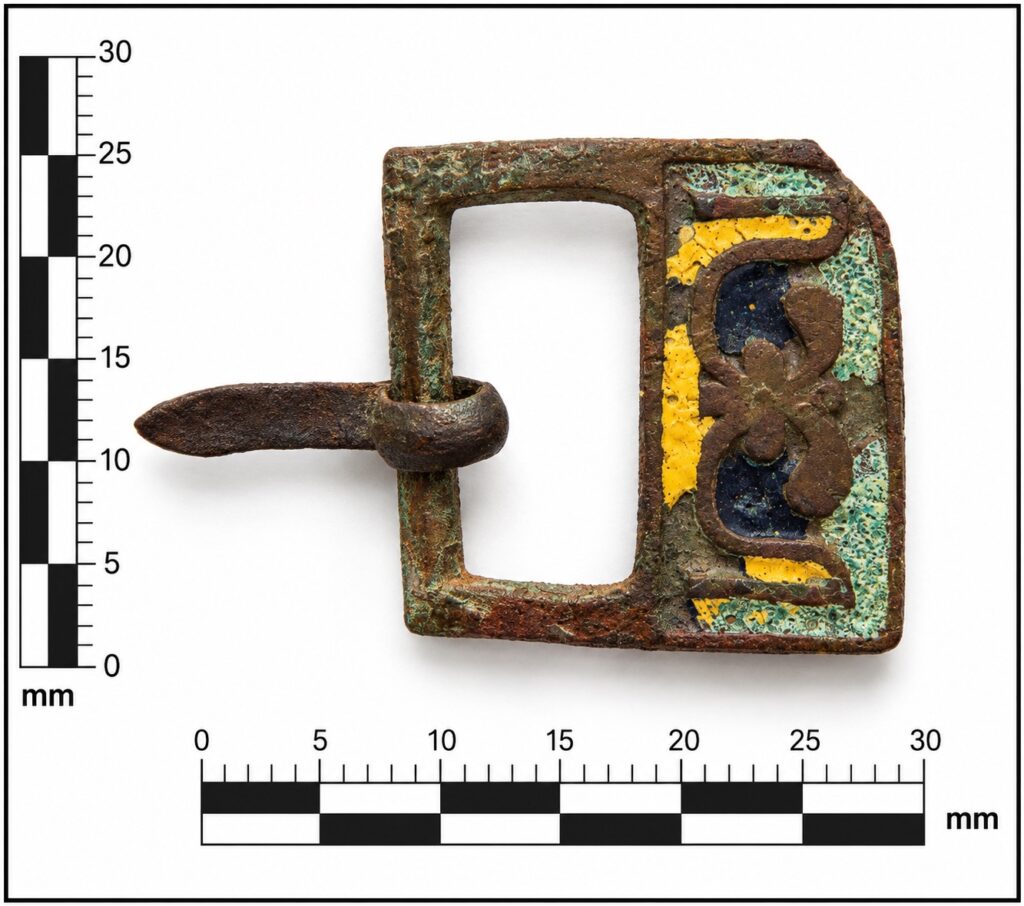
A collection of approximately 1,800-year-old metal artifacts decorated with colorful enamel has been discovered in Tsetsyno Forest near Chernivtsi in western Ukraine. The objects include a remarkably small buckle measuring just 21 by 22 millimeters, a decorative belt fitting and three circular metal mounts. Their craftsmanship points to connections with the Roman provinces, particularly Dacia, during the second and third centuries AD.
Local residents found the objects scattered across a wooded hillside and brought them to the attention of historian Antoniy Moysey of Bukovinian State Medical University. After examining the surviving enamel and comparing the fittings with Roman-period artifacts, Moysey proposed that they may once have formed part of a decorated belt ensemble. Their original owner remains unknown, although one possibility is that the accessories belonged to a Sarmatian horseman.
Small Objects with an Unexpected History
The finds came to Moysey, a professor and head of the Department of Social Sciences and Ukrainian Studies at Bukovinian State Medical University, through local residents. He had been investigating the historical and cultural heritage of Chernivtsi’s Rosha district during 2024–2026 as part of the European Union-funded RESTORY project.
The residents had found several metal objects scattered a few meters apart on a slope in Tsetsyno Forest. They did not initially consider them particularly valuable, but Moysey noticed surviving colored enamel beneath dirt and corrosion. Closer examination revealed decoration that offered important clues to the objects’ age and possible origin.
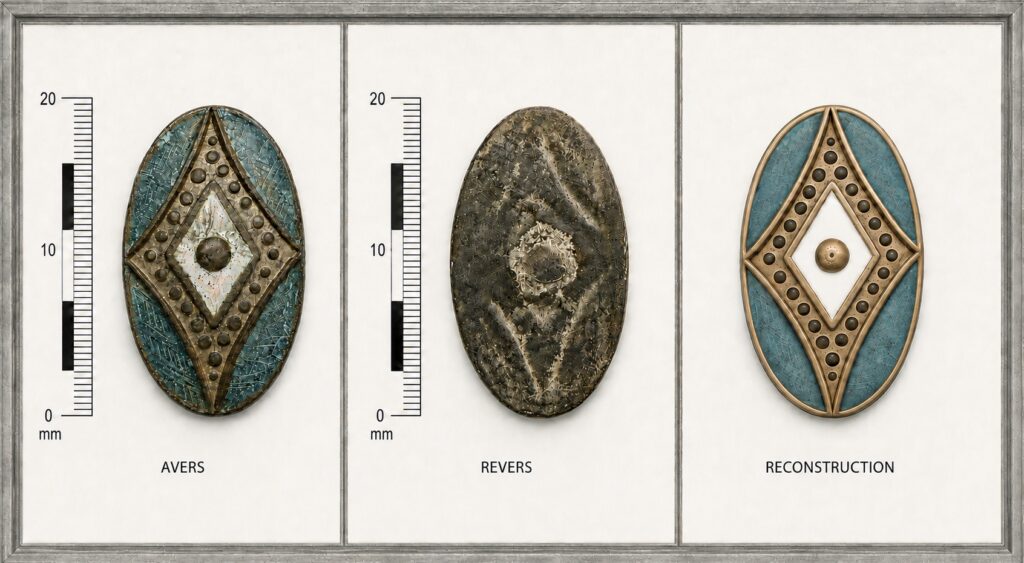
The most distinctive artifact is a small copper-alloy buckle measuring just 21 by 22 millimeters. Its surface preserves yellow, greenish-turquoise, and dark blue enamel, while an elongated decorative fitting displays lighter and blue-green elements. A projecting pin on the reverse of the fitting suggests that someone once attached it to a leather belt or similar material.
Three smaller circular metal mounts, also equipped with attachment pins, were found nearby. Moysey believes the five pieces may have formed part of a single belt ensemble, although their precise arrangement remains uncertain.
He has prepared a hypothetical reconstruction showing how the decorated fittings might originally have appeared together. The reconstruction is an interpretation based on the surviving objects rather than a complete belt recovered in its original position.
A Connection to Roman Dacia
The colored enamel is central to identifying the artifacts. Ancient craftspeople produced this type of decoration by placing colored material into recessed areas of a metal surface, creating durable ornamental patterns.
Moysey compared the objects’ construction, decorative techniques, and ornamentation with archaeological material from Roman provinces. The closest parallels date mainly to the second and third centuries AD, particularly objects associated with Roman Dacia, much of which occupied territory in present-day Romania.
The proposed date rests on these archaeological comparisons rather than radiocarbon dating or evidence from a securely dated excavation layer. Moysey also consulted archaeologist Mykola Ilkiv, affiliated with the Rescue Archaeological Service research center of Ukraine’s Institute of Archaeology, and specialists at Ștefan cel Mare University in Suceava, Romania.
Roman Dacia occupied an important position north of the lower Danube, where imperial communities interacted with populations living beyond the province’s borders. Equipment, ornaments, coins, and other manufactured goods could circulate through trade, military service, diplomatic relationships, and conflict.
Could the Belt Have Belonged to a Sarmatian Horseman?
The decorative fittings may have belonged to a Sarmatian warrior, possibly a horseman of high social standing. During the Roman period, Sarmatian communities lived across the lands north of the Black Sea, including areas around the Prut and Dniester rivers.
Their relationships with Rome were complex. Sarmatian groups sometimes fought against the empire, but individual horsemen also served in Roman military forces, while Roman-made goods circulated among communities beyond imperial control.
Moysey also examined possible parallels among artifacts associated with the Carpathian Barrow and Chernyakhiv archaeological cultures. According to the researcher’s preliminary assessment, these comparisons have not yet produced a close equivalent for the enameled buckle.
Without a documented burial, settlement context, or associated military equipment, the proposed Sarmatian connection remains a hypothesis. The artifacts could have reached the region through several kinds of cultural exchange, and their Roman-style manufacture does not establish the ethnicity of the person who used them.
Earlier Roman Finds in the Chernivtsi Region
The enameled fittings are not the first Roman-period objects reported from the Rosha district of Chernivtsi. Earlier discoveries include a silver coin bearing the image of Emperor Trajan, who ruled from AD 98 to 117, and fragments of ancient amphorae recovered from a local settlement. Unlike the newly discovered belt accessories, these finds represent different types of material evidence, ranging from coinage to containers associated with the movement and storage of goods.
The latest artifacts also raise questions that researchers cannot yet answer. Their discovery on a wooded slope, several meters apart, provides no secure evidence of whether they were lost together or belonged to a larger deposit. Further examination of their construction and enamel decoration may help establish closer parallels with Roman provincial metalwork.
Moysey plans to complete the scientific study before transferring the objects to the Chernivtsi Regional Museum of Local History. There, the tiny buckle and its accompanying fittings could join the archaeological record of a region whose Roman-period history remains only partly understood.
