
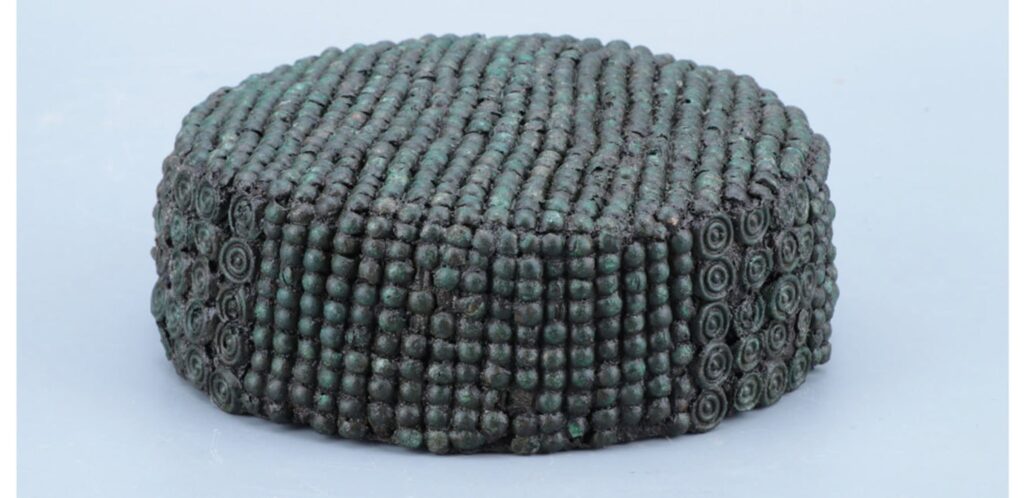
Archaeologists in Ukraine have uncovered a rare leather cap and belt in a woman’s burial at the Skorobir necropolis near Bilsk Hillfort, offering one of the clearest glimpses yet into elite female dress in the Scythian-era forest-steppe. The cap’s low, flat-topped form has also drawn attention for its resemblance to the traditional Lika hat known from Croatia.
The more than 2,500-year-old objects, decorated with bronze plaques, were first found in 2017 but only recently entered wider scientific discussion after years of conservation and study. Researchers say the finds are exceptional because no direct parallels are known from Scythia, while their technique points instead toward Central European Iron Age traditions.
A rare survival from the Skorobir necropolis
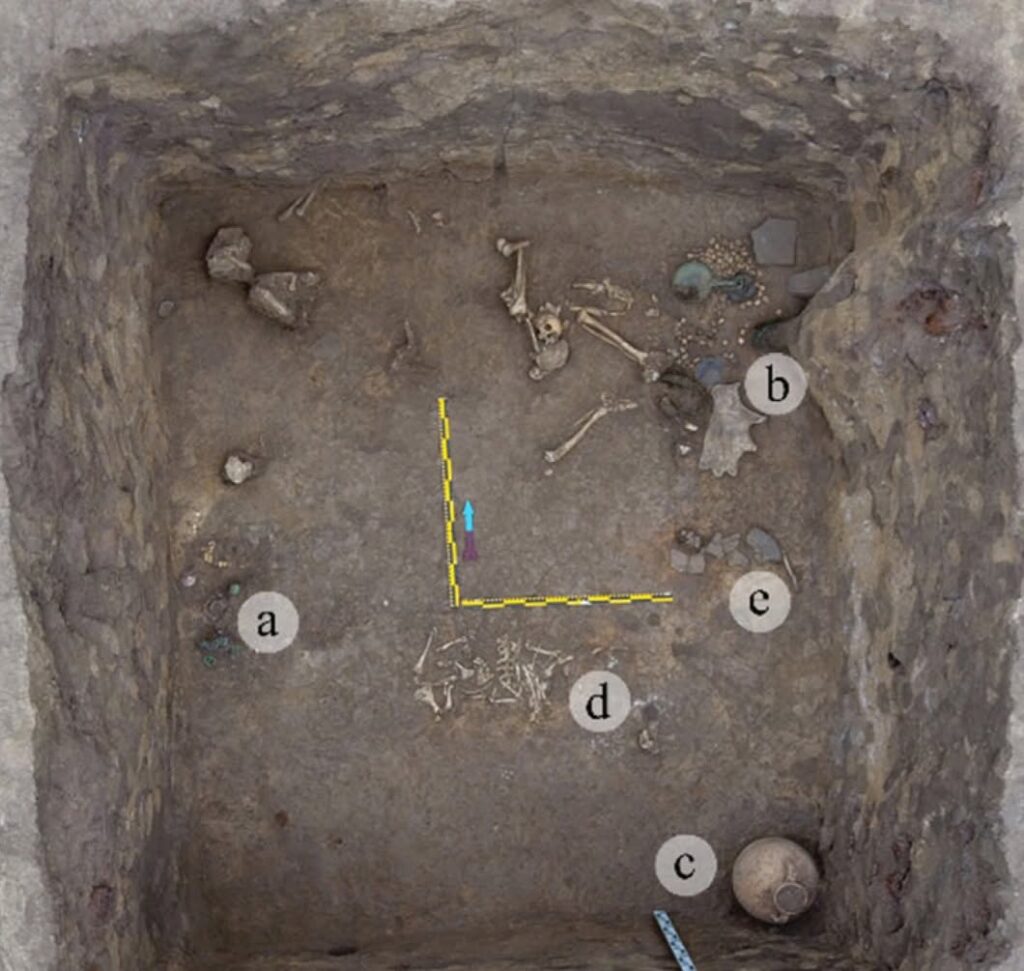
The finds came from a burial mound dated to the last quarter of the 6th century BC. Archaeologists uncovered a paired burial: a man aged roughly 30 to 40 and a young woman, probably between 18 and 22.
The grave had been disturbed by robbers, who likely removed many of the most valuable objects. Yet beside the woman, archaeologists recorded items that were far less obvious but scientifically exceptional. Near her head and feet lay the remains of a leather cap and belt decorated with bronze plaques.
Other objects found in the burial included a bronze mirror, gaming bones, a black-polished bowl, a horn dish, and fittings from a wooden vessel. Taken together, the assemblage suggests that the woman held an elevated position in society. The objects also point toward a possible connection with ritual or sacred practices, rather than ordinary domestic life.
The man in the same burial was interred with weapons and metal elements of horse gear, fitting the image of a warrior within the social world of the Early Iron Age forest-steppe.
Leather that almost disappeared after excavation
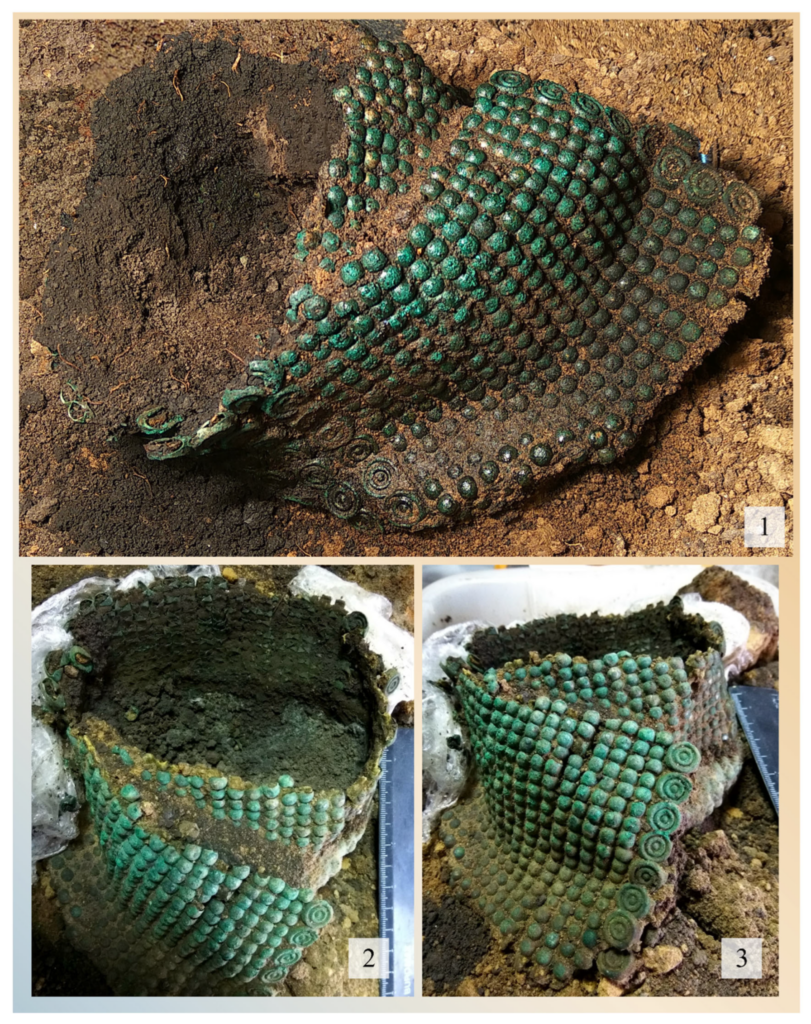
Organic material rarely survives well in burial conditions, which makes the Bilsk discovery unusually valuable. According to accounts from the Historical and Cultural Reserve “Bilsk,” the leather objects were lifted from the ground inside an earth block. Once exposed to changing conditions, the leather began to deteriorate rapidly.
Restorers from the Kharkiv branch of Ukraine’s National Research Restoration Center, Serhii Omelnyk and Volodymyr Bolotin, had to stabilize the material in field conditions before longer conservation work could begin.
The process was technically difficult. The leather continued to shrink and could not be fully softened without risk. In the end, conservators fixed the objects in a stable form, preserving as much of the original structure as possible.
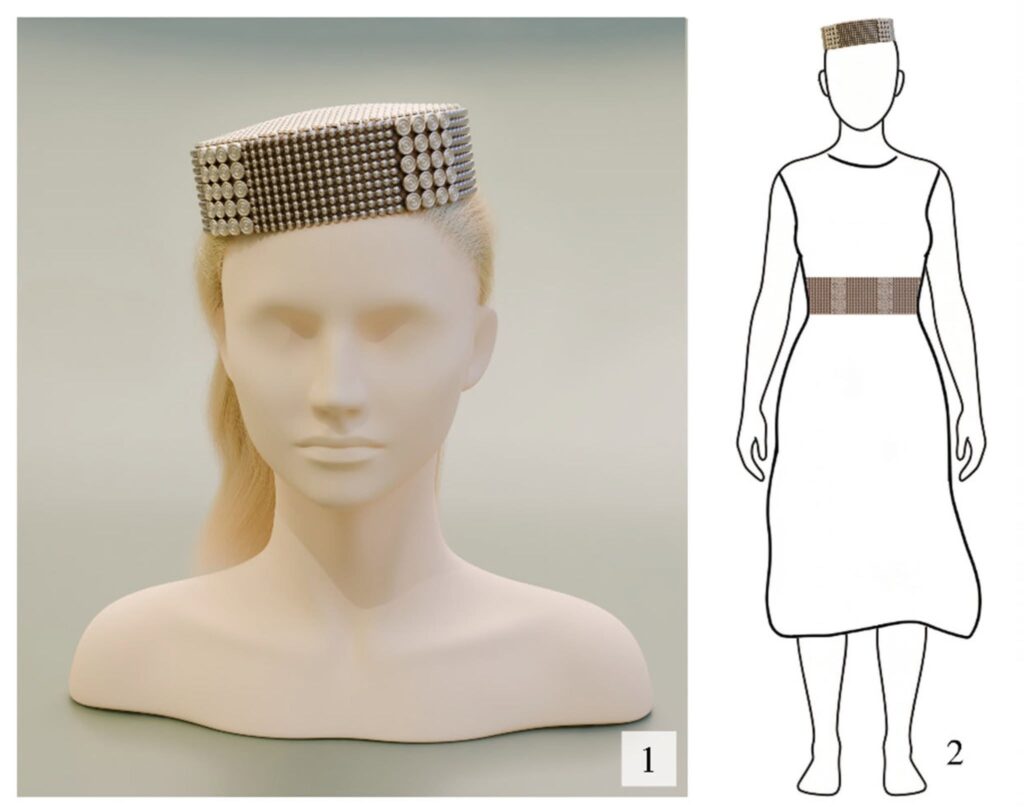
The cap is especially striking. It had the form of a low cylinder with a flat top and was covered with small bronze decorative plaques. Inside, conservators identified fragments of a thin leather lining. That lining would have made the object more comfortable to wear and protected the head from the sharp ends of metal fasteners.
The belt survived only in fragments, making a full reconstruction impossible. Even so, its preserved parts show that it was made in the same technical tradition as the cap.
Not a typical Scythian female headdress
Elite women’s burials in forest-steppe Scythia are often associated with elaborate headgear, sometimes decorated with gold plaques. The Skorobir cap is different.
Instead of gold, it used bronze. Instead of a familiar Scythian decorative system, it was made with many small staple-shaped bronze plates attached to a leather base. Iryna Shramko, the archaeologist who published the study in Arts, argues that this technique is unknown in the Scythian world but has strong parallels in the Hallstatt cultural sphere of Central Europe.
The closest comparisons appear to come from the southeastern Alpine zone and related Central European traditions, where small bronze plaques were used to decorate leather belts and headgear. Similar leather belts with bronze fittings were also known in areas such as southern Germany during the Early Iron Age.
This does not mean the woman can be reduced to a single ethnic label. The burial is more interesting than that. It suggests movement, contact, marriage ties, inherited costume traditions, or the presence of people with Central European backgrounds within the social environment of Bilsk Hillfort.
A woman from the local elite, but not an ordinary burial
DNA analysis of teeth and bone remains, reportedly carried out at the University of Tartu in Estonia, indicated a genetic affinity with a Central European region associated with the Iapodes, a people linked to the area of present-day Croatia.
Researchers have also noted that the cap’s shape recalls the Lika cap, a traditional element of Croatian dress. That comparison should be treated carefully, since more than two millennia separate the ancient object from modern costume. Still, it adds a notable cultural echo to the archaeological evidence.
The working interpretation is that the young woman was not simply buried with foreign-looking objects as trophies. The cap and belt were parts of a meaningful costume tradition. They may have belonged to her, to her family, or to a group that had moved into the region and maintained older forms of dress in ritual contexts.
The use of bronze rather than gold is important. These items were not necessarily meant to advertise wealth in the most obvious way. Their value may have rested in identity, status, ancestry, and ceremonial meaning.
Bilsk Hillfort and the question of ancient Gelonus
Bilsk Hillfort, near Kotelva in Ukraine’s Poltava region, is one of the most important Early Iron Age sites in Eastern Europe. The vast fortified settlement is often identified with Gelonus, the city described by Herodotus in his account of Scythia.
The site occupied a strategic position in the Ukrainian forest-steppe, between the world of mobile Scythian groups, settled local communities, Greek trade routes, and Central European cultural networks. Its size, ramparts, settlement layers, and surrounding cemeteries show that it was not a marginal outpost. It was a major political and cultural center.
The Skorobir necropolis is one of the largest burial grounds linked to Bilsk Hillfort. Archaeologists believe it may once have contained more than a thousand burial mounds, though fewer than a hundred have been scientifically investigated. In recent years, the necropolis has yielded several elite female burials and rare artifacts from the archaic Scythian period.
That makes the leather cap and belt part of a wider picture. They show that Bilsk was not culturally uniform. Its population included different groups, traditions, and social identities. Nomadic Scythians, settled forest-steppe elites, Greek contacts, and Central European influences all appear to have shaped life around the hillfort.
From conservation to scientific publication
The restored cap and belt have now been introduced into international scholarship through Irina Shramko’s study, “Central European Female Clothing Ensemble from the Burial Mound of the Skorobir Necropolis,” published in the journal Arts.
According to Ukrainian reports, the objects have been submitted for inclusion in Ukraine’s State Register of National Heritage. They are also expected to be shown in a special exhibition in Poltava once suitable security and conservation conditions are in place.
For archaeologists, the discovery is valuable because it preserves something rarely available from the Early Iron Age: an organic costume element with clear social and cultural meaning. For Bilsk Hillfort, it adds another piece to the long-debated puzzle of Gelonus and the people who lived at the edge of the Scythian world.
The find does not simply add another artifact to the record. It gives shape to a young woman whose burial carried traces of status, ritual authority, and distant cultural connections across ancient Europe.
Shramko, I. (2026). Central European Female Clothing Ensemble from the Burial Mound of the Skorobir Necropolis. Arts, 15(6), 122. https://doi.org/10.3390/arts15060122
Cover Image Credit: Historical and Cultural Reserve “Bilsk” via Facebook
