
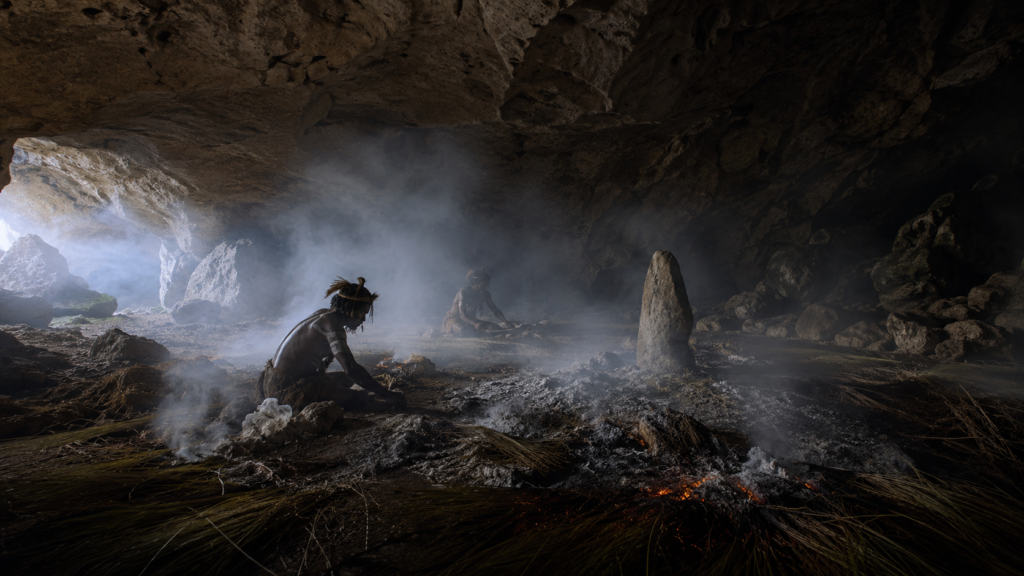
For at least 25,000 years, people entered Cloggs Cave carrying plants.
They did not appear to bring the grasses solely for food, warmth or ordinary domestic work. Instead, new microscopic evidence suggests that whole plants were deliberately gathered, transported into the secluded cave and burned in repeated, low-temperature fires—activities that strengthen the interpretation of Cloggs Cave as a place reserved for ritual specialists, healing practices and spiritual power.
Located in GunaiKurnai Country in southeastern Australia, Cloggs Cave preserves one of the continent’s longest archaeological records of relationships between people and plants. A new study published in Frontiers in Environmental Archaeology examined phytoliths—microscopic silica structures formed inside plants—preserved in deposits spanning approximately 25,000 years.
The results point toward something far more complex than a shelter where people simply cooked, slept or sought protection from the weather.
Whole grasses carried into the cave
Researchers identified phytoliths from multiple parts of grass plants, including leaves, stems and flowering structures. Their presence indicates that people collected and transported entire plants into the cave, including portions that would not normally have been needed if the goal had been only to obtain edible seeds.
That distinction matters. Bringing whole grasses into a confined and secluded underground space required deliberate selection and effort. According to the study, the pattern supports earlier evidence that Cloggs Cave was visited for specialised practices rather than routine food preparation or everyday occupation.
The clearest evidence of human involvement comes from blackened phytoliths. These heat-altered plant remains were found throughout the cave’s stratigraphy but were entirely absent from the preserved possum droppings analysed by the researchers. This allowed the team to separate at least some human activity from the natural accumulation of plant material introduced by animals.
Burned phytoliths appear across much of the 25,000-year sequence, showing that people repeatedly brought plants into the cave and used fire over an extraordinarily long period. The evidence does not establish one continuous, unchanged ceremony. It does, however, reveal a persistent association between the cave, selected vegetation and controlled burning.
Fires designed to create ash and smoke
Dozens of thin ash layers have been documented inside Cloggs Cave. Many contain little charcoal, suggesting that the fires were produced mainly from soft vegetation rather than substantial quantities of wood.
The new phytolith analysis supports that interpretation. Grass remains dominate the assemblage, while evidence associated with woody plants is scarce. Researchers concluded that grasses were probably selected over wood for cultural burning activities that left shallow sheets and lenses of ash across the cave floor.
Only a limited proportion of the phytoliths showed signs of blackening or melting. The researchers therefore argue that many of the fires burned at relatively low temperatures. Rather than serving as conventional cooking fires, these controlled surface burns may have been intended to generate ash or smoke.
That interpretation fits documented GunaiKurnai traditions in which grass, ash and charcoal held ceremonial significance. Historical accounts describe their use in initiation, healing, magic and other specialised performances. The study does not identify the precise purpose of each ancient fire, but the archaeological pattern closely aligns with a cultural framework in which plants and combustion carried meanings beyond subsistence.
A secluded place for mulla-mullung
Cloggs Cave has increasingly been understood not as an ordinary habitation site but as a restricted place associated with mulla-mullung—powerful GunaiKurnai men and women who possessed specialised knowledge connected with healing, magic, cursing and the spiritual world.
The new findings strengthen that interpretation by showing how consistently plants and fire shaped activity inside the cave. The grasses were gathered outside, carried into darkness and burned in ways that produced repeated layers of ash. Such behaviour differs from the scattered debris usually expected from everyday camp life.
Previous discoveries provide further context. Archaeologists have identified two miniature fireplaces dating to approximately 11,000 and 12,000 years ago, each containing a carefully prepared Casuarina stick coated with animal or human fat. Around 2,000 years ago, vegetation was repeatedly burned near a small standing stone for roughly four centuries. These finds were reported in earlier studies, but the new phytolith evidence reveals that the broader practice of bringing and burning plants extended through much of the cave’s archaeological history.
The cave’s isolation also matters. Its narrow passage and enclosed chamber would have separated activities inside from the surrounding landscape. In this setting, smoke, ash, darkness and selected plants may have created a carefully controlled sensory environment suitable for practices carried out by individuals with specialised cultural authority.
Researchers remain cautious about assigning a specific ritual to every ash layer. Unburned phytoliths could have entered the cave through both people and animals, and the microscopic remains cannot always identify individual grass species. Yet the burned material is unmistakably connected with human activity.
Taken together with traditional knowledge, historical ethnography and previous archaeological discoveries, the new evidence presents Cloggs Cave as a place where plants were not merely consumed. They were chosen, transported and transformed by fire within a landscape of secrecy, healing and spiritual power—a tradition whose material traces reach back tens of thousands of years.
Grono E, David B, Mullett R, Stevenson J, Petchey F, Delannoy J-J, McDowell MC, Miller DJ, Morley MW, Fresløv J, Jenkin D and GunaiKurnai Land and Waters Aboriginal Corporation (2026) Phytoliths from Cloggs Cave, GunaiKurnai country (southeastern Australia) reveal the gathering of whole grasses for burning practices inside the cave. Front. Environ. Archaeol. 5:1871928. doi: 10.3389/fearc.2026.1871928
