
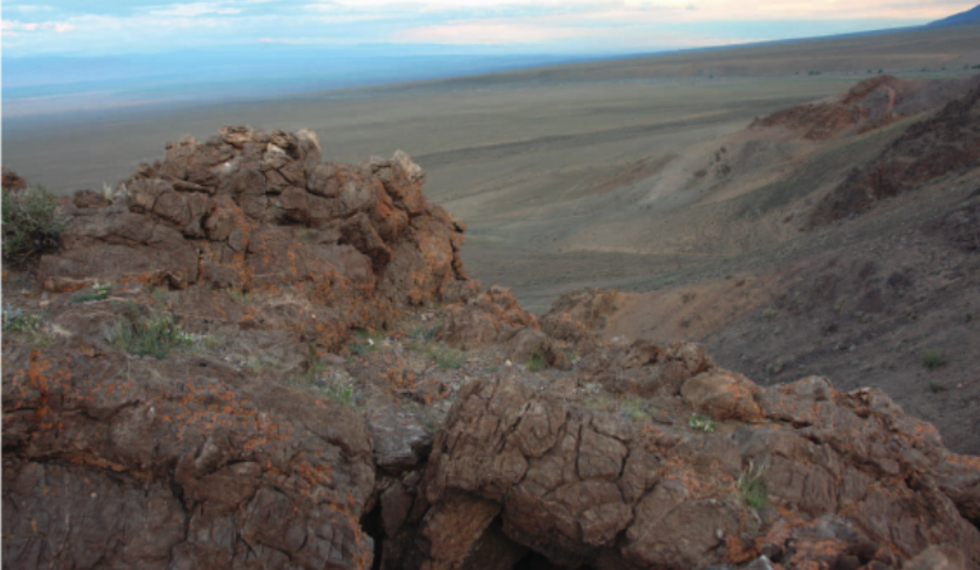
A remote rock tomb in western Mongolia has preserved two exceptional objects from the early medieval steppe: a composite bow made with a peach wood core and a horse-head stringed instrument bearing ancient Turkic runic inscriptions.
The burial was discovered in 2008 in the Jargalant Khairkhan Mountains of Khovd Province. Local herder Namsrai Dandar noticed the nearly hidden cave while retrieving sheep that had climbed toward the rocky summit. After pulling out a wooden saddle, a yellow bow and a quiver, he encountered human bones and stopped digging. Archaeologists excavated the site on June 26 that year.
Inside was the skeleton of a man aged approximately 20 to 25, accompanied by riding equipment, armor plates, silk fragments, belt fittings, a knife, arrows and a musical instrument. The bow, quiver and saddle had originally been placed beside the body, while the instrument lay behind the man’s head.
A sophisticated composite bow
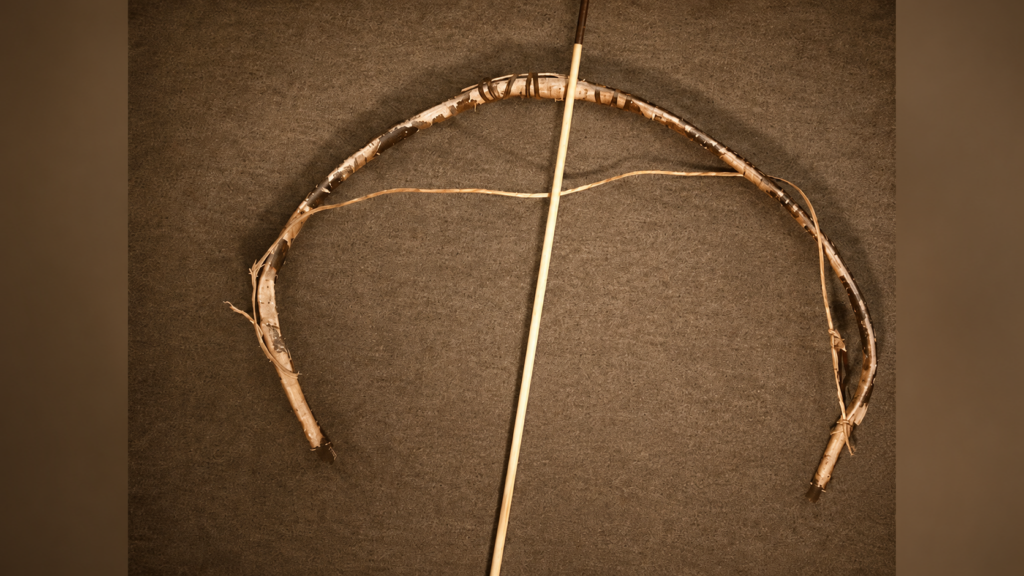
The bow is regarded as one of the oldest substantially preserved examples recovered in Mongolia. Studies reported after its conservation identified the wooden core as peach wood.
Its construction combined several materials selected for different mechanical properties. Horn from mountain goats and wild cattle reportedly reinforced the bow, while animal sinew and fish-based adhesive helped bind its layered structure. Birch bark and leather protected it from moisture and wear.
The quiver contained 23 wooden arrow shafts and 20 iron arrowheads of different forms. The shafts were reportedly made from rosehip shoots and stabilized with golden eagle feathers. Researchers also documented painted markings close to the nocks, possibly allowing the archer to identify arrows fitted with different types of points. The scientific report notes that the preserved bow, quiver and arrows provide unusually detailed evidence for early medieval manufacturing techniques.
A horse-head instrument with hidden runic writing
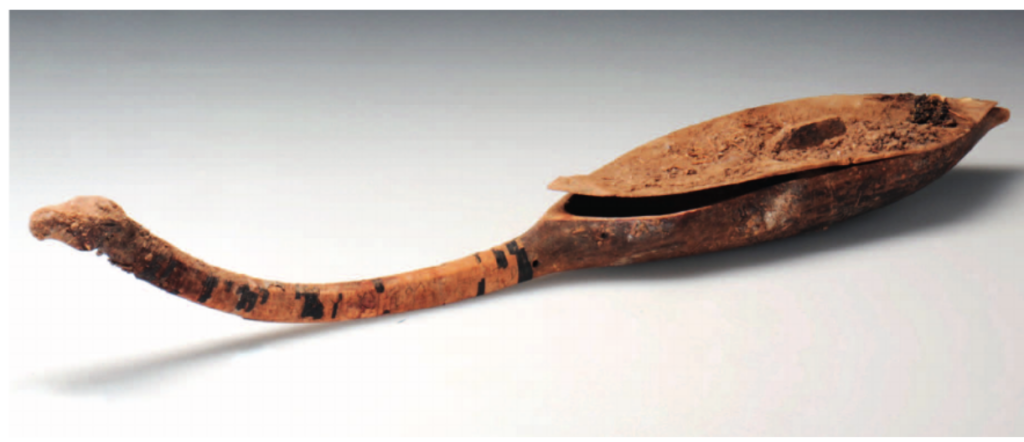
The musical instrument is equally significant. Its neck ends in a carved horse’s head, leading researchers to describe it as a horse-head fiddle. However, its form differs markedly from the modern Mongolian morin khuur.
Rather than being assembled from a separate neck and trapezoidal sound box, the ancient instrument was made in a spoon-like form, with its elongated body and neck forming a continuous structure. The body was identified as birch, while the soundboard and bridge were carved from willow. Its construction more closely resembles the šanagan chuur, or ladle-fiddle, considered a predecessor of the modern horse-head fiddle.
A sequence of 12 ancient Turkic runic characters was carved into the neck and later concealed beneath dark bands. Researchers proposed that the inscription may have recorded the maker’s name or another personal message, although its meaning remains uncertain. A second possible inscription on the sound body has not been deciphered.
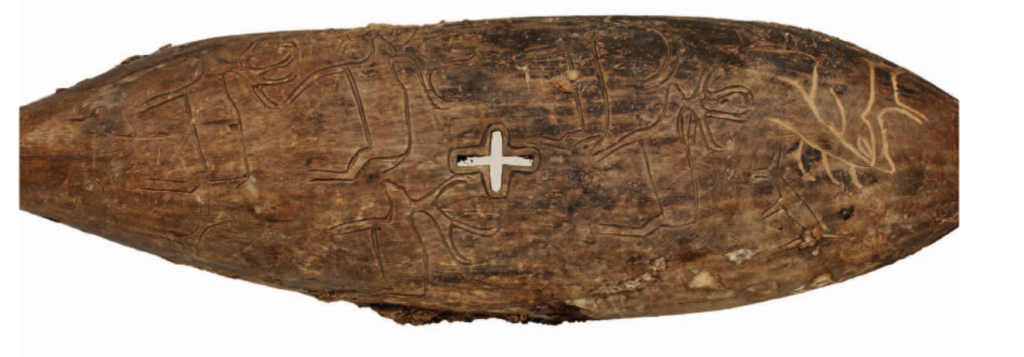
The underside of the instrument carries a petroglyph-like hunting scene showing an archer with a drawn reflex bow, together with stags, ibexes and dogs. The combination of runic writing, carved imagery and unusual construction makes it one of the most important surviving musical instruments associated with Mongolia’s Turkic period.
The grave inventory dates broadly to the sixth–eighth centuries AD. Together, the bow and inscribed instrument preserve two distinct sides of early steppe life: the highly developed technology of mounted archery and a musical tradition closely connected with horses, hunting and personal identity.
More Than a Warrior’s Grave
Taken together, the peach wood bow and the inscribed horse-head instrument turn the Jargalant Khairkhan burial into far more than a well-preserved warrior’s grave.
The bow and arrows document the technical sophistication of Turkic-period composite weapon production, while the instrument preserves an exceptionally rare combination of music, runic writing and carved hunting imagery. Because wood, bark, leather, textiles and other organic materials survived in unusual condition, the tomb offers a remarkably complete view of craftsmanship, mounted warfare and cultural expression on the eastern Eurasian steppe between the sixth and eighth centuries AD.
Rather than being isolated curiosities, the two objects reveal how military technology and musical tradition existed side by side within the same early medieval society.
Törbat, T., Batsükh, D., Bemmann, J., Höllmann, T. O., & Zieme, P. (2009). A rock tomb of the ancient Turkic period in the Zhargalant Khairkhan Mountains, Khovd aimag, with the oldest preserved horse-head fiddle in Mongolia: A preliminary report. In J. Bemmann, H. Parzinger, E. Pohl, & D. Tseveendorzh (Eds.), Current archaeological research in Mongolia: Papers from the First International Conference on “Archaeological Research in Mongolia” held in Ulaanbaatar, August 19–23, 2007 (Bonn Contributions to Asian Archaeology, Vol. 4, pp. 365–383). Vor- und Frühgeschichtliche Archäologie, Rheinische Friedrich-Wilhelms-Universität Bonn.
Cover Image Credit: Törbat et al., 2009
