

Archaeologists excavating the ancient thermal complex of Aquae Calidae near Burgas, Bulgaria, have discovered a Roman inscription dating to the early years of Emperor Trajan’s reign, adding a new piece of evidence to the history of one of the most important ancient spa centers in the western Black Sea region.
The inscription dates to the late 1st or early 2nd century AD, during the reign of Trajan, who ruled the Roman Empire from AD 98 to 117. Its discovery is particularly significant because it joins a growing collection of inscriptions from Aquae Calidae that are gradually revealing how the settlement, its famous mineral springs, and its monumental baths developed during the first centuries of Roman rule.
The archaeological investigations are being led by Assoc. Prof. Dr. Dimcho Momchilov and carried out by the Burgas Regional Historical Museum with financial support from Burgas Municipality. Bulgarian epigrapher Dr. Nikolay Sharankov of Sofia University “St. Kliment Ohridski” is currently working on the reading and scholarly interpretation of the newly discovered inscription.
For now, researchers have not announced the complete text or a detailed interpretation. That makes the epigraphic study especially important: inscriptions can preserve names, official titles, dedications, construction records, or other information that rarely survives in the archaeological record.
A New Piece of Aquae Calidae’s Roman History
Aquae Calidae developed around thermal springs that had attracted people long before the Roman period. During Roman rule, the springs became the center of an important bathing complex, while the site also occupied a strategic position in the road network of the province of Thrace.
The Roman phase of Aquae Calidae appears to have expanded considerably during the first two centuries AD. The site’s baths, religious traditions and connections to the surrounding administrative and transport network made it much more than a place for bathing: it was also a point of movement, worship and social activity.
Trajan’s reign provides an especially important historical setting for the new inscription. The Burgas Regional Historical Museum notes that the construction of public baths and roads formed part of Roman state policy during this period, as the empire consolidated urban and administrative centers in Thrace. Aquae Calidae stood within this changing landscape, close to important routes linking settlements along the western Black Sea and the interior.
The new inscription therefore comes from a period when Roman infrastructure and political organization were reshaping the region. What remains to be determined is whether its text can connect the monument directly with construction, administration, religious activity or an individual associated with the site.
Earlier Inscriptions Are Building a Larger Picture
The Trajanic inscription is not an isolated discovery. Several important Latin inscriptions dating to the 1st and 2nd centuries AD have been found at Aquae Calidae during excavations over the past decade.
One of the most significant was discovered in 2015 and dates to the reign of Emperor Nero. That inscription provided evidence for bath construction at the site during the 1st century AD and helped push the securely documented Roman development of Aquae Calidae back into the Nero period.
Further evidence emerged in later seasons. In 2022, archaeologists discovered a well-preserved Latin inscription on a votive altar dedicated to the nymphs by a Roman officer. That inscription was also studied by Nikolay Sharankov and reinforced the connection between the thermal springs, Roman religious practice and the long-standing cult of the local nymphs.
Taken together, these discoveries are creating an unusually rich epigraphic record. Instead of relying only on architecture, coins and other artifacts, researchers can increasingly use written evidence to reconstruct the people and institutions connected with Aquae Calidae.
A Roman Spa with a Much Longer Life
Aquae Calidae’s importance did not end with Rome. The hot springs continued to attract visitors through Late Antiquity and the Middle Ages, while the settlement underwent repeated episodes of destruction, rebuilding and fortification.
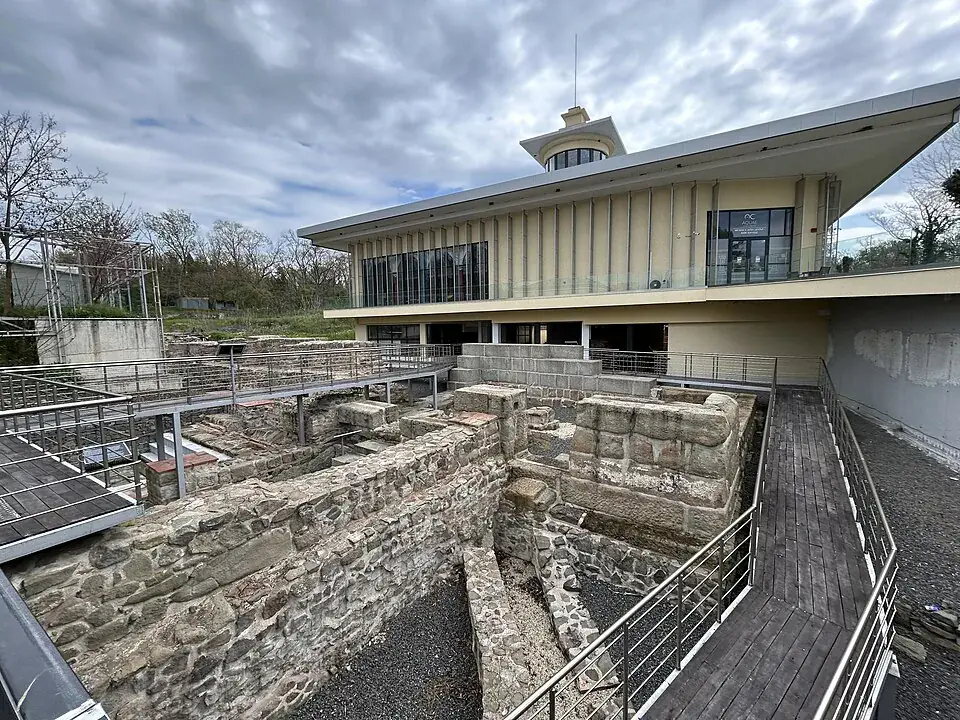
Archaeological research has revealed substantial remains of the ancient bathing complex as well as later Byzantine and medieval structures. Excavations at the site have continued for years, gradually exposing a deep archaeological sequence that reflects centuries of activity around the mineral springs.
The newly discovered inscription now adds Trajan’s reign to this expanding documentary record. Once its text has been fully read and interpreted, it may offer more precise evidence about Aquae Calidae at a formative moment in its Roman history — and potentially identify the people, institutions or building activity behind one of the Black Sea region’s most enduring thermal centers.
